Le clustering des galaxies: observation 1/4
Ecole Rodolphe Cledassou 2024

Corentin Ravoux
LPCA, CNRS/IN2P3, Clermont-Ferrand

ACCEL² simulation
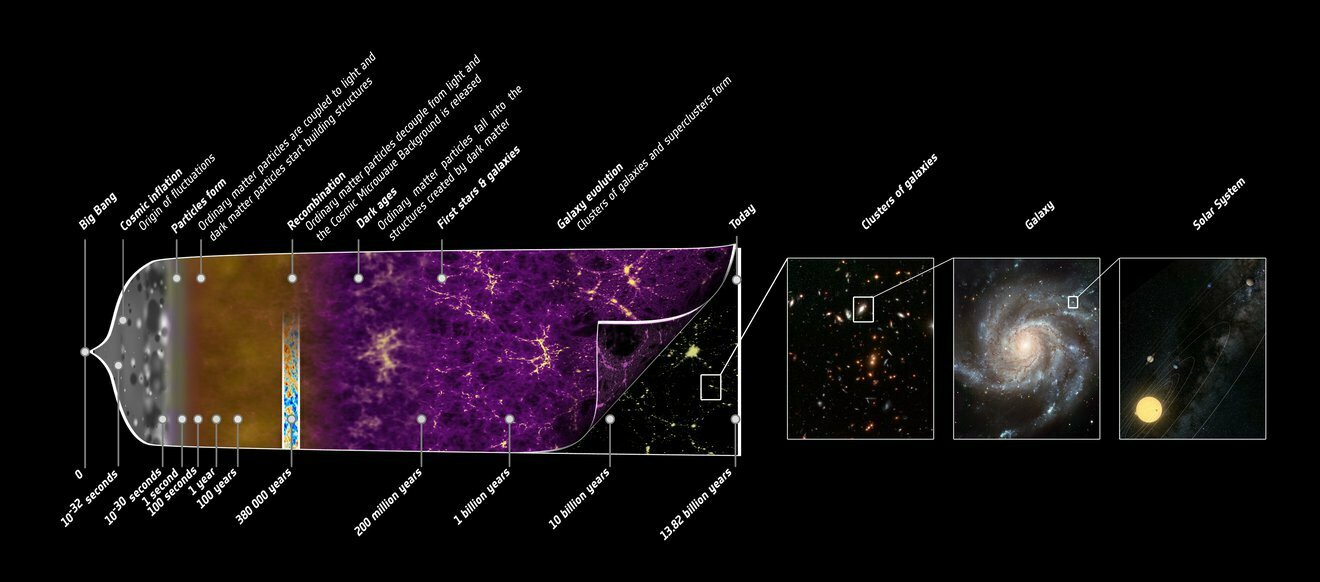
Cosmological context
How did the Universe evolve to its current state?
What are the fundamental constituents of our Universe?
How is matter distributed in the Universe?
The Story of Our Universe - NASA
You are here
Ecole Rodolphe Cledassou 2024 - galaxy clustering: observation
Ecole Rodolphe Cledassou 2024 - galaxy clustering: observation
Global content of our Universe
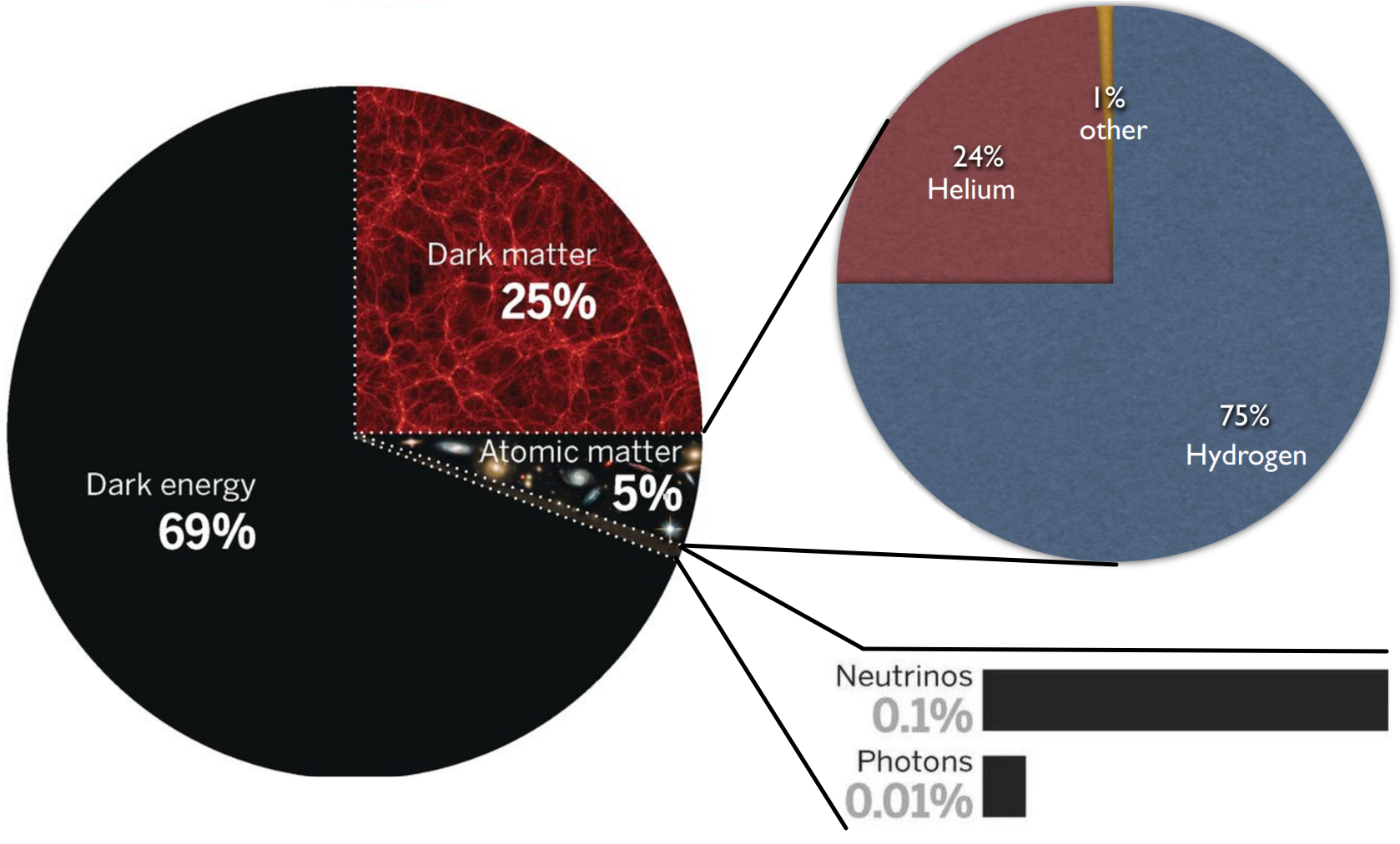
- Evolution of the Universe described by the ΛCDM model
-
Composition today:
- Only 5 % of its content is known
- Properties of components constrained by observations
What is the nature of dark energy
and dark matter?
Large scale structures
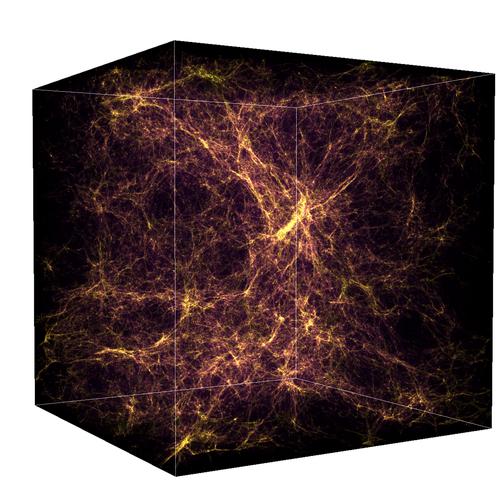
- Initial density perturbations in the primordial Universe.
- Perturbations grows to form the cosmic web: Nodes, filaments, walls and voids
- Large-scale distribution of matter characterized by the linear power spectrum
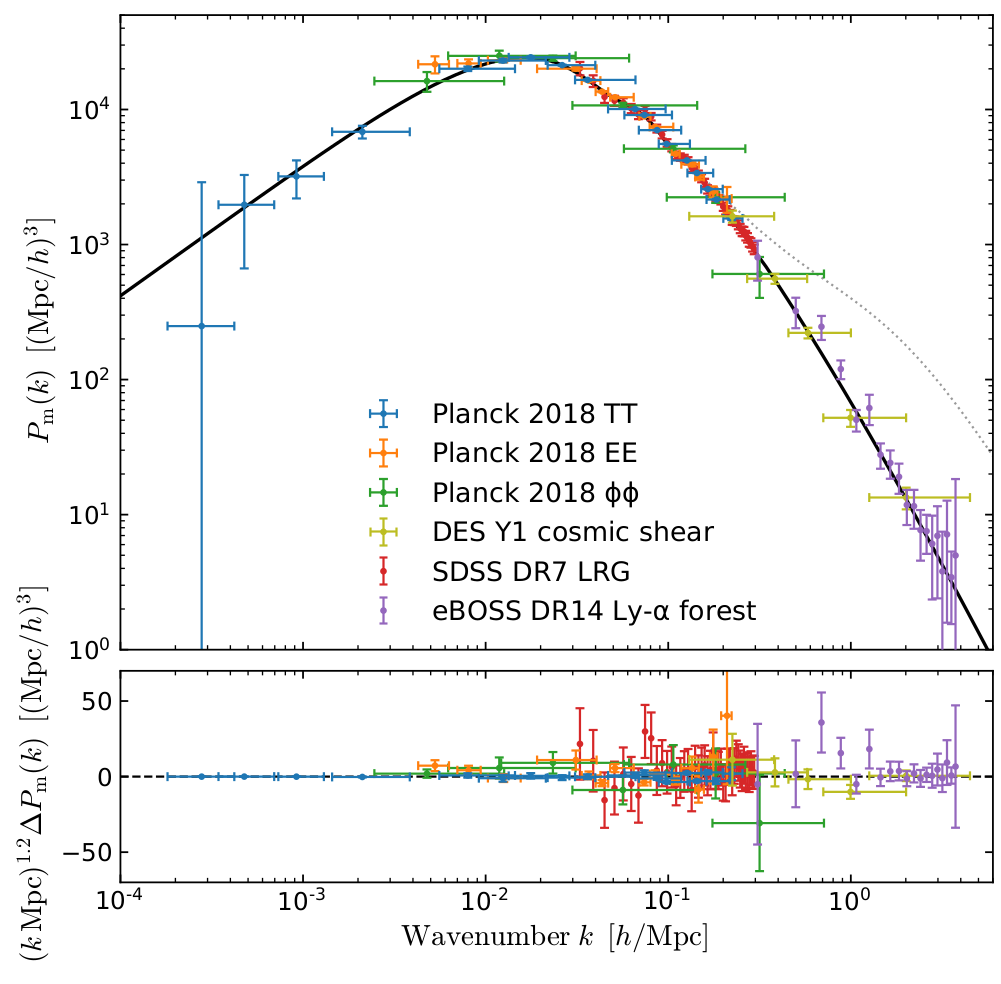
Walther et al. 2021
Chabanier et al. 2019
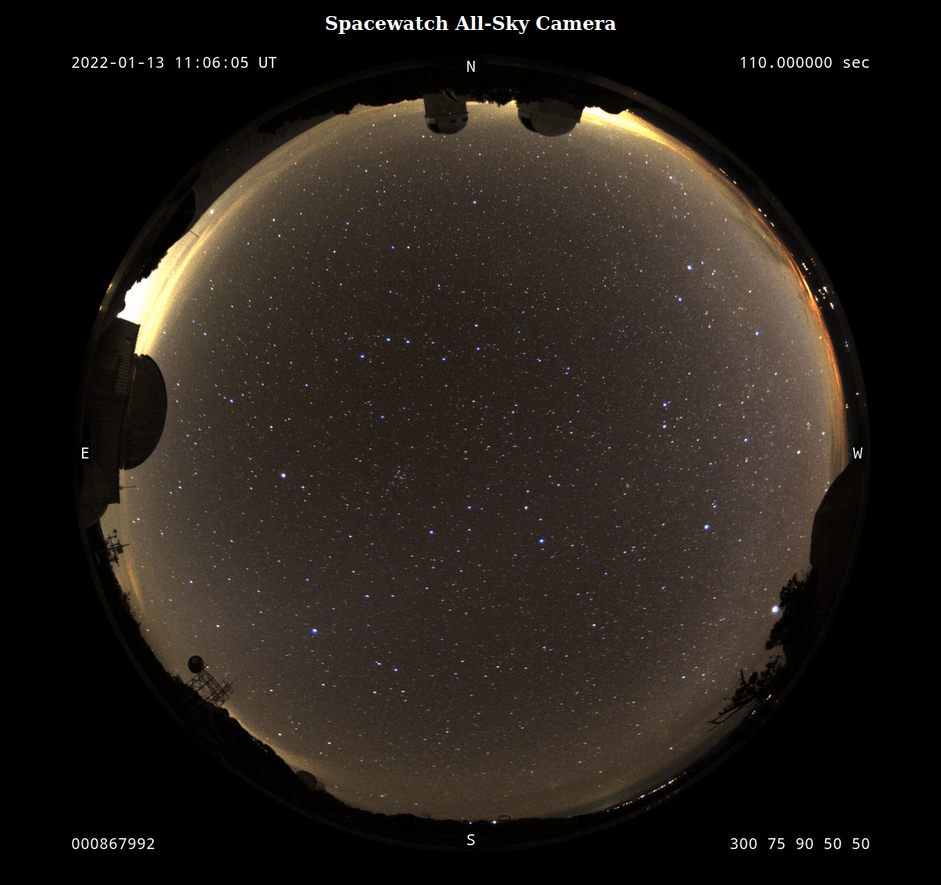
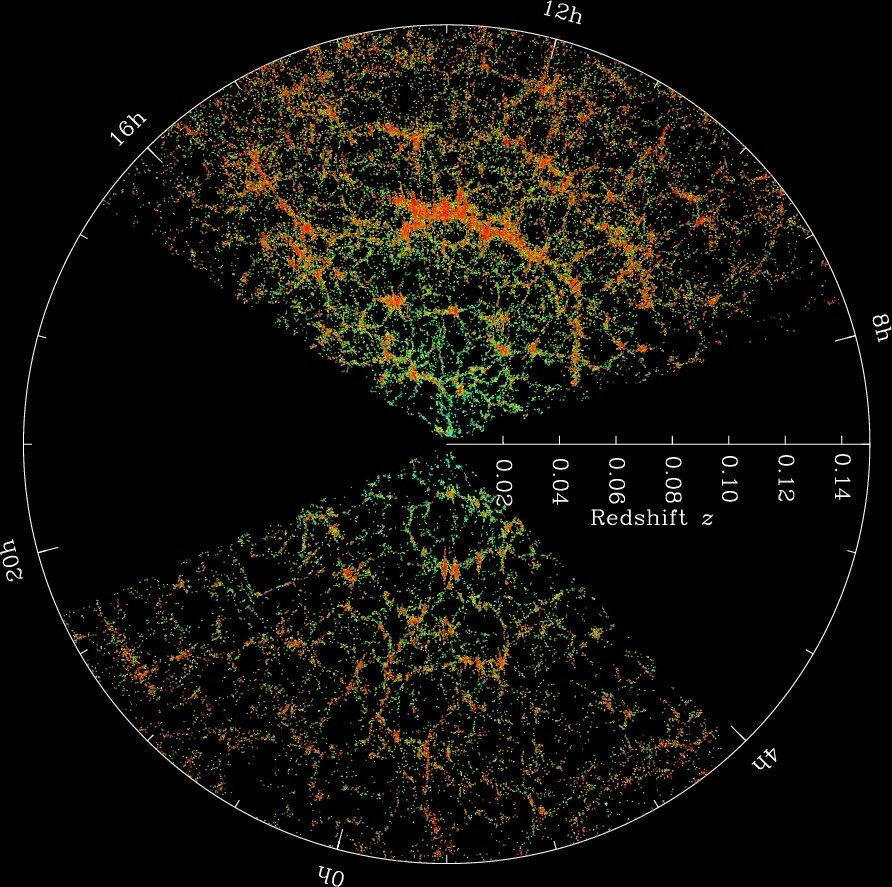
How can we probe the cosmic web?
What can we learn from it?
Ecole Rodolphe Cledassou 2024 - galaxy clustering: observation
?
Ecole Rodolphe Cledassou 2024 - galaxy clustering: observation
Outline
1. Properties of observed objects
2. Light path from source to detector
3. Galaxy survey properties
4. An overview of galaxy surveys
Ecole Rodolphe Cledassou 2024 - galaxy clustering: observation
1. Properties of observed objects
2. Light path from source to detector
3. Galaxy survey properties
4. An overview of galaxy surveys
1. Properties of observed objects
Outline
Ecole Rodolphe Cledassou 2024 - galaxy clustering: observation
Astrophysical objects
-
In a galaxy survey, we generally observe:
- Stars (Milky Way, galaxy component)
- Galaxies
- Quasars
- Very complex objects presenting a wide range of astrophysical phenomena
Arizona desert sky on a clear night
Ecole Rodolphe Cledassou 2024 - galaxy clustering: observation
Stars: spectra
Source: ESO
- The stars are basically black bodies, i.e. follows Planck radiation law.
- Surface temperature given by Wien's law
- Luminosity given by Stefan-Boltzmann's law
- For the same class of stars, the temperature, lifetime and luminosity mainly depend on the mass (degeneracy)
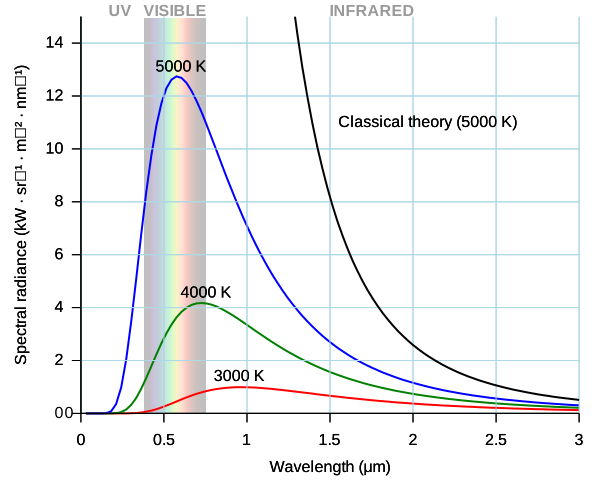
Spectral radiance: power emitted by the emitting surface per unit area, per unit solid angle and per spectral unit
Ecole Rodolphe Cledassou 2024 - galaxy clustering: observation
Stars: stellar populations
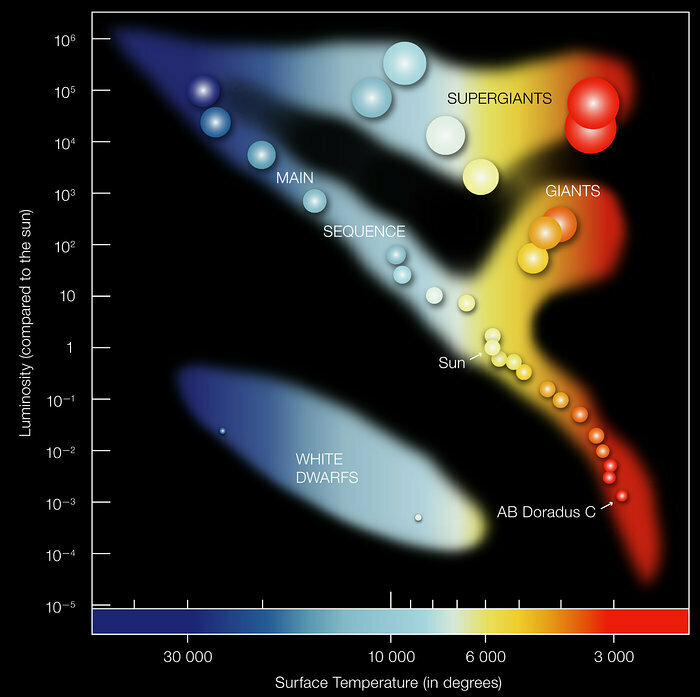
Source: ESO
-
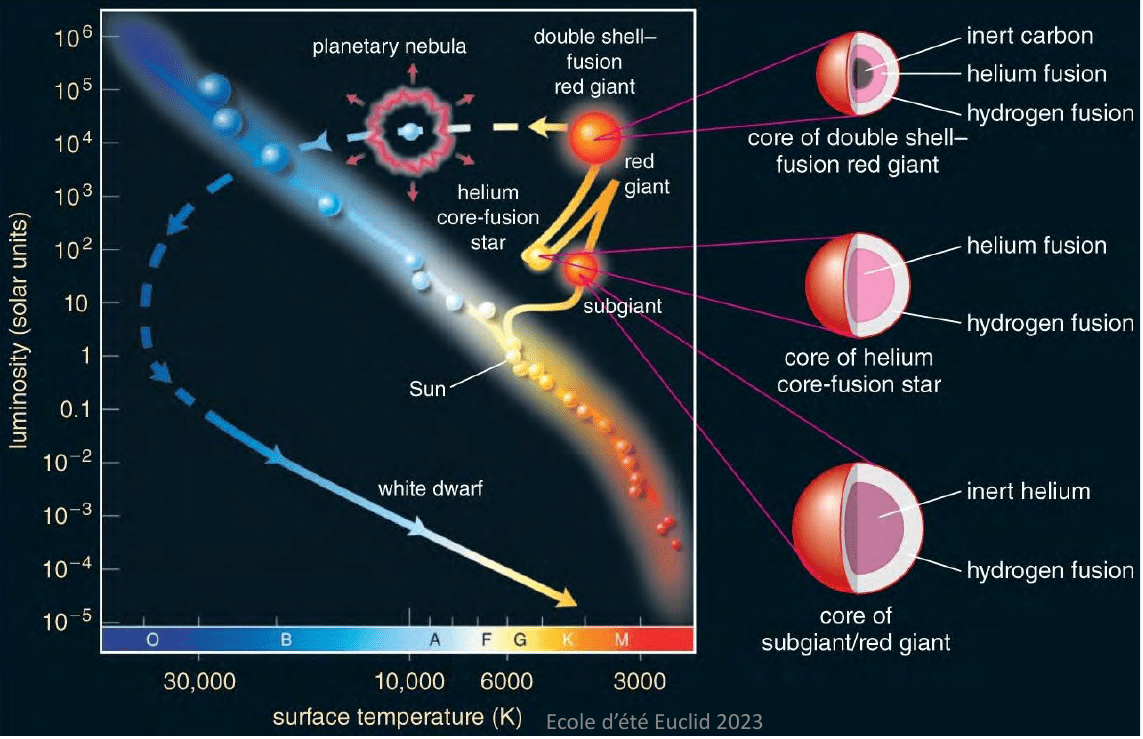
Different class of stars located in the Hertzprung Russel (HR) diagram
- Different diagram forms (color, temperatures)
- Theoretical and observational (e.g. Gaia)
- Large luminosity range
- Complex evolution on this diagram
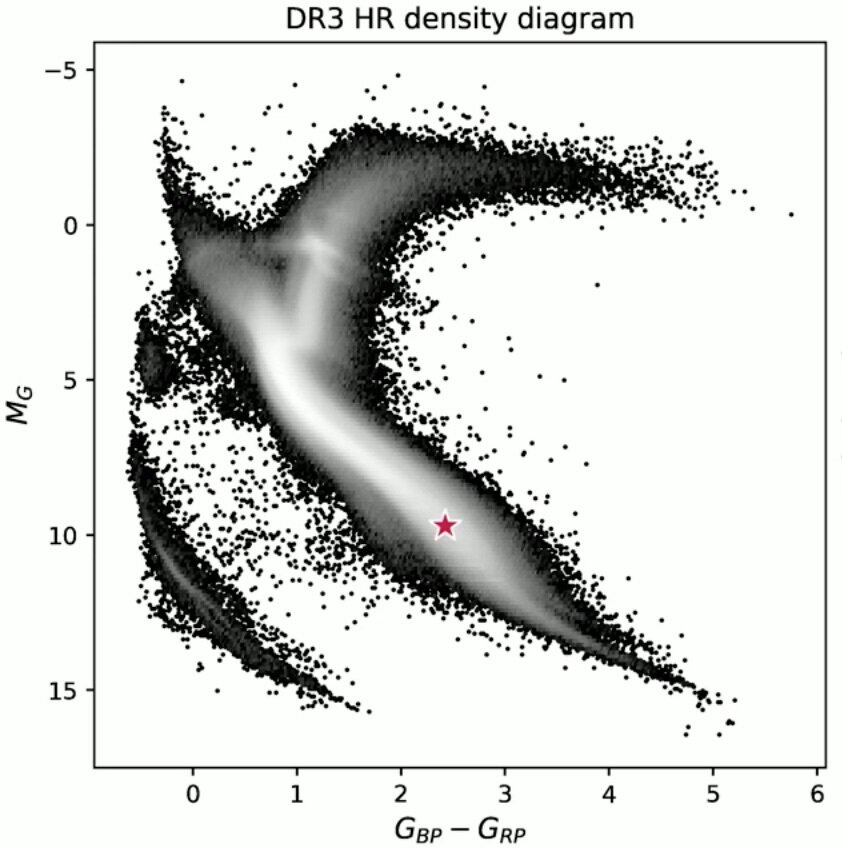
Source: Gaia DR3
Ecole Rodolphe Cledassou 2024 - galaxy clustering: observation
Source: ESO
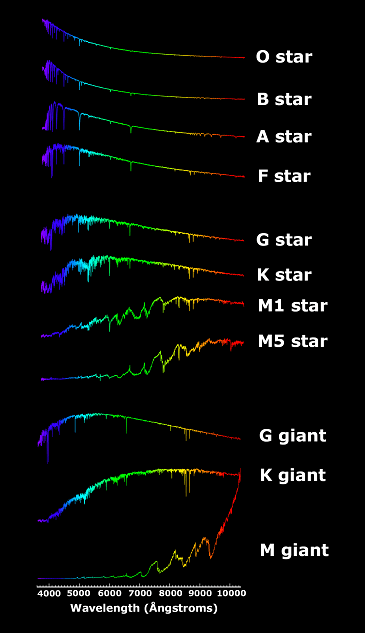
- Deformed black body spectra
- Classification based on the surface temperature (O, B, A...)
- Contains emission and absorption lines (mainly absorption) caused by elements in the star atmosphere
- Sawtooth profile of reddest stars (M, M giant) caused by molecules formed in the star atmosphere due to low surface temperature
Stars: real spectra
Source: SDSS
Ecole Rodolphe Cledassou 2024 - galaxy clustering: observation
Galaxies
Source: ESO
-
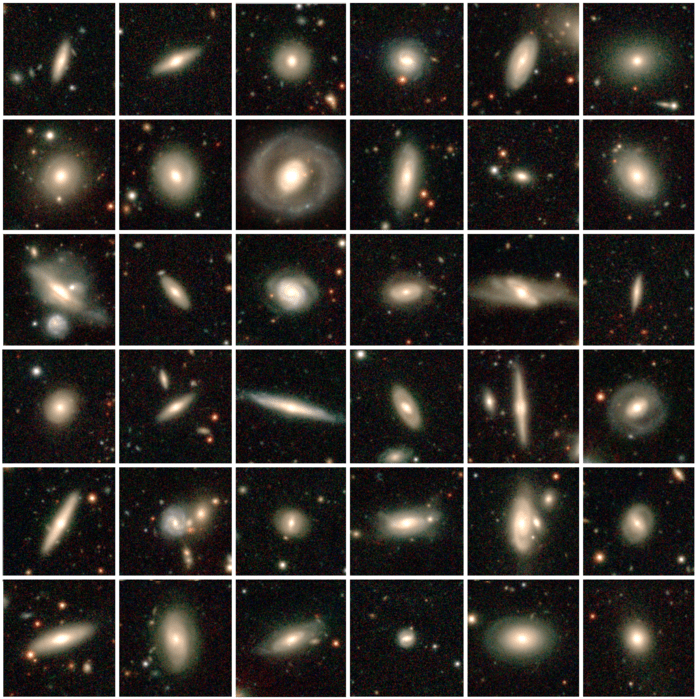
A galaxy is a collection of:
- A central supermassive Black Hole
- Stars (> 10⁸)
- Gas (of various temperature and composition)
- Dust
- Dark matter
- Largest fraction of the luminous matter in the form of stars.
Ecole Rodolphe Cledassou 2024 - galaxy clustering: observation
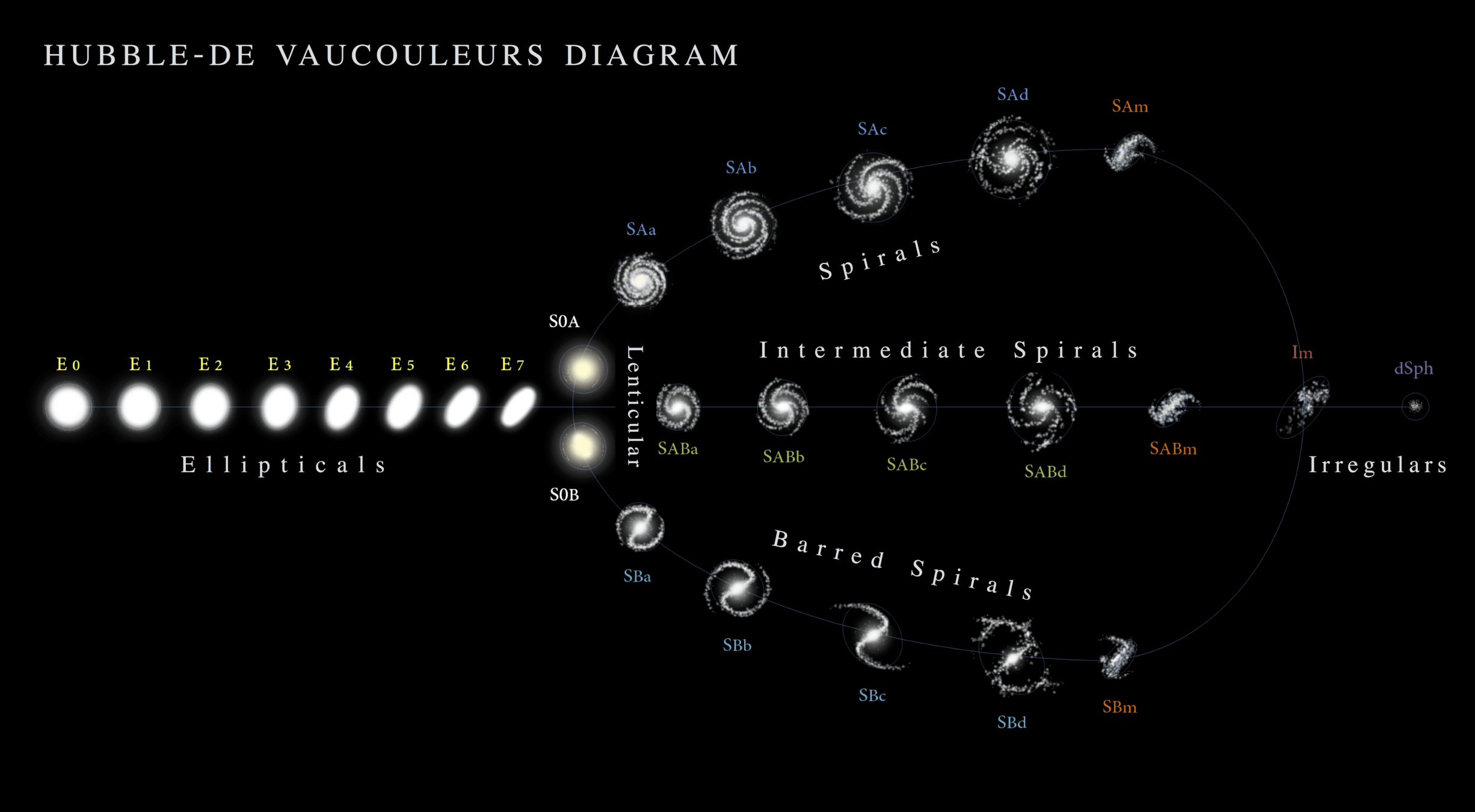
Galaxies: diversity
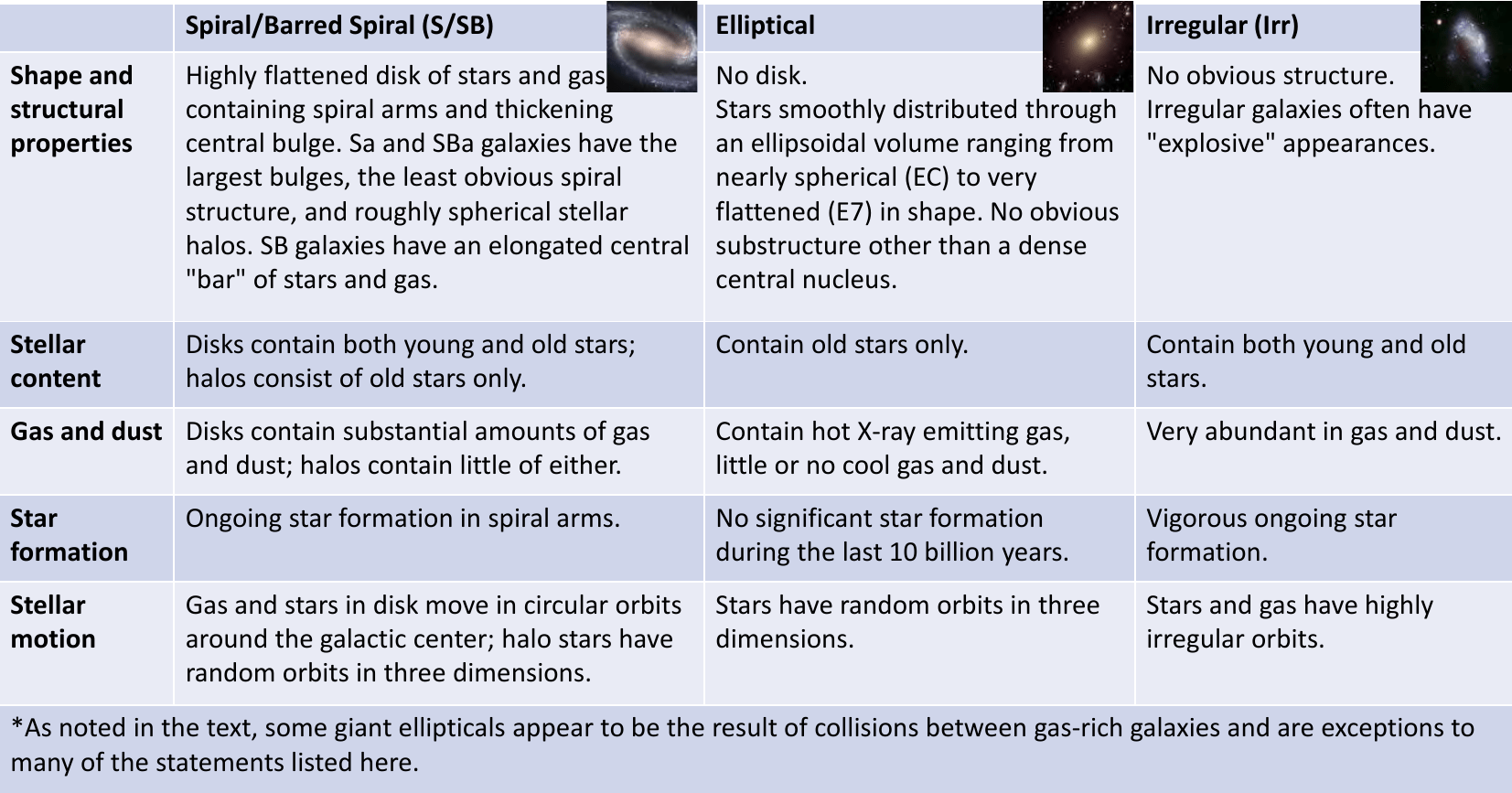
- Very historically-oriented classification of shapes: Hubble-de Vaucouleurs
-
Galaxy types:
- Elliptical
- Spirals and barred
- Irregulars
- Very simplified in comparison to recent classifications
Ecole Rodolphe Cledassou 2024 - galaxy clustering: observation
Source: ESO
Galaxies: spectra
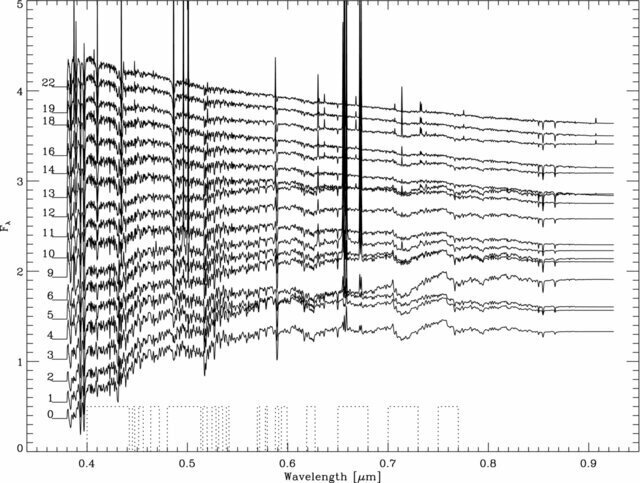
The galaxy spectra shape depends mainly on its stellar population, and thus on:
- The initial distribution of stellar masses
- The history of star formation in the galaxy
- The age of the galaxy
- The merging history of the galaxy
Ecole Rodolphe Cledassou 2024 - galaxy clustering: observation
Source: ESO
Galaxies: continuum
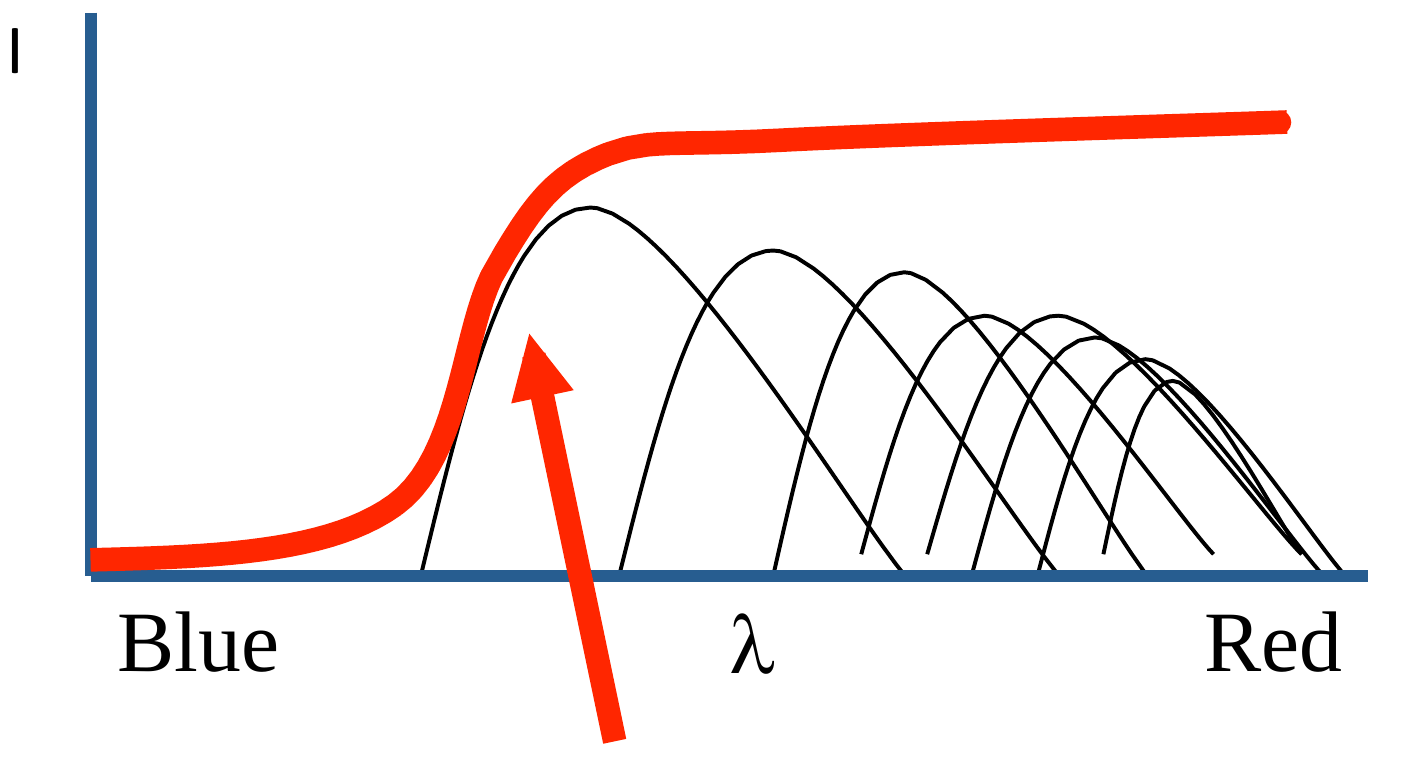
- Combination of many Black-Body spectra spanning a range in temperatures
- This produces a fairly flat overall spectrum
-
A characteristic feature is the 4000Å break caused by:
- Accumulation of absorption from metals in the stellar atmospheres
- The lack of hot blue stars
- Hence, older galaxies present a strong 4000Å break
Ecole Rodolphe Cledassou 2024 - galaxy clustering: observation
Source: ESO
Galaxies: lines
Absorption
Emission
- Need metals in stellar atmospheres or cold gas in the interstellar medium
- Old stellar population = old
galaxy - Ellipticals galaxies or spiral bulge
- Emission from high ionized regions around stars (recombination, collision)
- Need very hot gas and O and B
type stars (bluer ones) - Newly formed stars =
star-forming/young galaxy - Spiral Disks or Irregular galaxies
Old galaxies
Young galaxies
Ecole Rodolphe Cledassou 2024 - galaxy clustering: observation
Source: ESO
Galaxies: population summary
Color:
Star age:
SFR:
HI gas:
Dust:
Red
Blue
Old
Young
Low
High
Low
High
Low
Low
High
Old, no star production, red, 4000Å break, absorption lines
Young, star production, blue, no 4000Å break, emission lines
"Early-type"
"Late-type"
Ecole Rodolphe Cledassou 2024 - galaxy clustering: observation
Galaxy spectra examples
Source: ESO
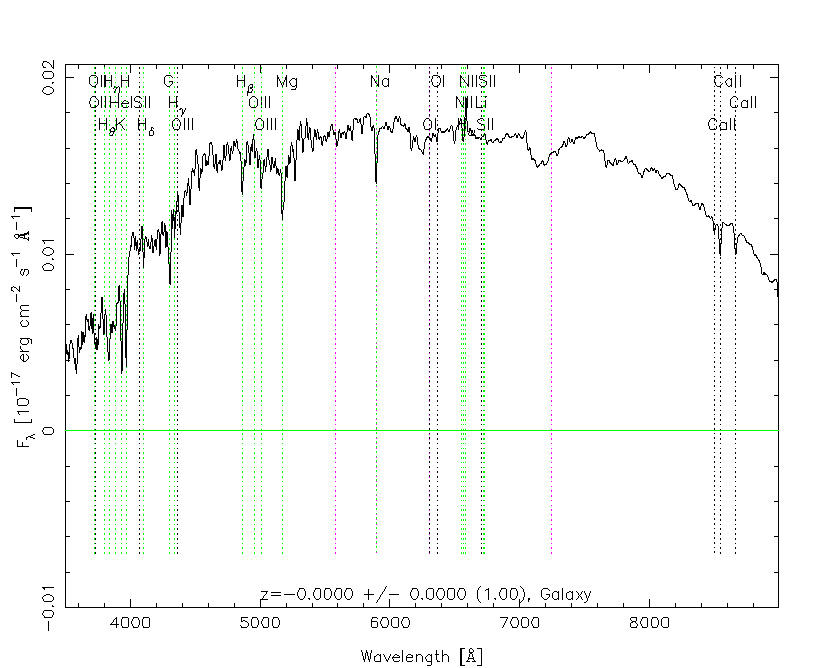
SDSS DR5 template spectrum
Ecole Rodolphe Cledassou 2024 - galaxy clustering: observation
Galaxy spectra examples
Source: ESO
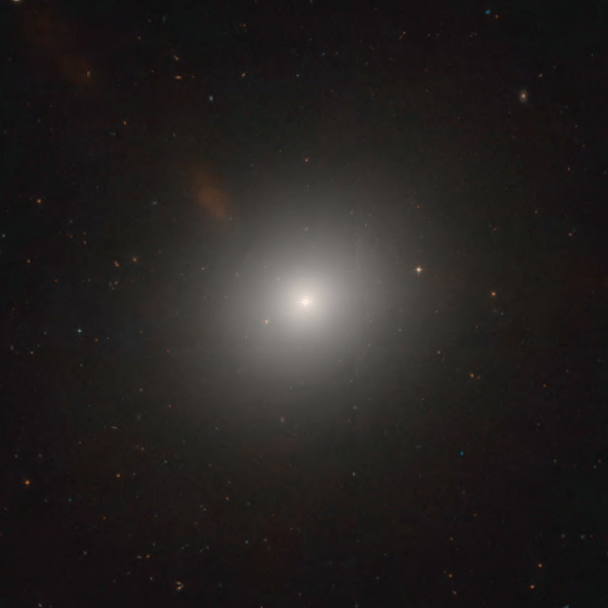
4000Å break, absorption lines,no emission lines
Elliptical "Early-type"
SDSS DR5 template spectrum
Ecole Rodolphe Cledassou 2024 - galaxy clustering: observation
Galaxy spectra examples
Source: ESO
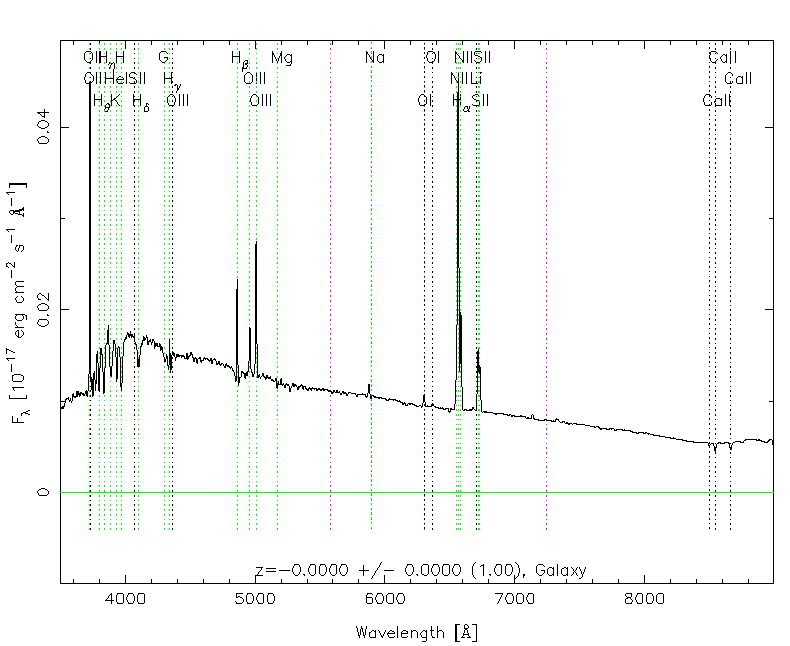
SDSS DR5 template spectrum
Ecole Rodolphe Cledassou 2024 - galaxy clustering: observation
Galaxy spectra examples
Source: ESO
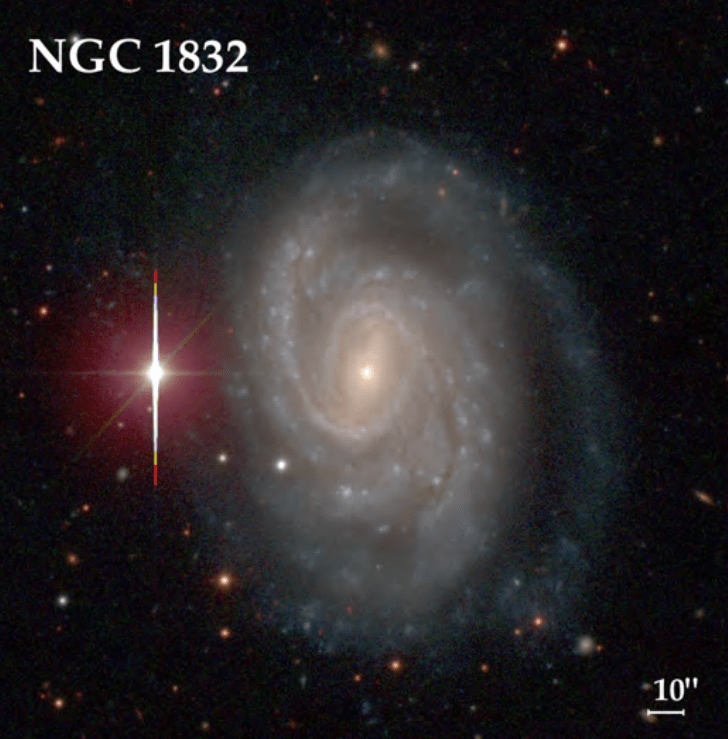
no 4000Å break, emission lines
Spiral "Late-type"
SDSS DR5 template spectrum
Ecole Rodolphe Cledassou 2024 - galaxy clustering: observation
Quasars
Source: ESO
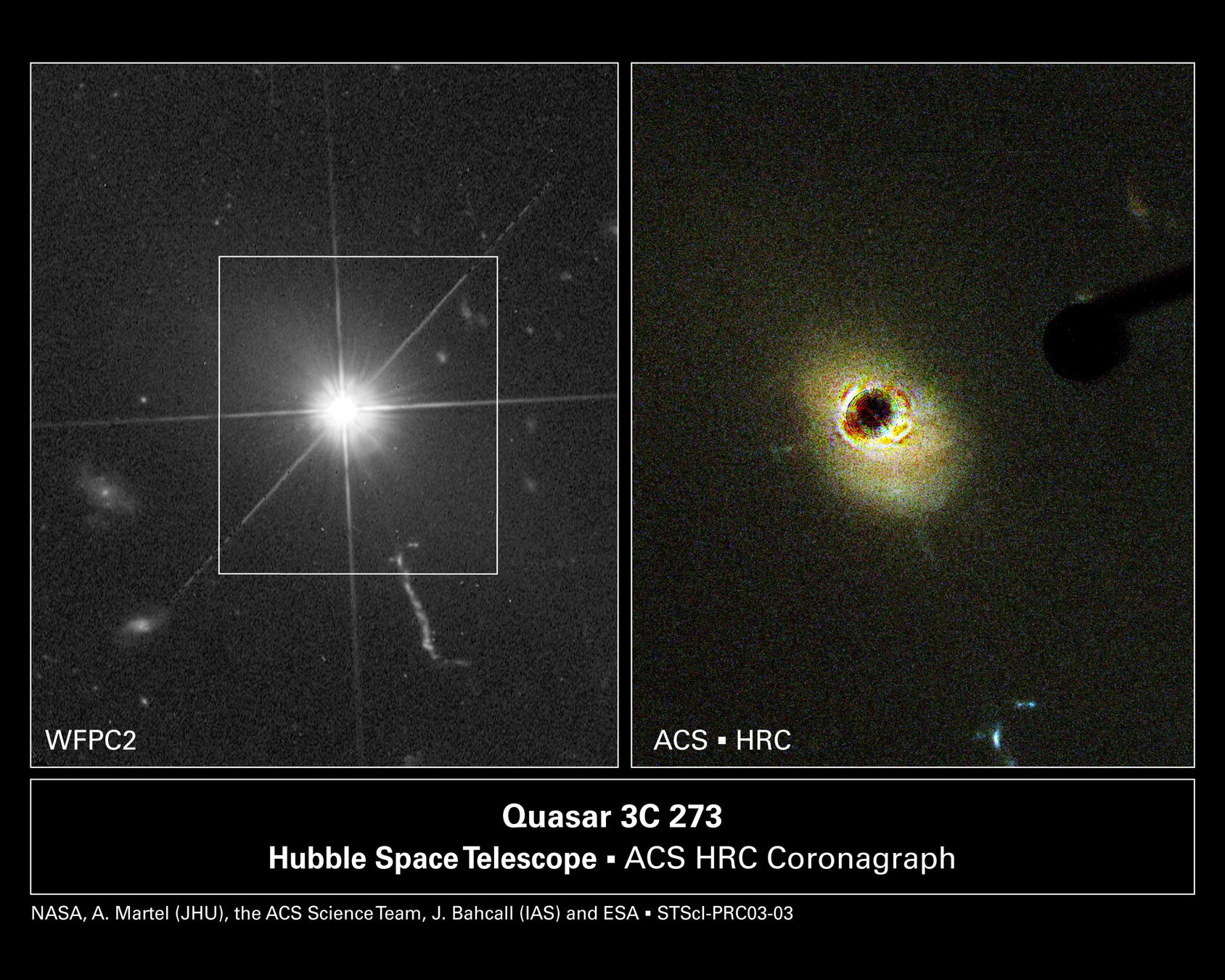
- Quasar = supermassive black hole + accretion disk
- Brightest objects in the Universe (up to 1000 x Milky Way)
- Observed up to redshift z~7
Ecole Rodolphe Cledassou 2024 - galaxy clustering: observation
Quasars: subtype of Active Galaxy Nuclei
Source: ESO
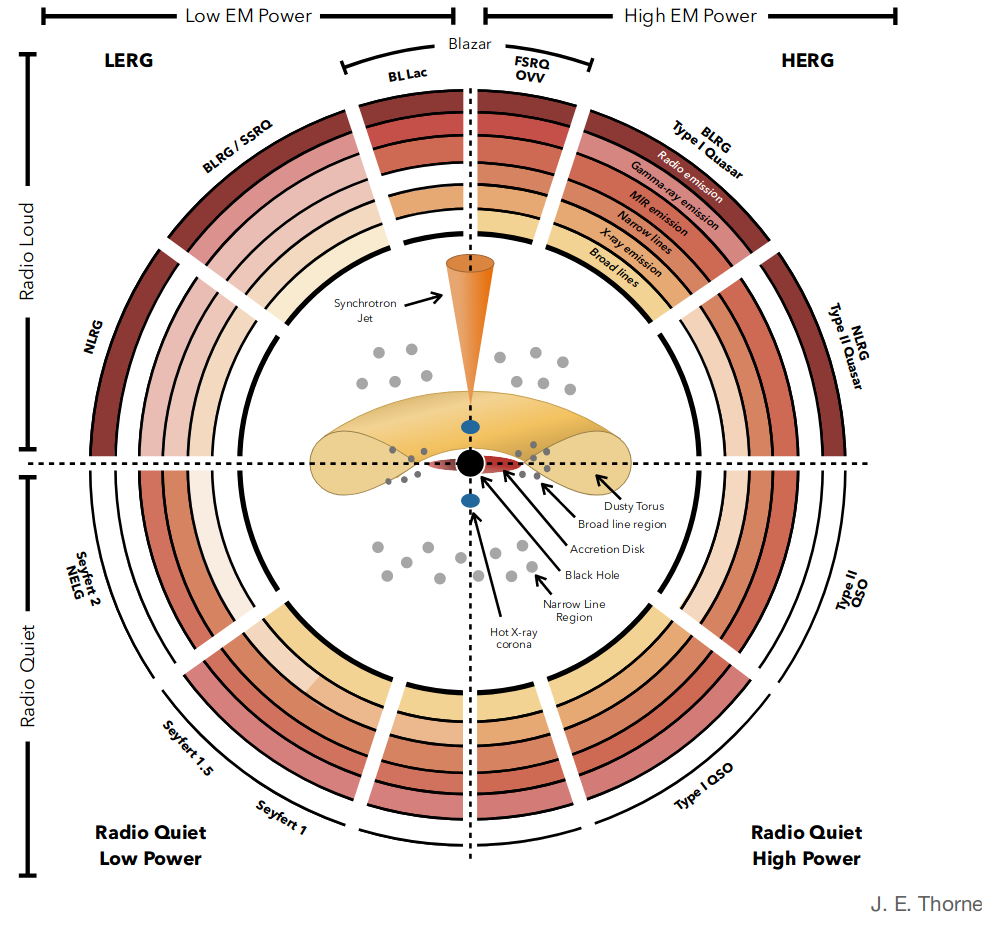
- Quasar enters into the classification of Active Galaxy Nucleus (AGN)
- High gravitational energy
- Heating of accreted matter by complex non-linear processes
Ecole Rodolphe Cledassou 2024 - galaxy clustering: observation
Quasars: spectra
Wavelength [Angstrom]
Flux
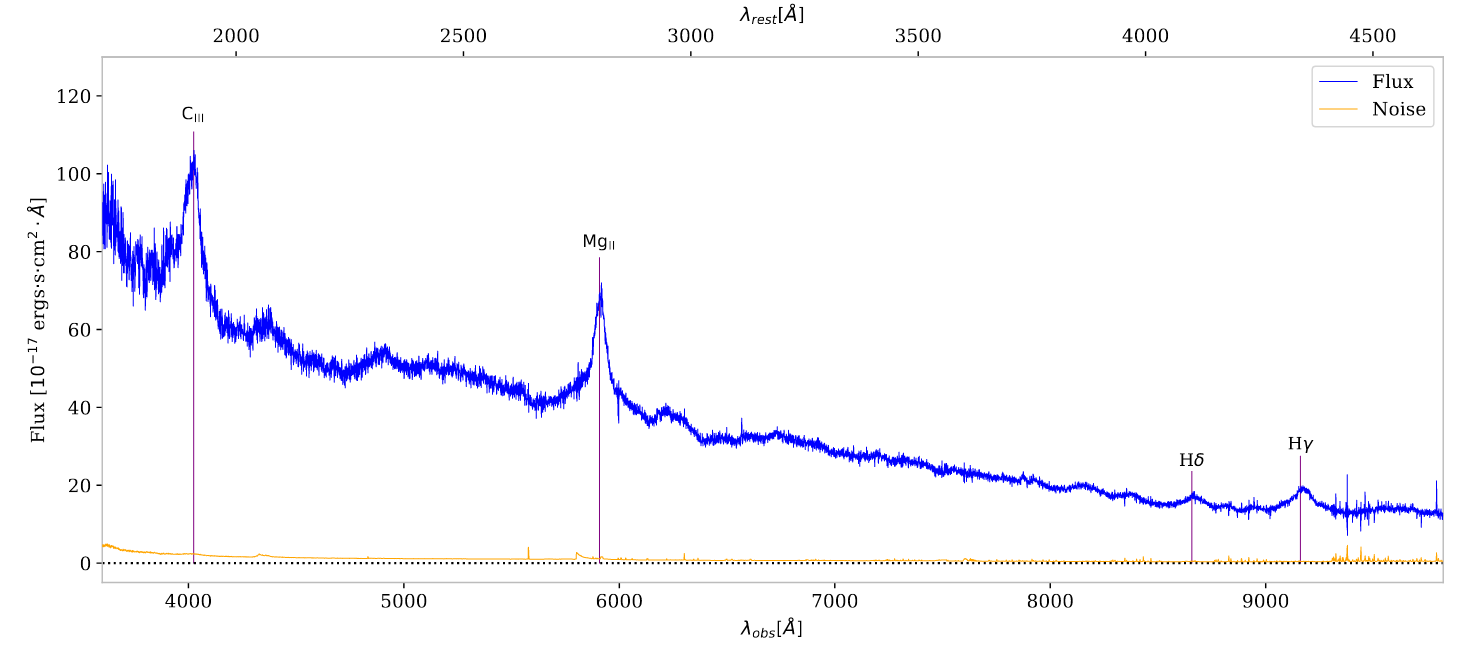
DESI quasar at z = 1.11
- Strong emission in the visible, UV, X-ray and gamma-ray
- Can emit radio depending on its orientation
- Very large emission lines due to thermal and collisional process in the accretion disk
Ecole Rodolphe Cledassou 2024 - galaxy clustering: observation
Blind test on real data
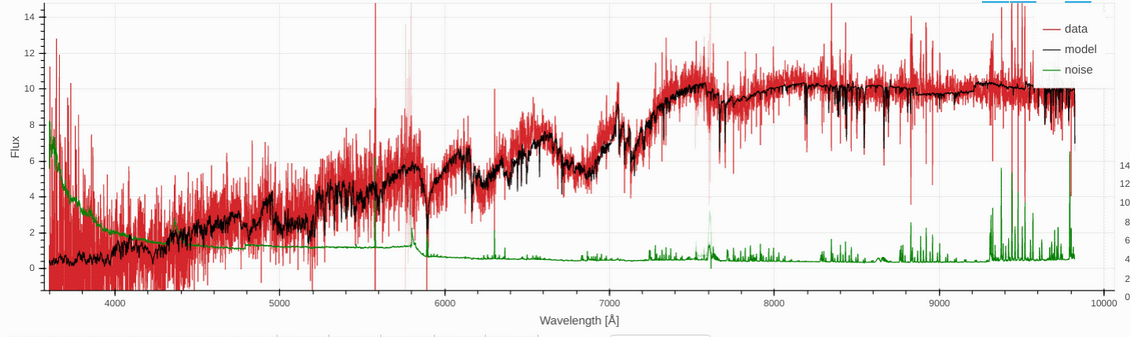
DESI EDR data
Ecole Rodolphe Cledassou 2024 - galaxy clustering: observation
Blind test on real data
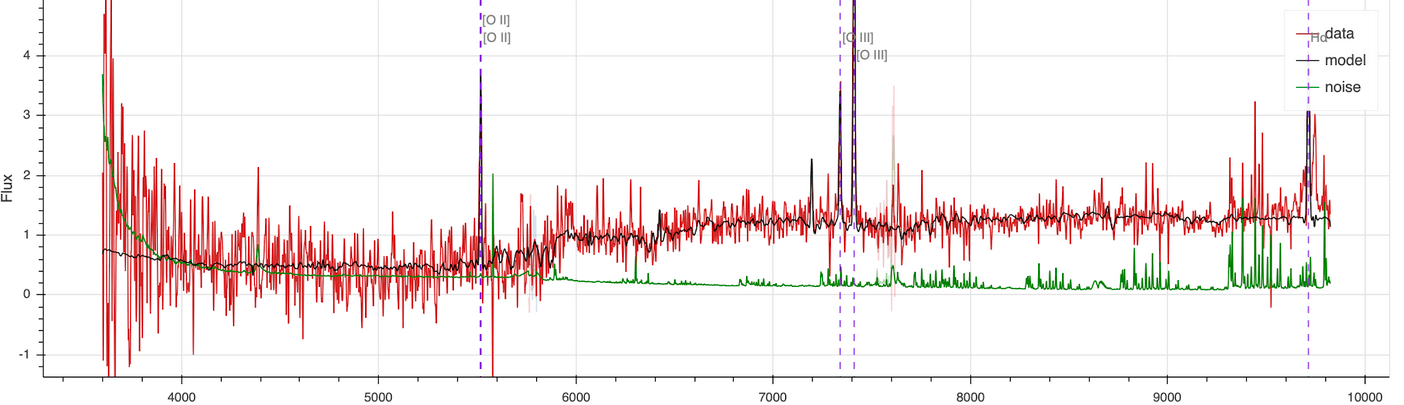
DESI EDR data
Ecole Rodolphe Cledassou 2024 - galaxy clustering: observation
Blind test on real data
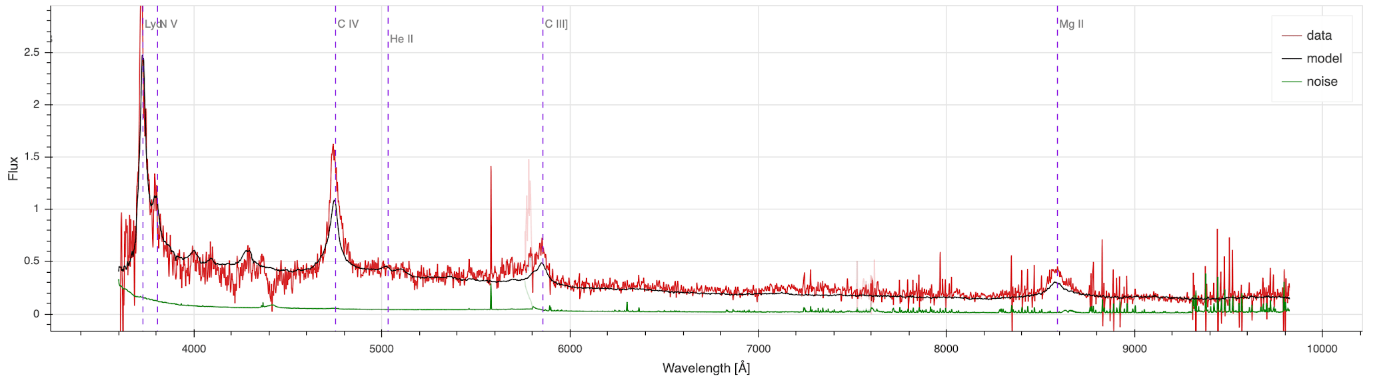
DESI EDR data
Ecole Rodolphe Cledassou 2024 - galaxy clustering: observation
Blind test on real data
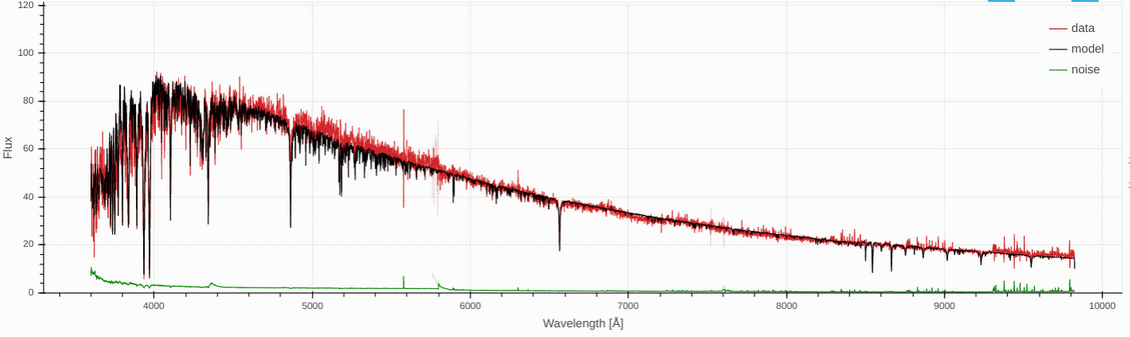
DESI EDR data
Ecole Rodolphe Cledassou 2024 - galaxy clustering: observation
Blind test on real data
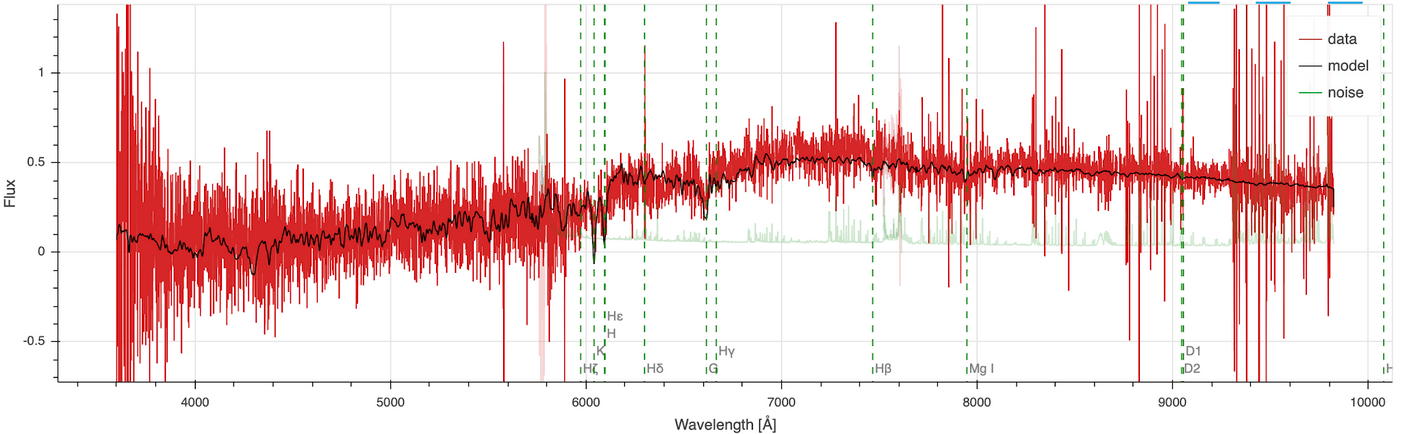
DESI EDR data
Ecole Rodolphe Cledassou 2024 - galaxy clustering: observation
1. Properties of observed objects
2. Light path from source to detector
3. Galaxy survey properties
4. An overview of galaxy surveys
Outline
2. Light path from source to detector
Ecole Rodolphe Cledassou 2024 - galaxy clustering: observation
Life of a photon


Source
Cosmic web
Telescope
Atmosphere
Milky Way
Ecole Rodolphe Cledassou 2024 - galaxy clustering: observation
Life of a photon
Source
Ecole Rodolphe Cledassou 2024 - galaxy clustering: observation
Redshift
Source
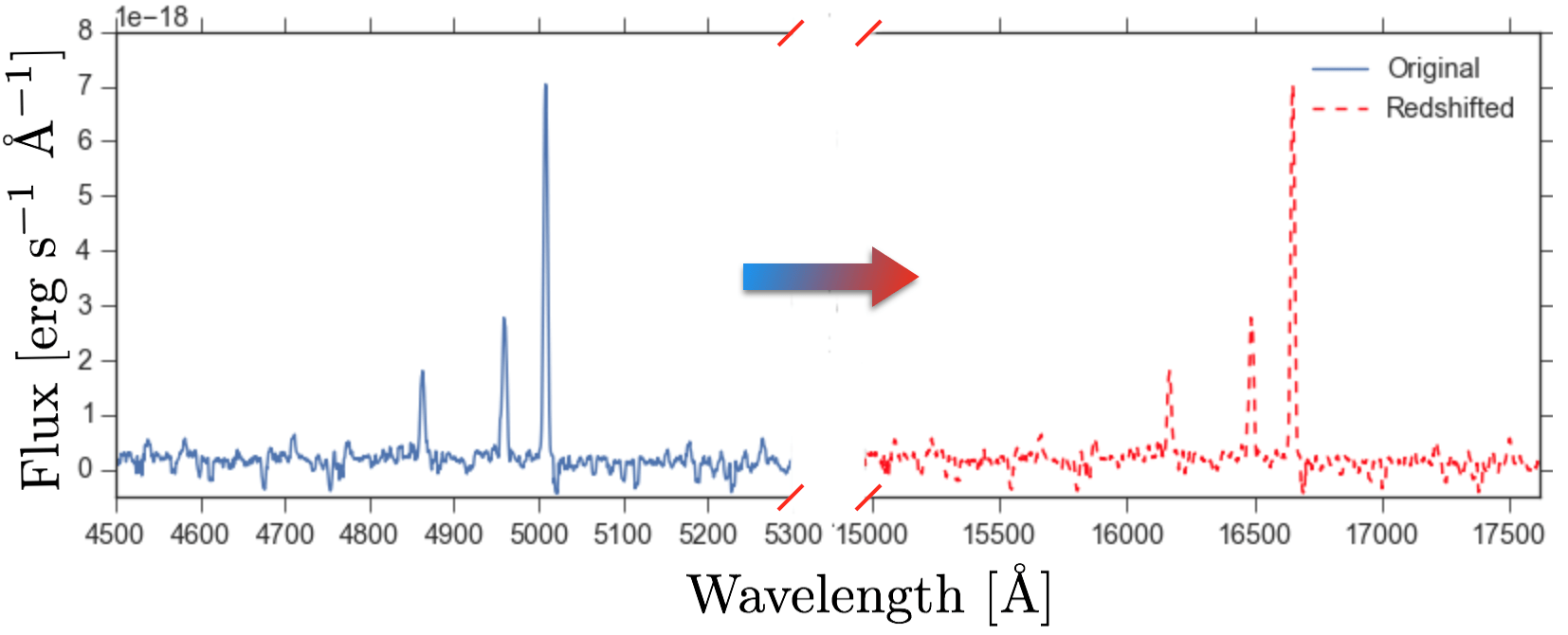
- Emitted spectra is redshifted due to Universe expansion and galaxy peculiar velocity
Probe universe expansion
Probe cosmic web
Ecole Rodolphe Cledassou 2024 - galaxy clustering: observation
Life of a photon
Cosmic web
Ecole Rodolphe Cledassou 2024 - galaxy clustering: observation
Traveling the cosmic web
- Galaxy/Quasar light travels over large distances through:
- Intergalactic medium (IGM)
- Other galaxies/clouds
- All these elements leave an imprint on the spectrum that can be used to probe the cosmic web
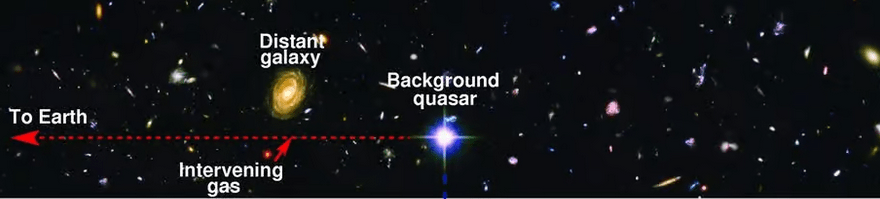
Cosmic web
Ecole Rodolphe Cledassou 2024 - galaxy clustering: observation
Example: the Lyman-α forest
Cosmic web
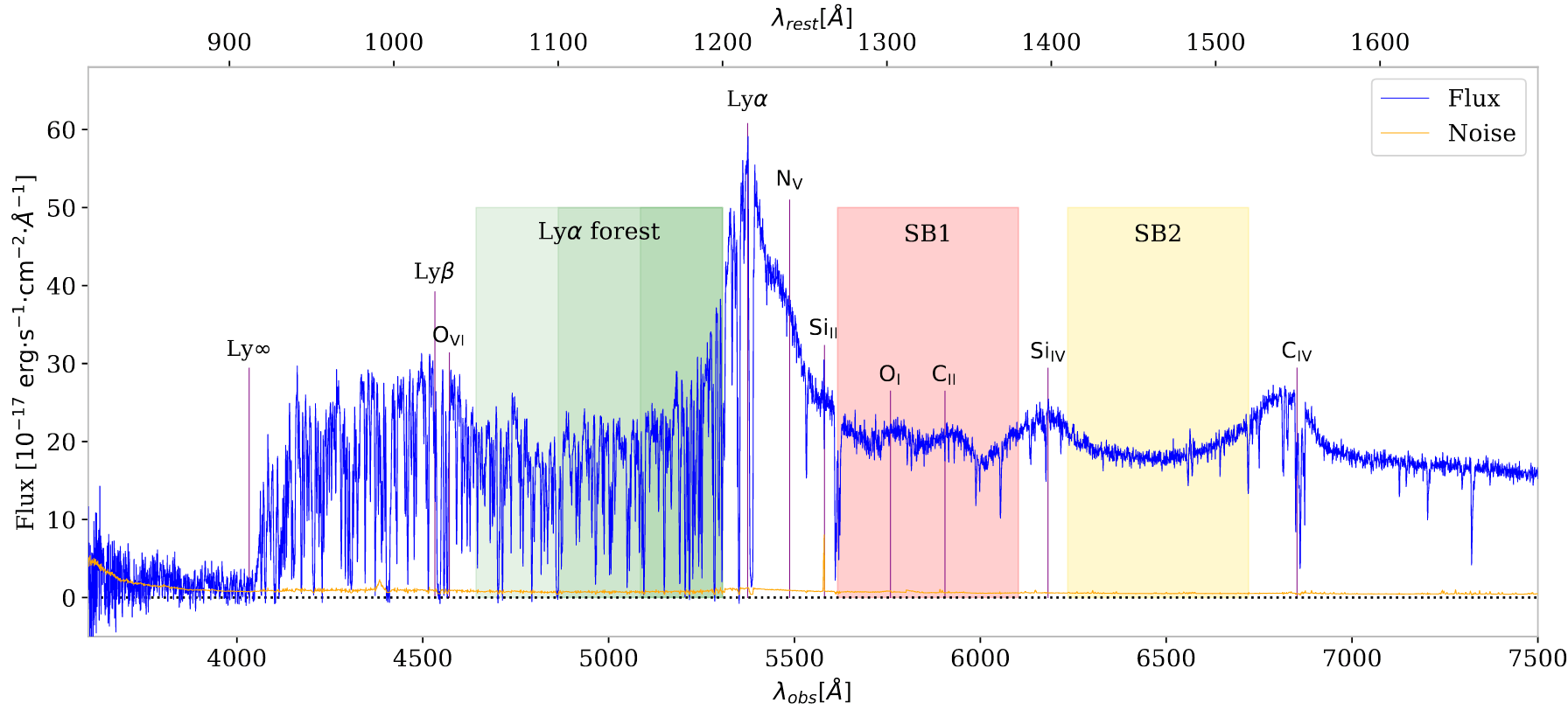
Ravoux et al. 2023
- Lines in quasar spectra at caused by absorbers in the intergalactic medium at
DESI quasar z = 3.42
Tracer of neutral hydrogen between the quasar and us
Ecole Rodolphe Cledassou 2024 - galaxy clustering: observation
The Lyman-α forest
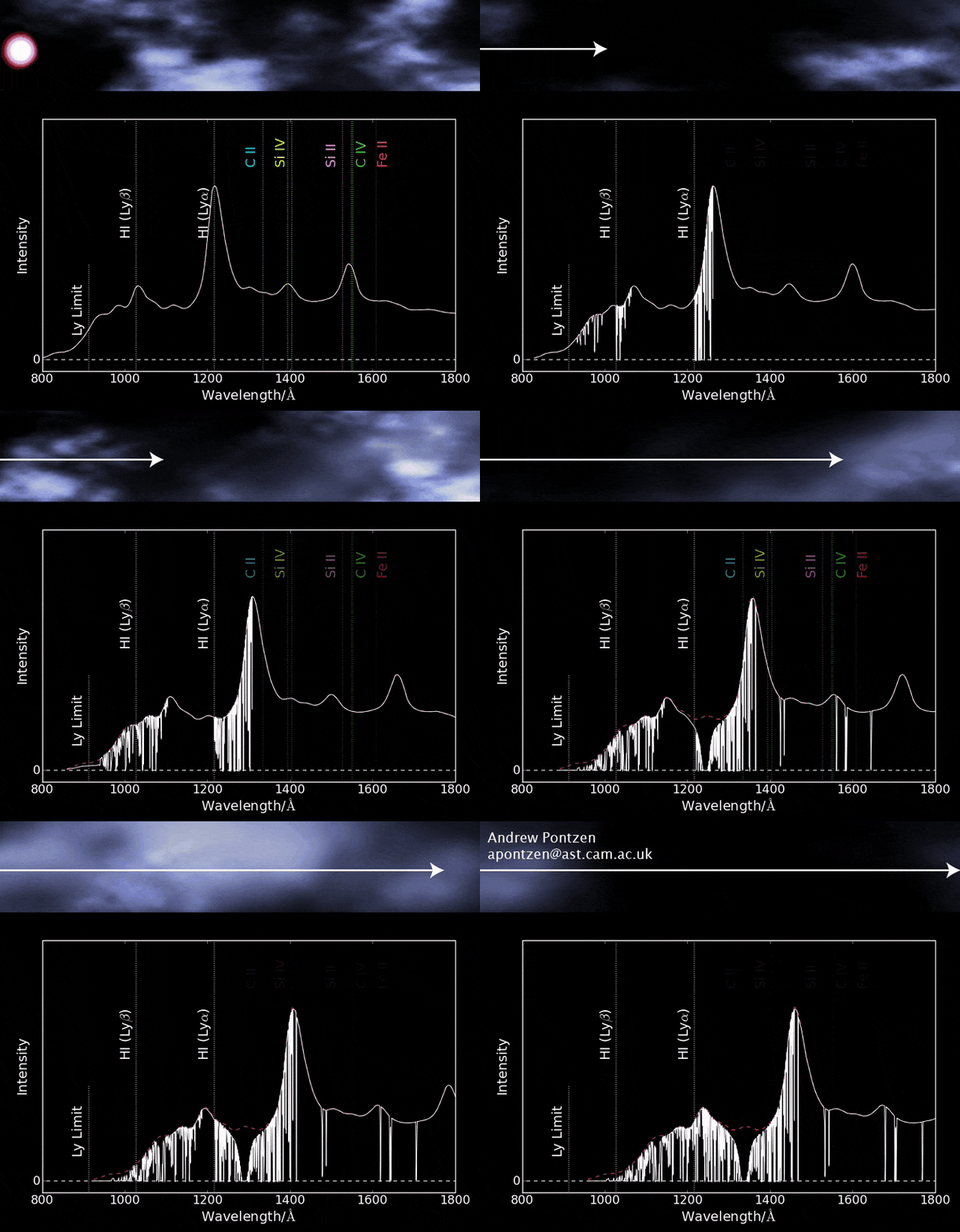
Cosmic web
Ecole Rodolphe Cledassou 2024 - galaxy clustering: observation
Example: the Lyman-α forest
Lyman-α forest




Observer
Quasar
Cosmic web
Ecole Rodolphe Cledassou 2024 - galaxy clustering: observation
Example: the Lyman-α forest
Quasar
Lyman-α forest
= Fraction of transmitted flux
Observer
Correlation
3D auto correlation
Cosmic web
Ecole Rodolphe Cledassou 2024 - galaxy clustering: observation
Example: the Lyman-α forest
Lyman-α forest
= Fraction of transmitted flux
Observer
Correlation
Cosmic web
Quasar
3D cross correlation with quasars
Ecole Rodolphe Cledassou 2024 - galaxy clustering: observation
Example: the Lyman-α forest
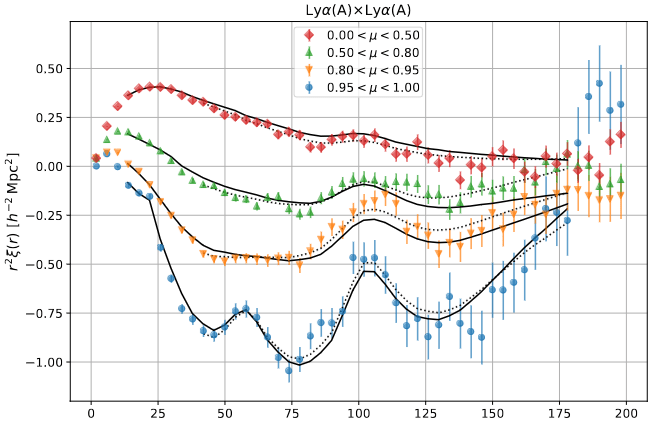
3D auto correlation
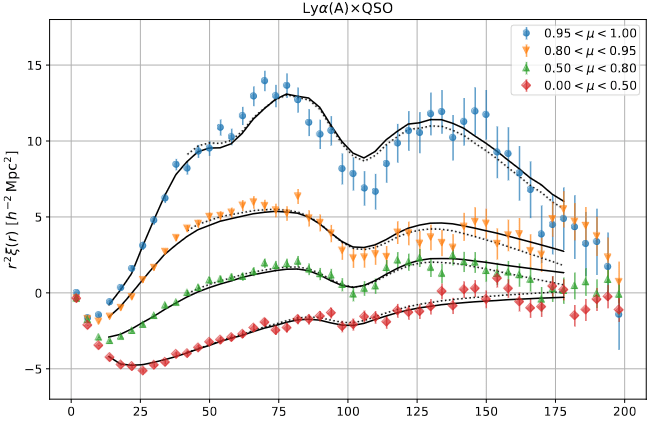
Separation (Mpc/h)
Separation (Mpc/h)
BAO scale
BAO scale
Measurement of the BAO scale with the Y1 data of DESI
DESI collaboration 2024
3D cross correlation with quasars
Cosmic web
Ecole Rodolphe Cledassou 2024 - galaxy clustering: observation
Life of a photon
Milky Way
Ecole Rodolphe Cledassou 2024 - galaxy clustering: observation
Absorption: dust
Milky Way
- Dust and gas affect the
transfer of radiation through a galaxy (scattering & absorption) - Impact generally expressed in term of color difference in B (blue) and V (visual) bands, called redenning:
- Light that cross dust appears redder than emitted light
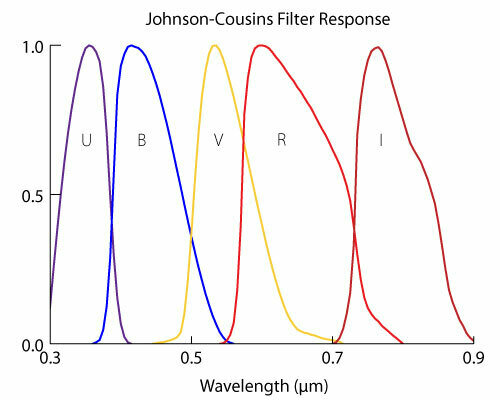
Johnson/Cousins UBVRI system
Ecole Rodolphe Cledassou 2024 - galaxy clustering: observation
Absorption: dust extinction
Milky Way
- Total extinction in the visual band (V)
- Extinction for a specific wavelength:
- a and b functions have complex profiles, depending on the galaxy
- Affects light both in the MW and in the host galaxy
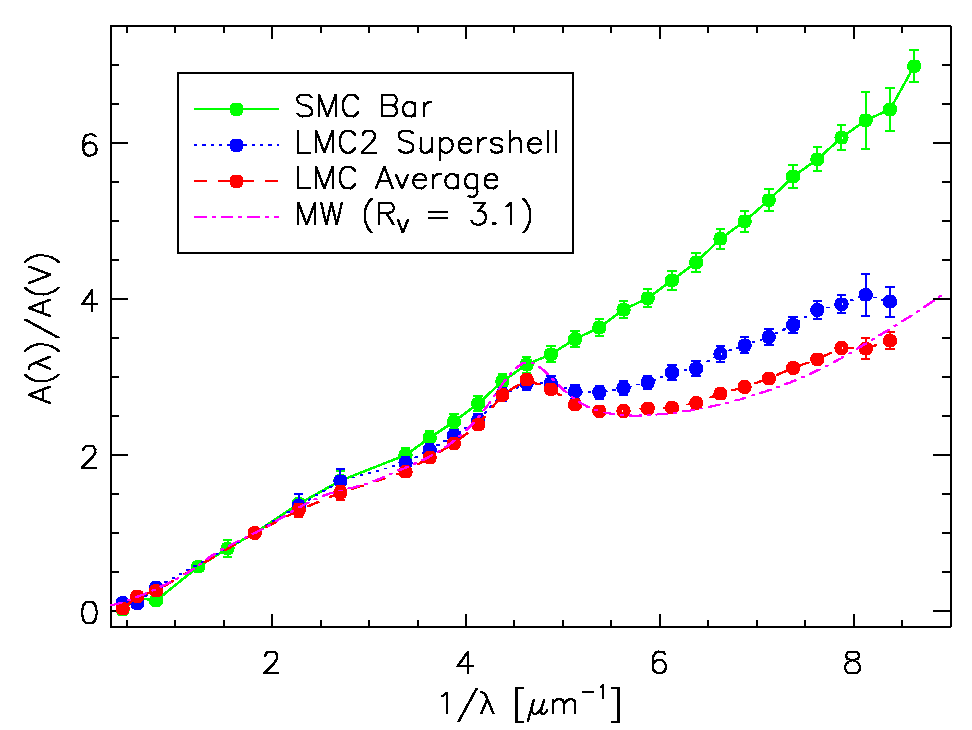
= ratio of total to selective extinction
~ 3.1 for Milky way but can vary depending on dust property
Ecole Rodolphe Cledassou 2024 - galaxy clustering: observation
Absorption: Milky Way dust
Milky Way
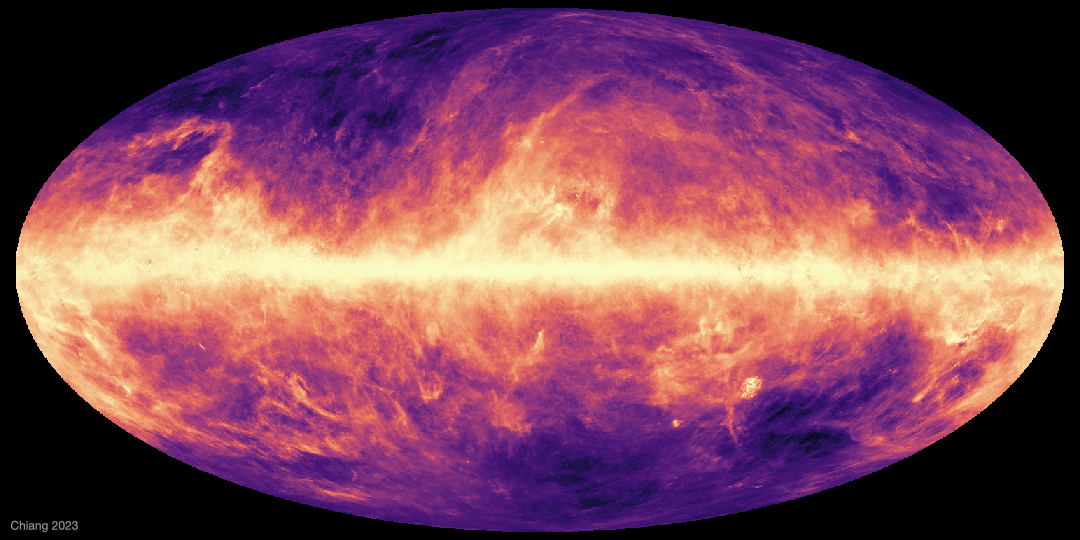
- E(B-V) dust extinction map in the Milky Way
- Major contaminant of CMB surveys
- For galaxy surveys: High values of E(B-V) can bias the clustering of pre-targetted galaxies
- Additional absorption lines of specific elements: CaII H-K lines, Na doublet line..
Ecole Rodolphe Cledassou 2024 - galaxy clustering: observation
Improved SFD map
Emission: background
Milky Way
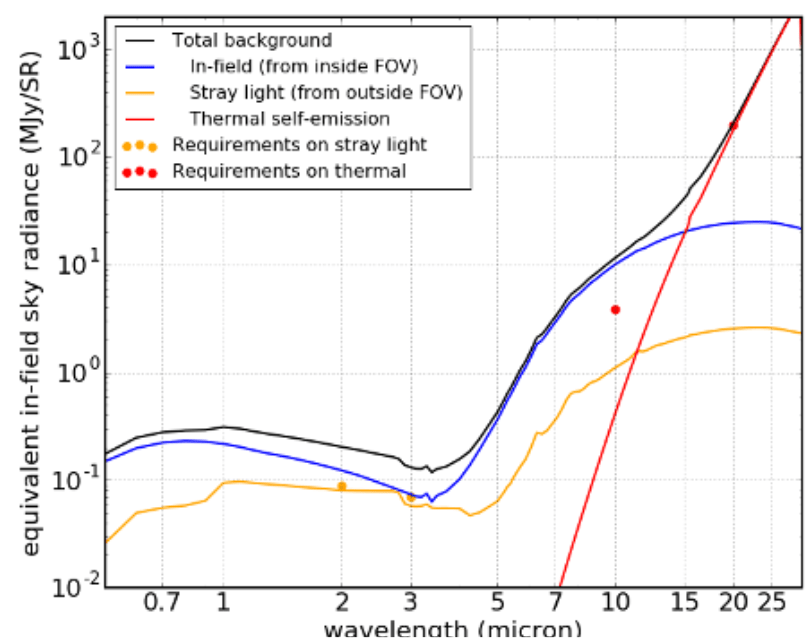
Background for JWST
- Yellow = out of FoV
- blue = galactic + zodiacal
- red = self emission
-
Galactic emission (ranked by intensity):
- Synchrotron: e⁻ in galactic magnetic field
- Thermal free-free: e⁻ scatter off ions
- Dust, molecular emissions
- Zodiacal emission: Infrared radiation by heated particles in our Solar System
Ecole Rodolphe Cledassou 2024 - galaxy clustering: observation
Example: correcting angular galaxy clustering
Milky Way
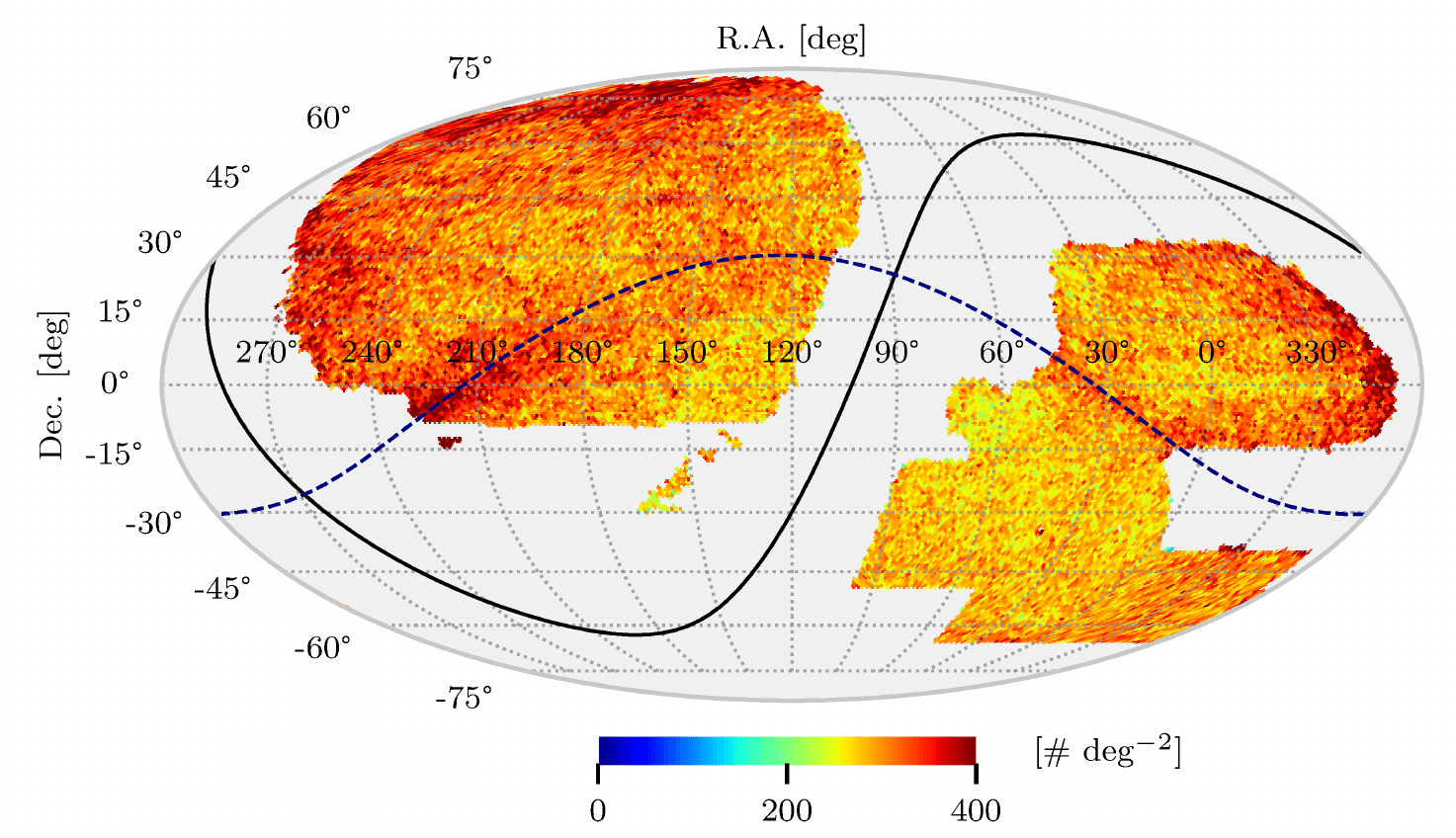
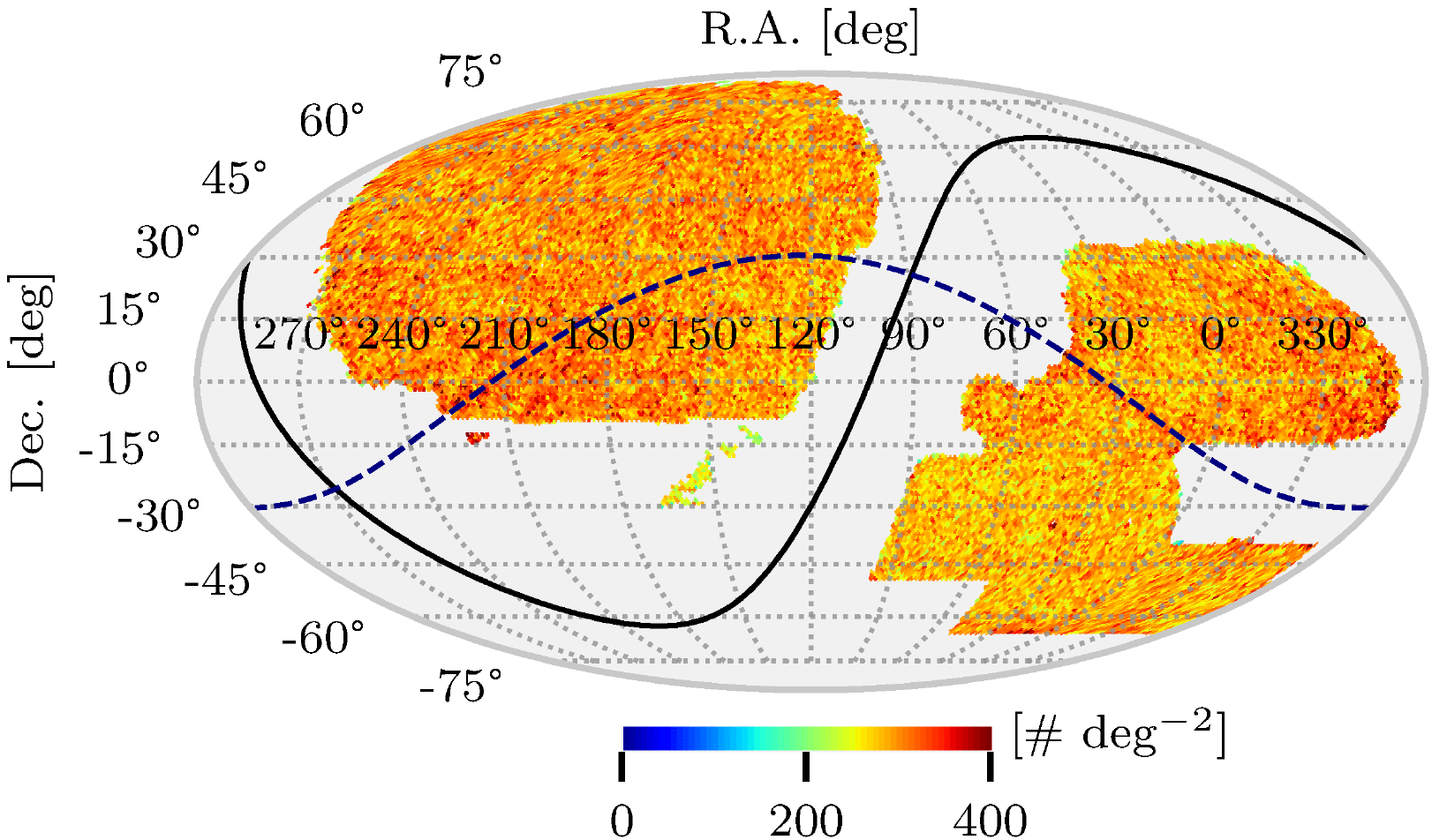
Chaussidon et al. 2022
- Quasar density fluctuations are contaminated by photometric properties, including Milky Way dust E(B-V)
- In DESI: systematics mitigated using various Machine Learning methods
Initial density map
After correcting all photometric systematics
Ecole Rodolphe Cledassou 2024 - galaxy clustering: observation
Life of a photon
Atmosphere
Ecole Rodolphe Cledassou 2024 - galaxy clustering: observation
Atmosphere
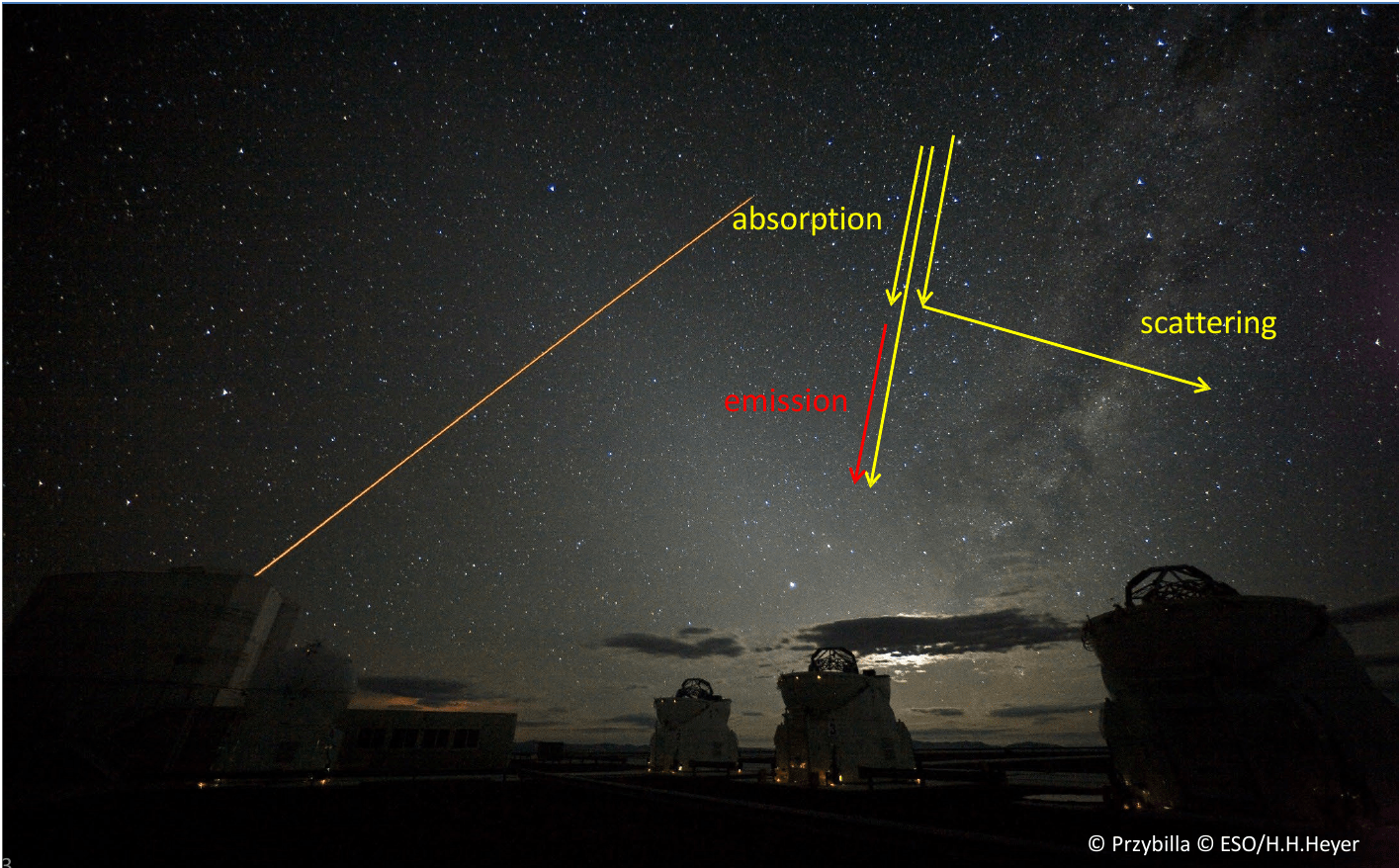
Atmosphere
For ground based surveys, need to account for atmosphere effects
Ecole Rodolphe Cledassou 2024 - galaxy clustering: observation
Some astronomy definitions
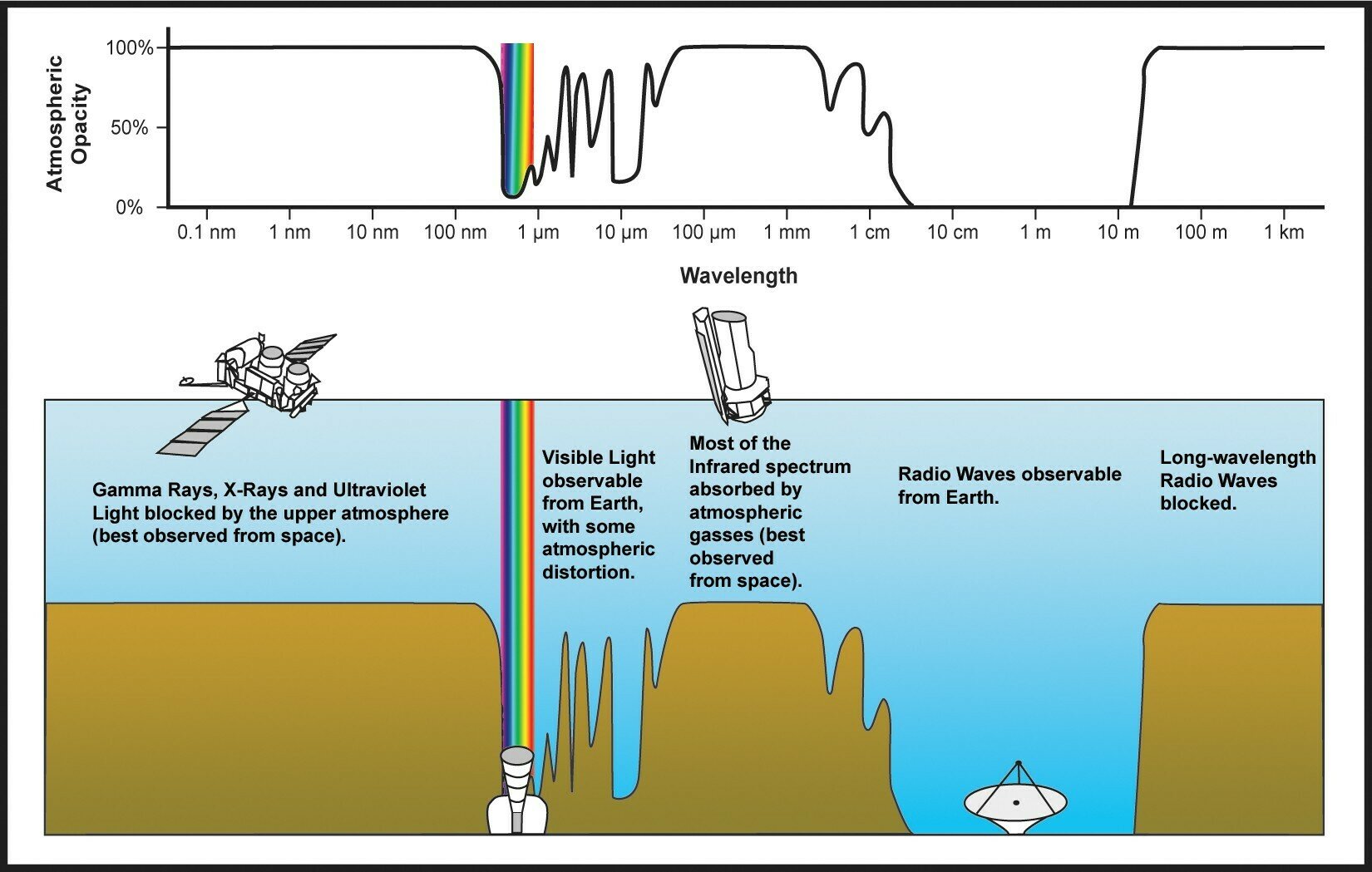
- Transparency/Opacity: transmission of the atmosphere on the line of sight.
- Sky level: Sky brightness from natural and artificial light sources (mag.arcsec⁻²)
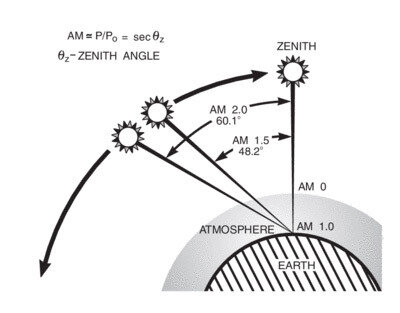
- Airmass: Amount of air in the line-of-sight (normalized to zenith).
- Seeing: Blurring caused by atmosphere, quantified by FWHM of a star image (in arcsec)
- Often normalized to a nominal atmosphere on the considered observation site
Atmosphere
Ecole Rodolphe Cledassou 2024 - galaxy clustering: observation
Atmosphere absorption
Atmosphere
Atmosphere absorption determines the wavelength range of a survey
Ecole Rodolphe Cledassou 2024 - galaxy clustering: observation
Atmosphere absorption
Atmosphere
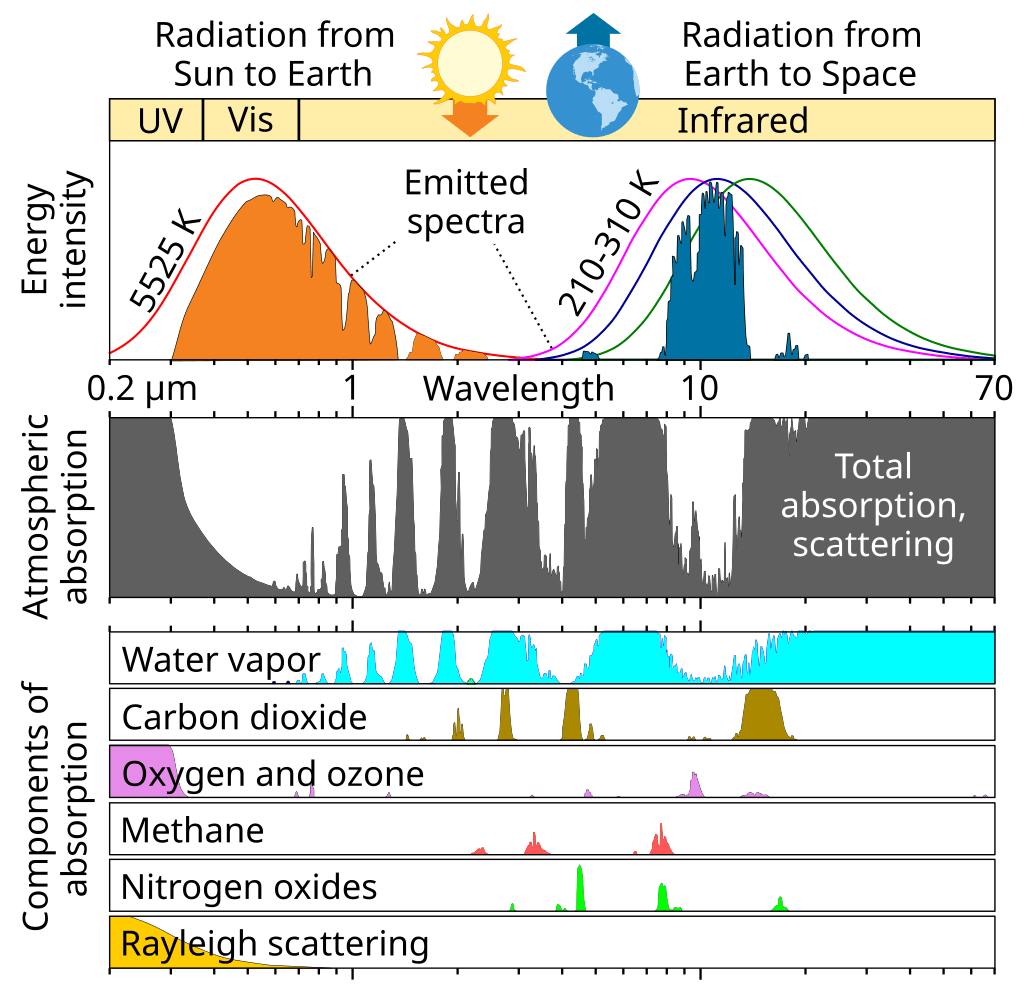
- Absorptions caused by different molecules in the atmosphere
- Rayleigh scattering caused by molecules and aerosols (particulate matter)
- Some absorptions varies during the night (water, aerosols)
Ecole Rodolphe Cledassou 2024 - galaxy clustering: observation
Atmosphere emissions
Atmosphere
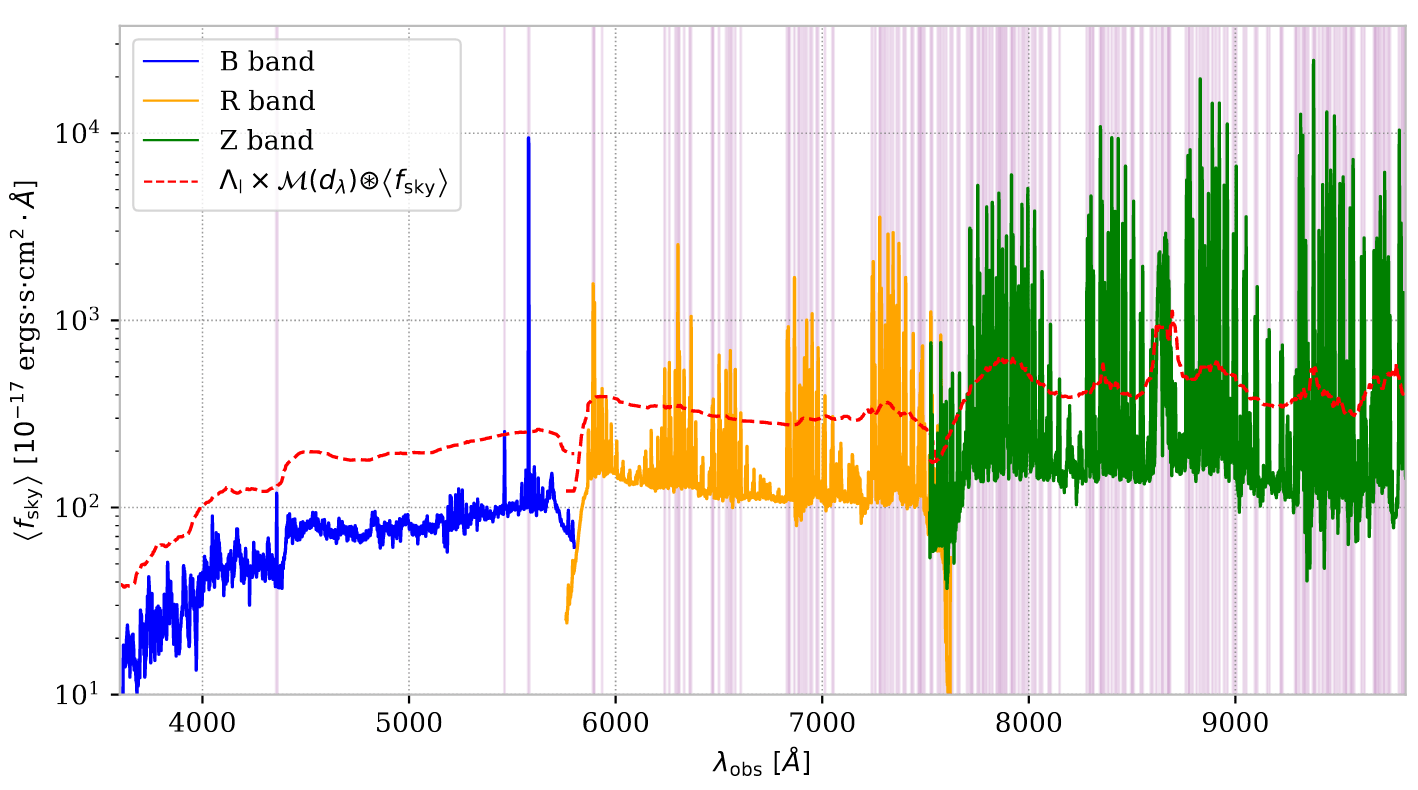
- Airglow: natural upper atmosphere emission
- Light pollution
- Moon light especially in the UV
- Molecular emissions
Sky emission spectrum taken by DESI
Ecole Rodolphe Cledassou 2024 - galaxy clustering: observation
Atmosphere continuum
Atmosphere
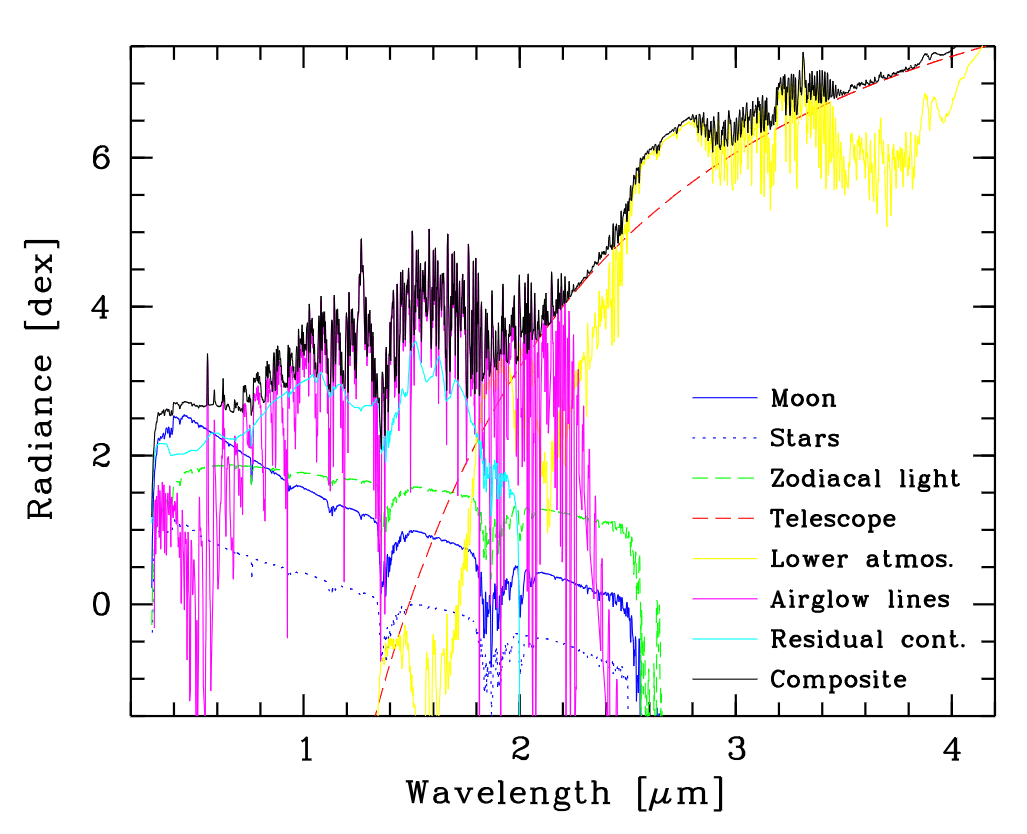
- In the optical and NIR, emission dominated by airglow (OH in particular)
- Thermal radiation from atmosphere and telescope dominates above 2.2 μm
Noll et al. 2012
Sky model in Cerro Paranal
Ecole Rodolphe Cledassou 2024 - galaxy clustering: observation
Atmosphere sky lines
Atmosphere
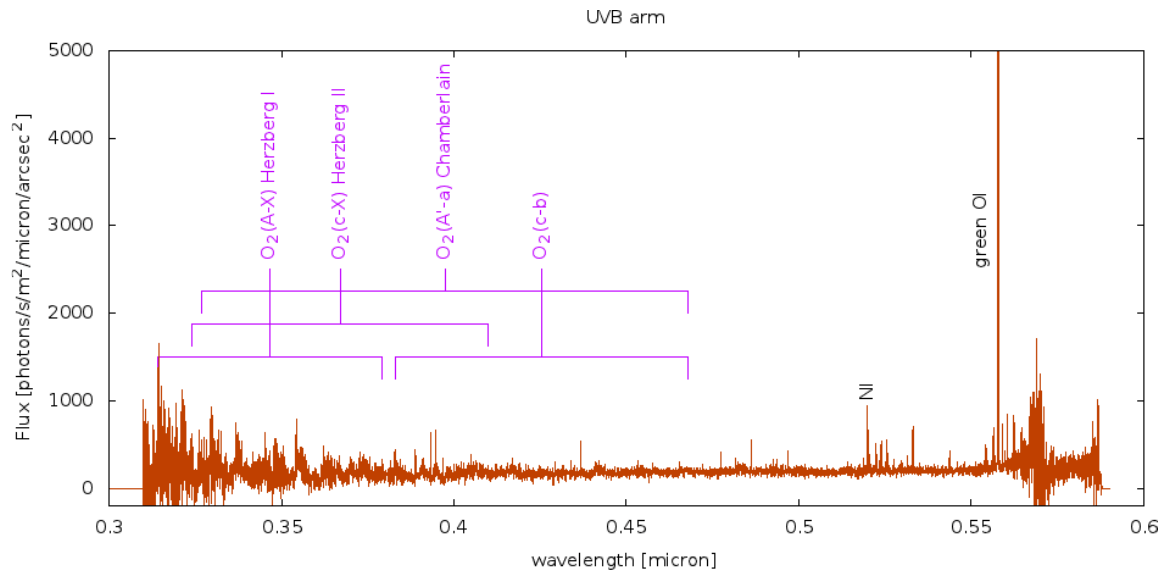
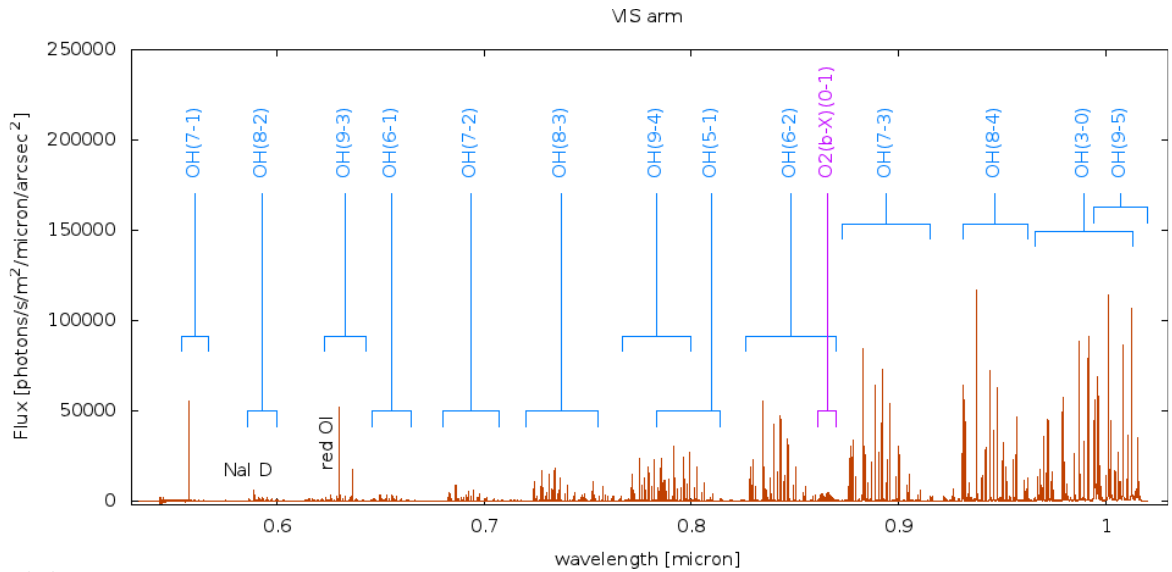
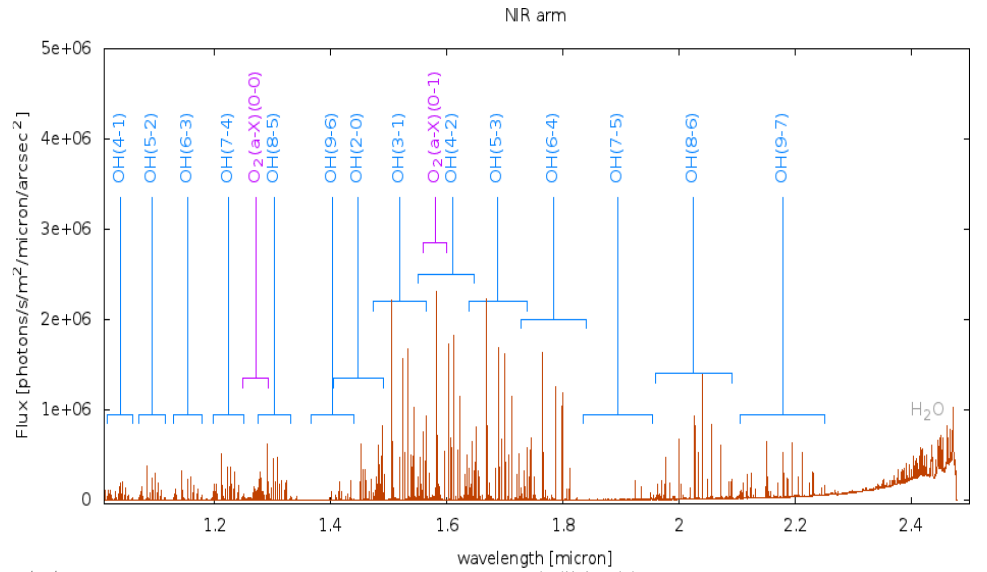
Sky emission highly dominated by OH hydroxyl radicals (continuum + lines)
Ecole Rodolphe Cledassou 2024 - galaxy clustering: observation
Example: characterizing atmosphere
Atmosphere
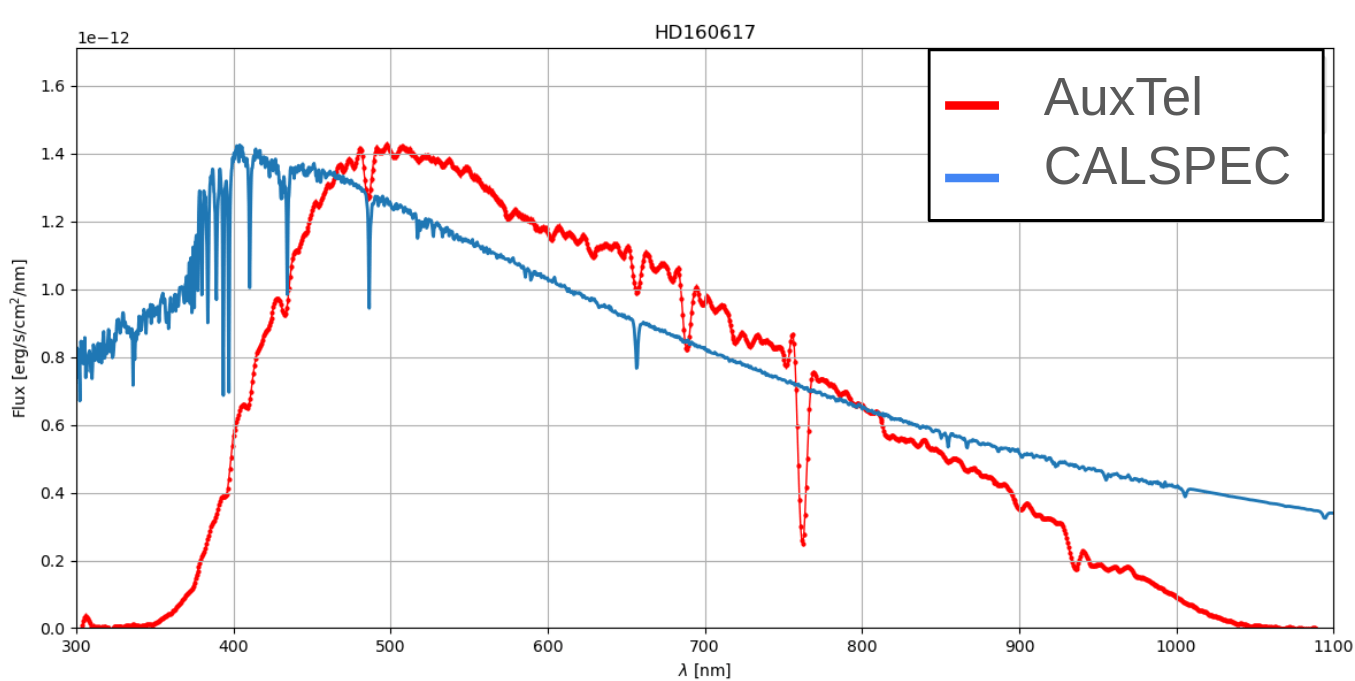
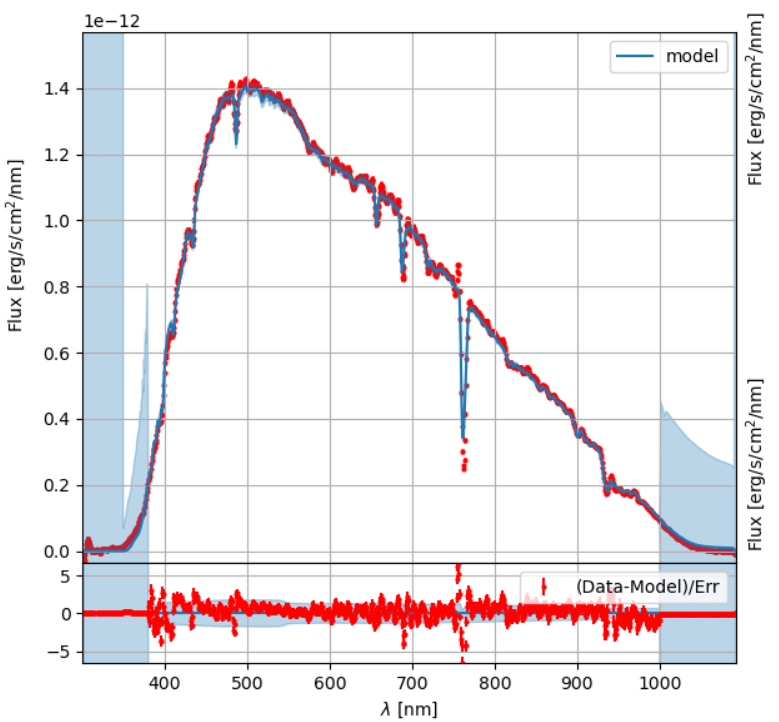
- Auxiliary telescope near LSST measuring star spectra
- Atmospheric properties obtained by forward modeling the atmosphere taking into account telescope transmission and out-of-spectra atmosphere
- Goal: Live correction of measured brightness
Ecole Rodolphe Cledassou 2024 - galaxy clustering: observation
Life of a photon
Telescope
Ecole Rodolphe Cledassou 2024 - galaxy clustering: observation
Instrument: optics
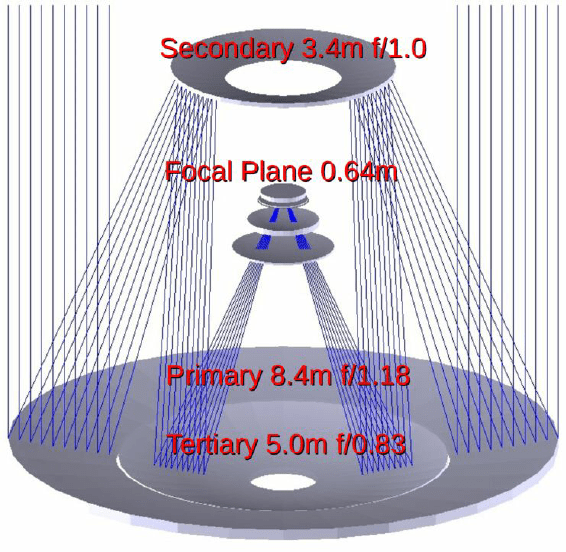
- Telescope design (refracting, reflecting, both)
- Lenses for focal plane focalisation and optical corrections
-
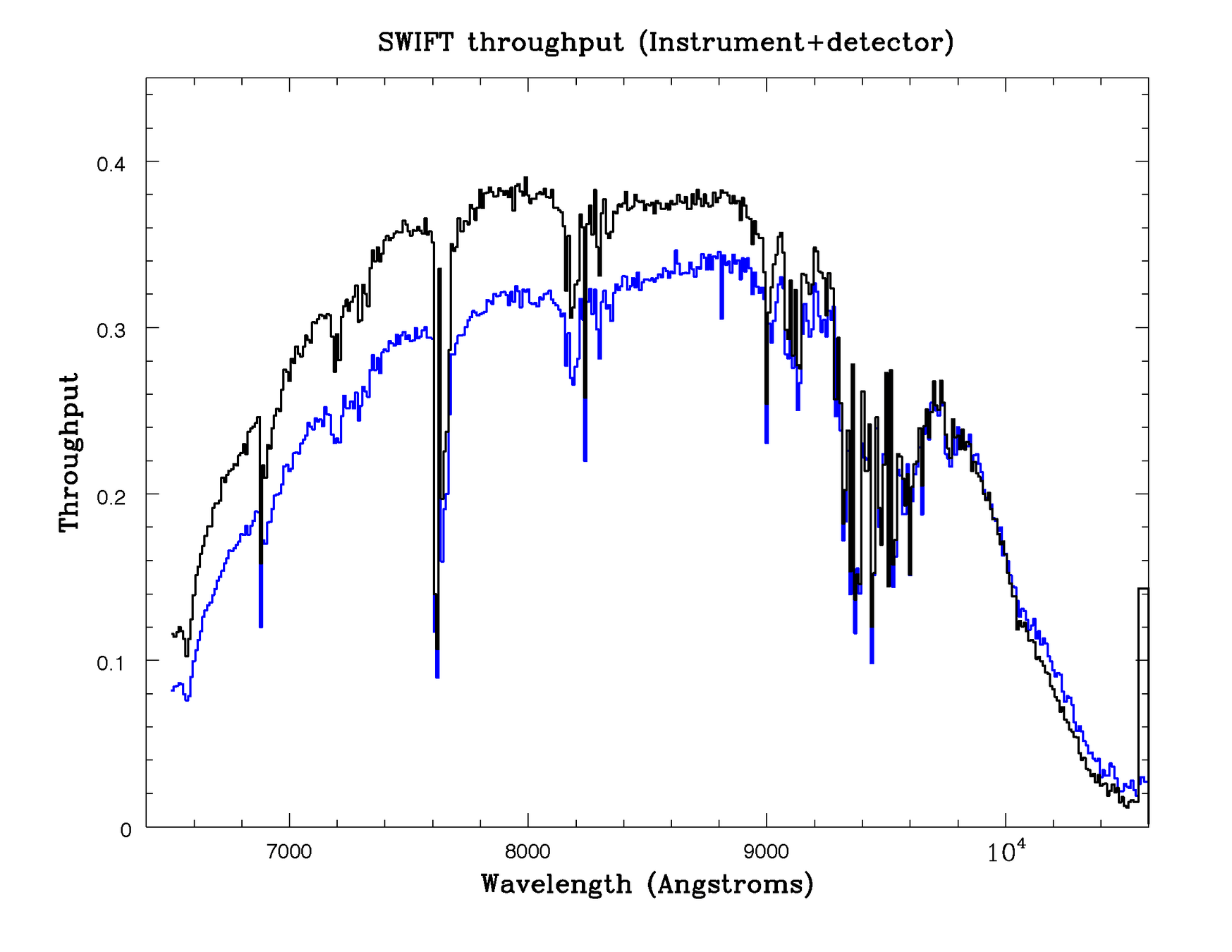
Telescope responses (sometimes including atmosphere):
- Throughput: Total transmission of the telescope as a function of wavelength
- PSF (Point Spread Function): image of a point-like source (with or without seeing)
Telescope
Jee et al. 2011
Ecole Rodolphe Cledassou 2024 - galaxy clustering: observation
Detection: CCD
Telescope
See "Concept instrumental des photomètres visibles" Y1 P. Astier
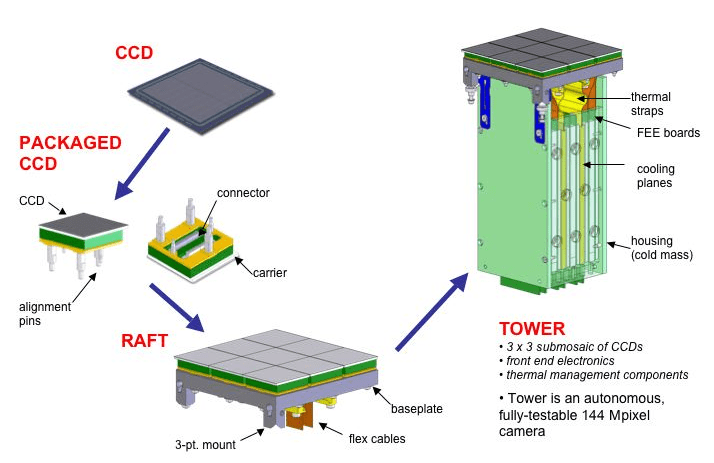
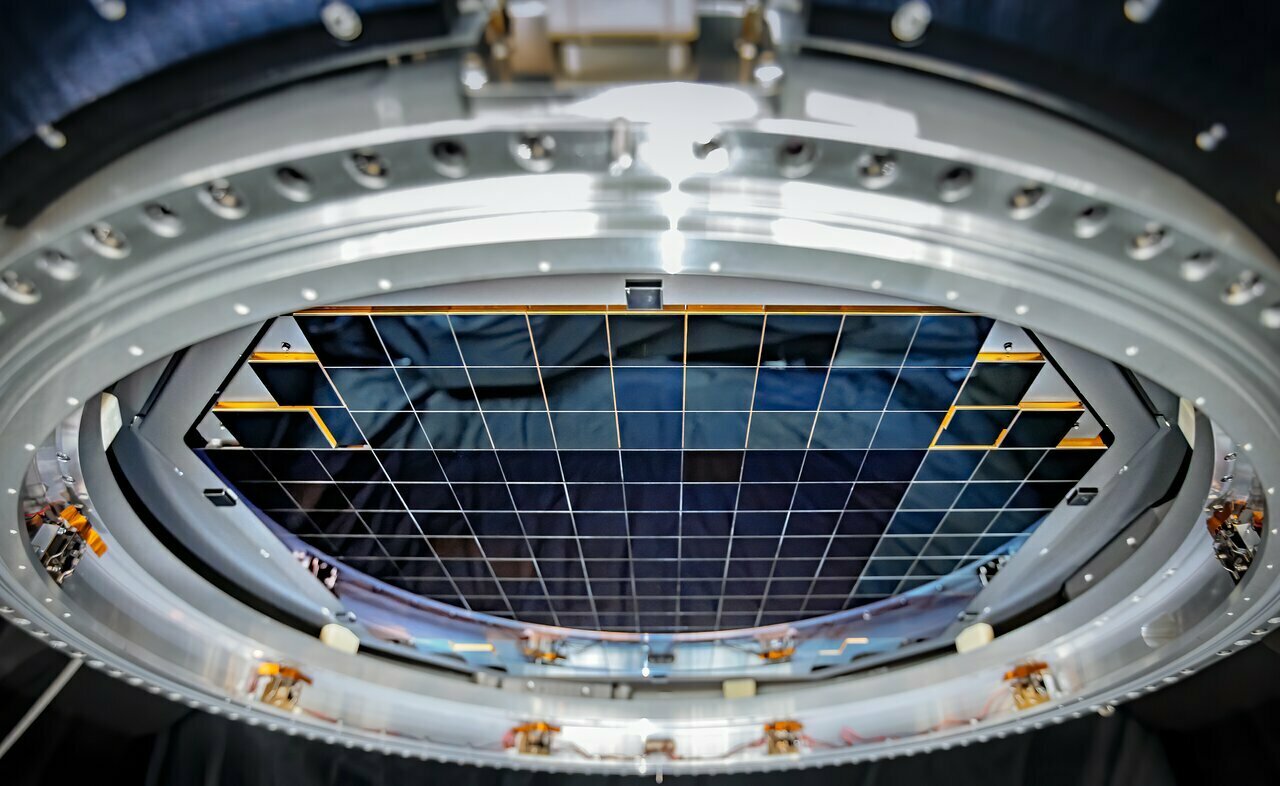
LSST focal plane
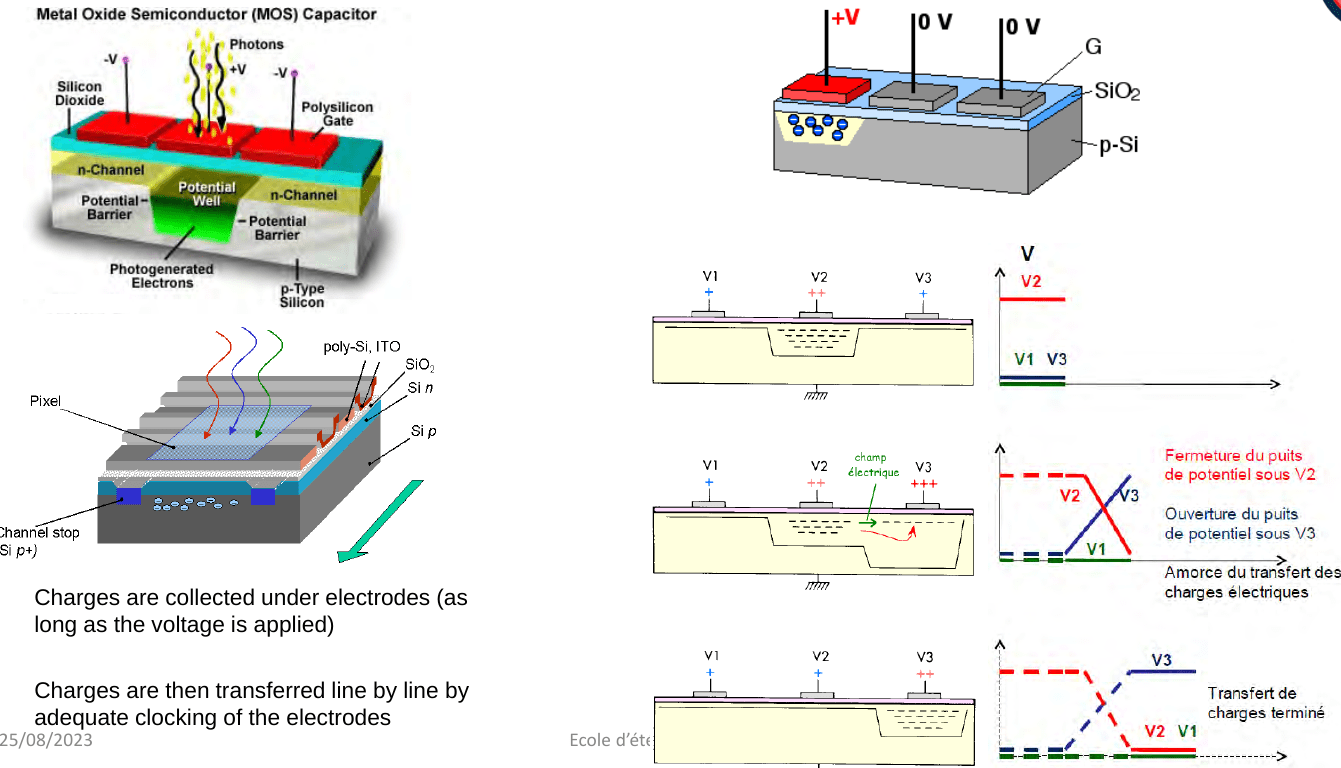
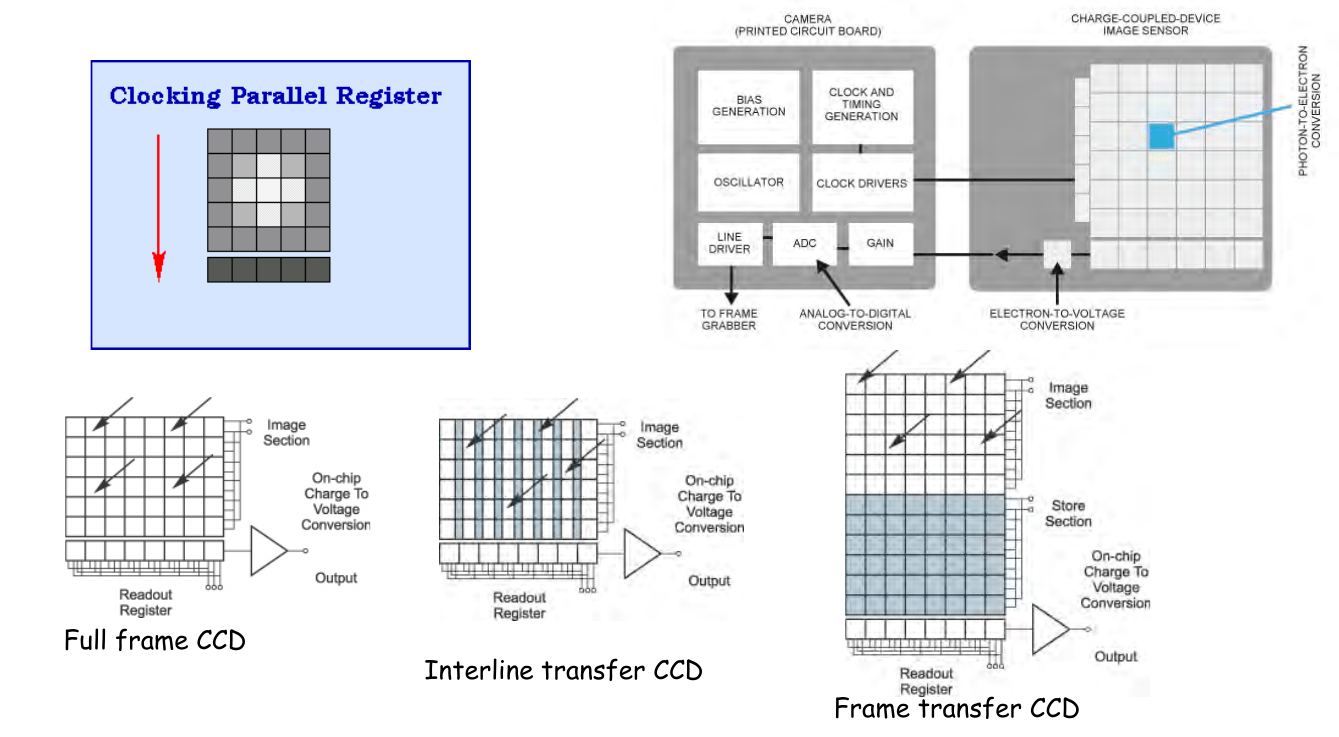
- CCD = Charged-Coupled Device
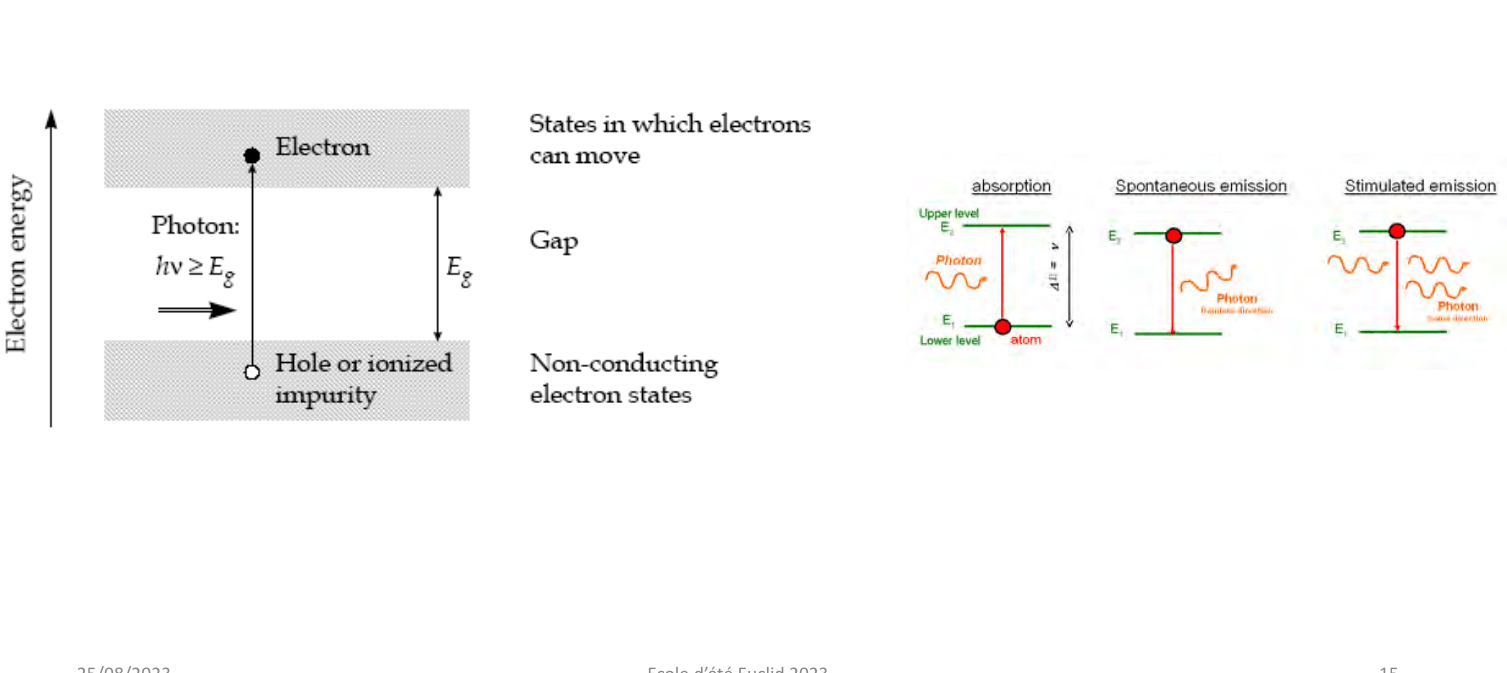
- Convert photons into e⁻ through photoelectric effect
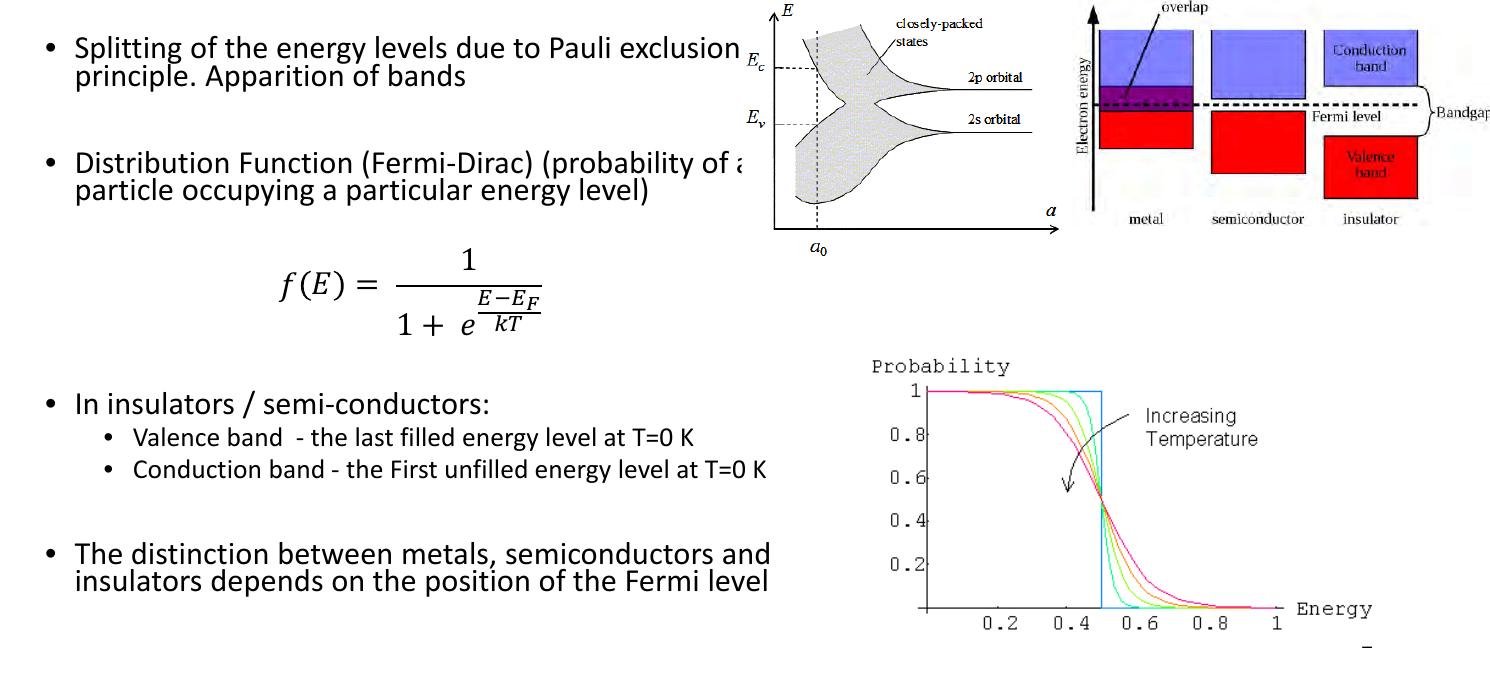
- Collect them with a p-n semiconductor junction (p=holes, n=excess)
- Transfer them line by line with adequate clocking
- Focal plane = several CCD mounted
- Different readout and communication systems
Ecole Rodolphe Cledassou 2024 - galaxy clustering: observation
Detection: quantum efficiency
Telescope
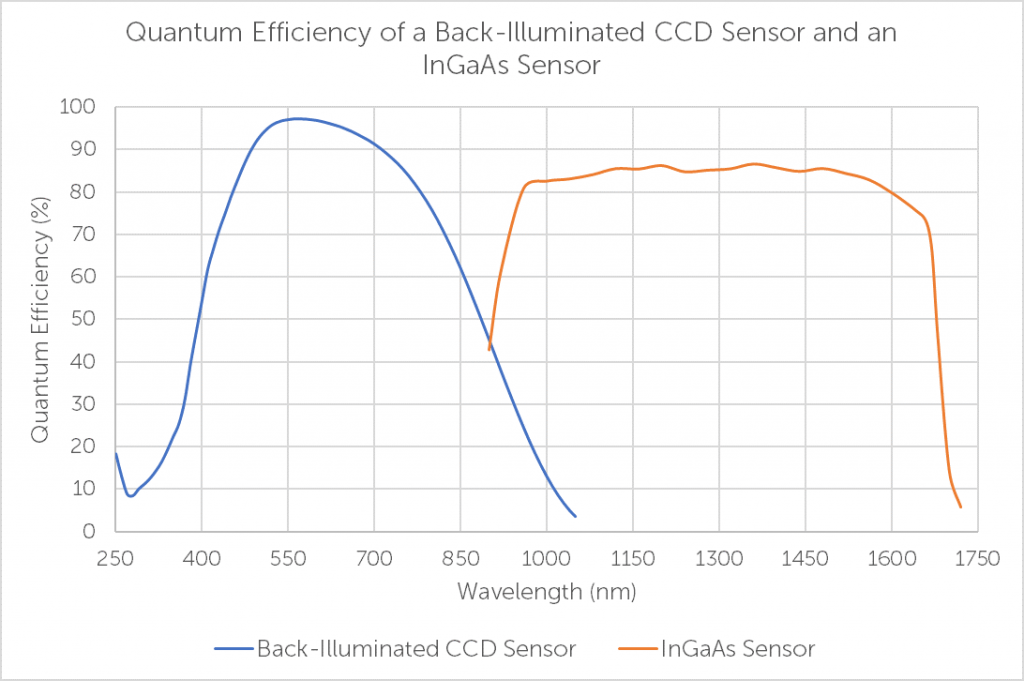
- Quantum efficiency = number of electrons / number of incoming photons (Sensor response)
-
Factors influencing QE:
- Reflection coefficient (anti-reflection coatings)
- Absorption coefficients
- Thickness
- Width of the depletion layer (layer for charge transfer)
- Structure of the electrodes
- Temperature...
Ecole Rodolphe Cledassou 2024 - galaxy clustering: observation
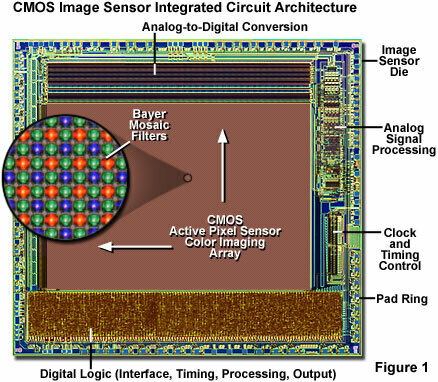
Detection: CMOS
Telescope
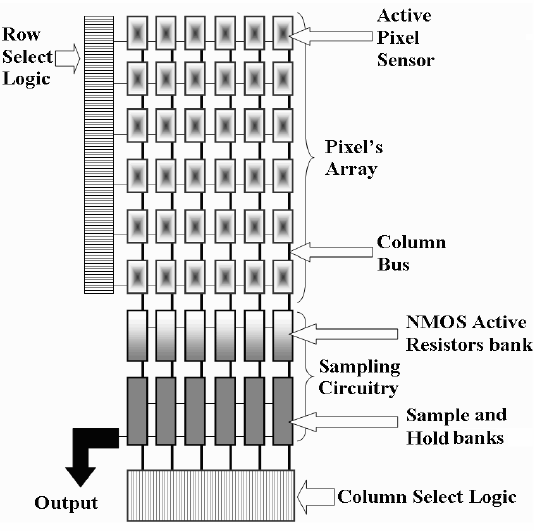
- CMOS = Complementary Metal-Oxide-Semiconductor
- Each pixel (photodiode) operate independently and convert into voltage
-
CMOS vs. CCD:
- Lower quantum efficiency
- Higher readout noise
- Higher readout speed
- No blooming (spilling of saturated pixel)
- Integration of processing functions
- Lower electrical consumption
- Lower price
- Increasing interest in astronomy applications due to integration and readout
Ecole Rodolphe Cledassou 2024 - galaxy clustering: observation
Detection: infrared detectors
Telescope
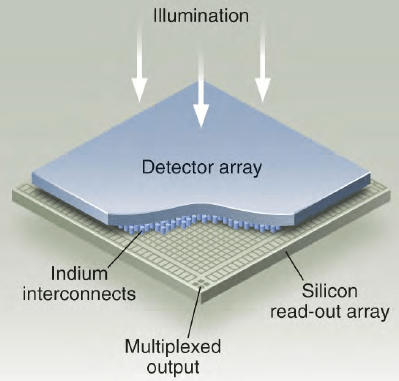
- Thermal detectors (bolometers): detection of resistance change induced by temperature
-
Photoelectric detectors: material absorbs infrared radiation and convert them to e⁻, generally connected to a CMOS Readout Integrated Circuit (ROIC)
- Material dependent on wavelength range (HgCdTe [1-14 µm] InSb [3–5 µm] ...)
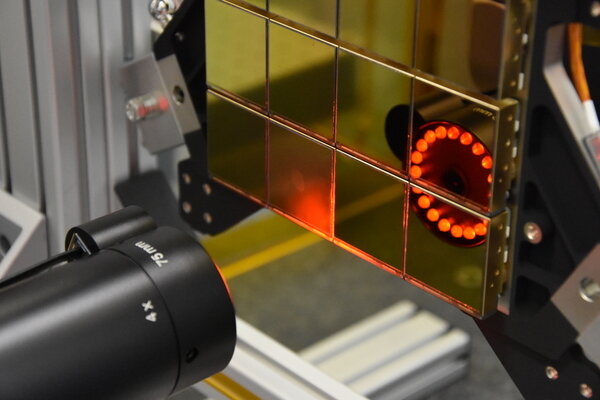
- Example: HgCdTe infrared detectors in Euclid NISP
Ecole Rodolphe Cledassou 2024 - galaxy clustering: observation
ACCEL² simulation
- Galaxy surveys contains a wide variety of complex objects
- From the source to the observer, a lot of effects (astrophysical, instrumental) can impact clustering measurement
Annexes
Annexes
Annexes
Annexes
Annexes
Annexes
Annexes
Le clustering des galaxies: observation 2/4
Ecole Rodolphe Cledassou 2024
Corentin Ravoux
LPCA, CNRS/IN2P3, Clermont-Ferrand
ACCEL² simulation
Summary
Source
Cosmic web
Telescope
Atmosphere
Milky Way
- Galaxies
- Stars
- Quasars
Ecole Rodolphe Cledassou 2024 - galaxy clustering: observation
1. Properties of observed objects
2. Light path from source to detector
3. Galaxy survey properties
4. An overview of galaxy surveys
Outline
3. Galaxy survey properties
Ecole Rodolphe Cledassou 2024 - galaxy clustering: observation
Surveys
- Generally, surveys tends to be either:
- Static or dynamic (transient)
- Wide & Faint or Small & deep
- Photometric or spectrometric
- Very recent surveys achieve several functions at once
- A survey covers a fixed wavelength range (from gamma to radio)
- In galaxy surveys for this course: optical/NIR, wide, static surveys

Ecole Rodolphe Cledassou 2024 - galaxy clustering: observation
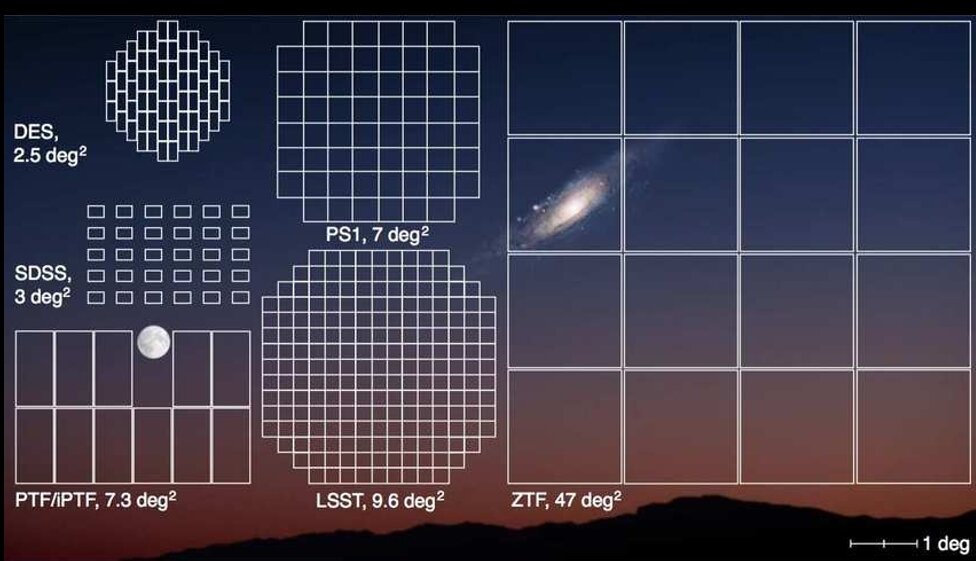
Properties: field of view
- Field of view (Ω): area of the sky visible through the telescope camera
- Depends on telescop optics (design, focal length, lenses, correctors) and camera size
- Collecting area surface (A): larger mirror = higher photon flux
- Etendue (E=AΩ): characterize the quantity of accessible information on the sky
Ecole Rodolphe Cledassou 2024 - galaxy clustering: observation
Properties: volume of the survey
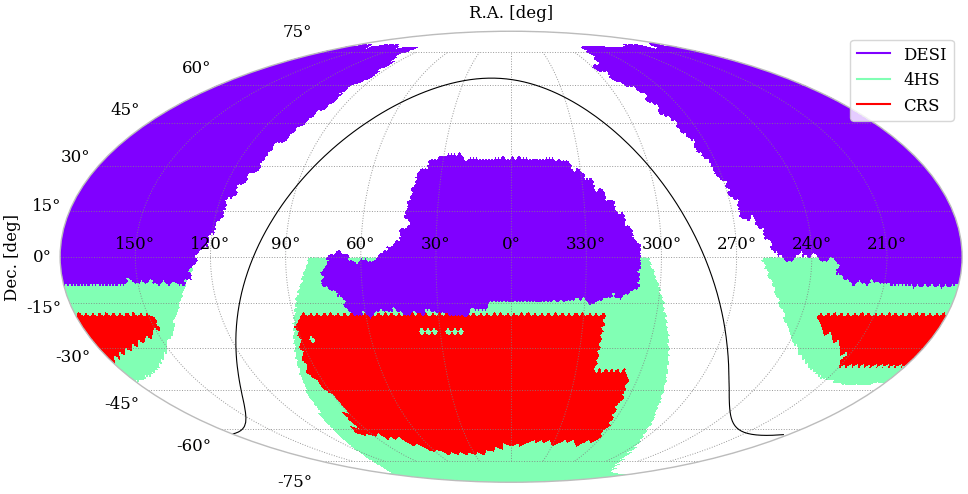
- Footprint: observed size on the sky at the end of the survey
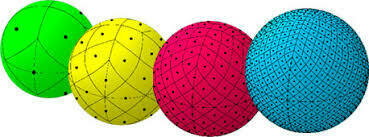
- Expressed in healpix format (hierarchical equal area isolatitude pixelation)
- Density: Number of object observed per square degree
- Redshift range dz
- Volume ∝ Footprint × dz
- Python package: healpy
Ecole Rodolphe Cledassou 2024 - galaxy clustering: observation
Properties: depth
- Magnitude: logarithmic scale for object fluxes for one given filter
- Apparent magnitude (m): magnitude on the detector (including extinction)
- Absolute magnitude (M): magnitude at 10 parsec
-
Zero point calibration:
- Vega system: Vega star magnitude null for all wavelength
- AB system: Reference to a constant flux object (3631 janskys)
= filter response/window
- Survey depth: magnitude (redshift) of the faintest (farther) object observed
- Signal-to-noise ratio (SNR): characterize the quality of one observation
Ecole Rodolphe Cledassou 2024 - galaxy clustering: observation
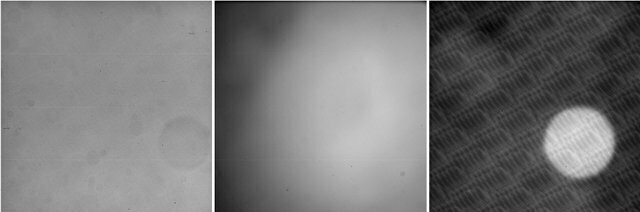
Calibration images
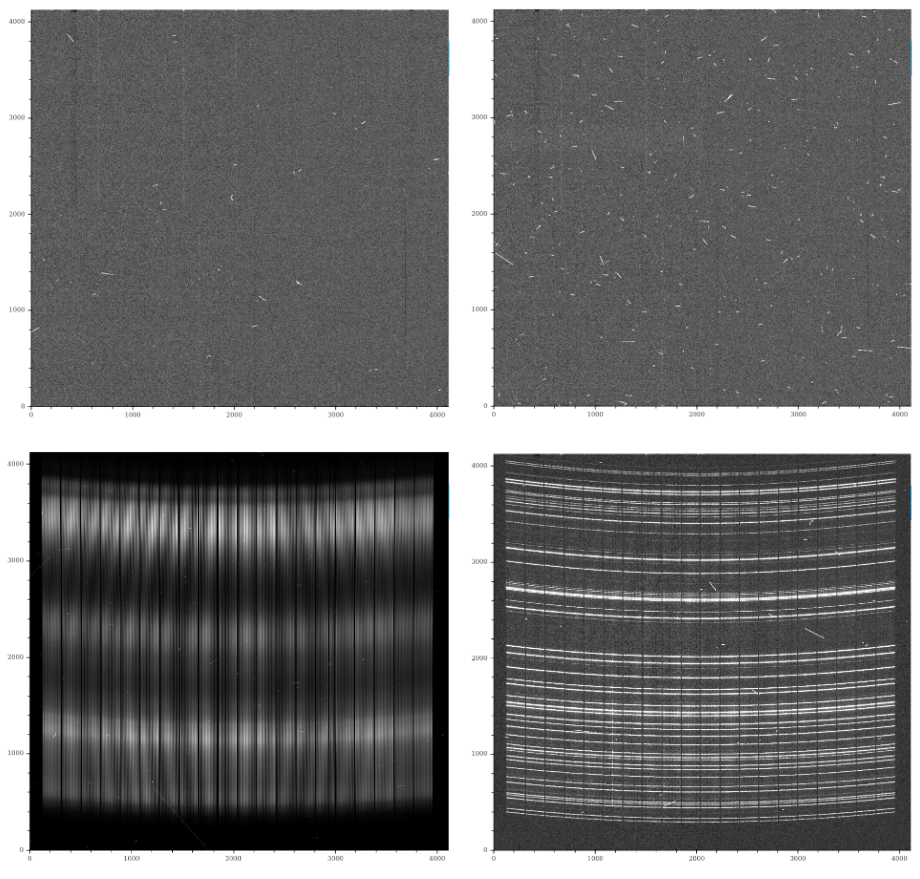
Zero/Bias
Dark
Flat
Arc
- All surveys need calibration images
-
Zero/Bias: minimum response time image
- Measure the CCD intrinsic readout noise
-
Dark: Image with the same exposure time as science image without any light
- Use to characterize noise sources
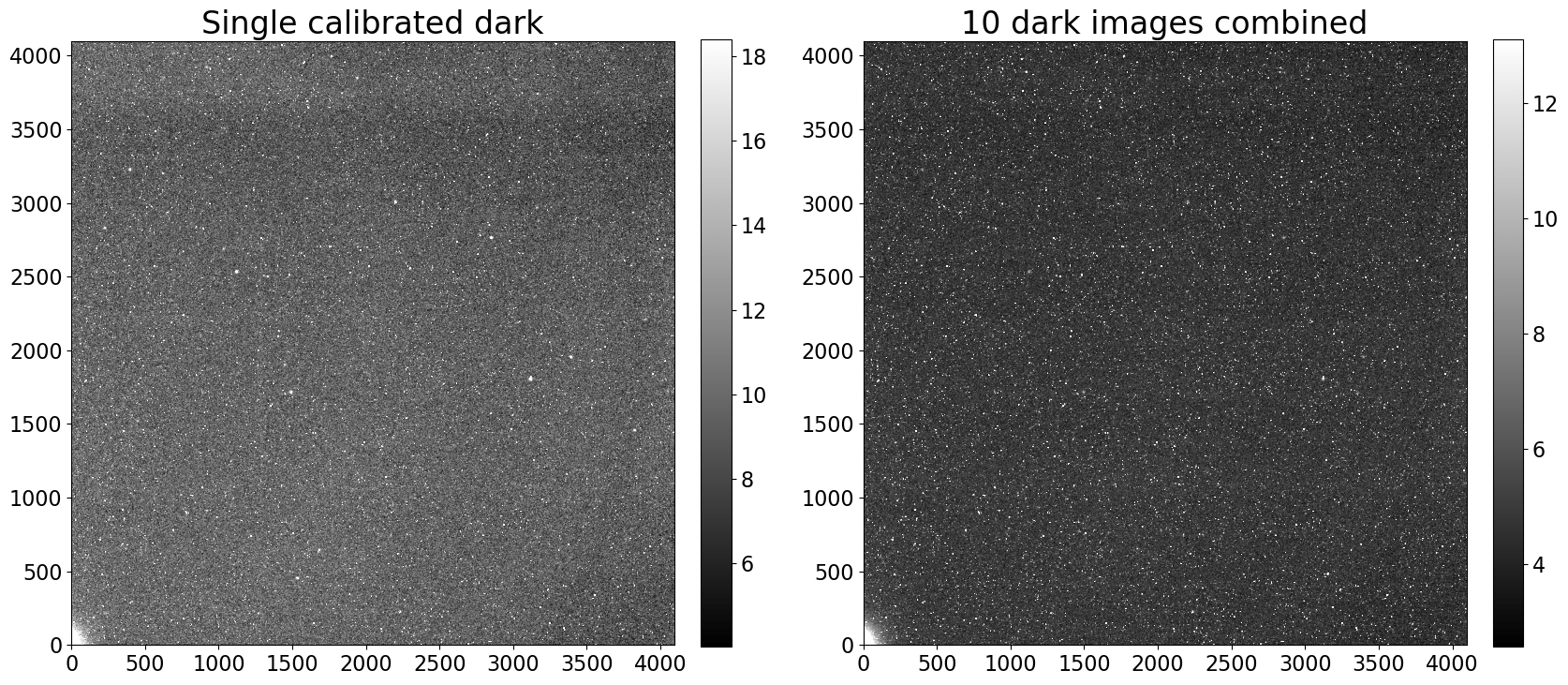
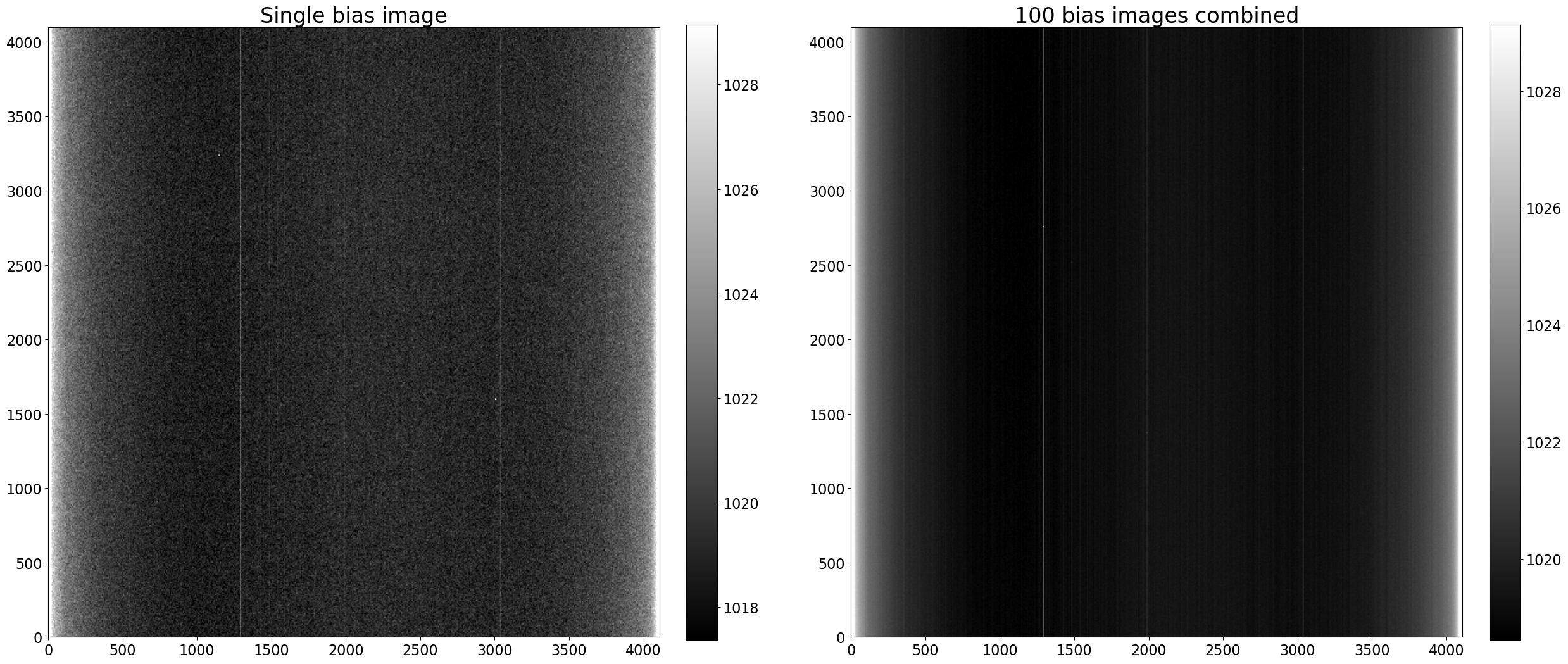
Ecole Rodolphe Cledassou 2024 - galaxy clustering: observation
Calibration images
-
Flat: Focal plane illuminated with a known smooth spectrum lamp
- Use to correct relative CCD responses under illumination
-
Arc: Image produced by known monochromatic lamps
- Use for wavelength calibration (only for spectra)
- Master: A stack/coadd of several calibration image
Zero/Bias
Dark
Flat
Arc
Ecole Rodolphe Cledassou 2024 - galaxy clustering: observation
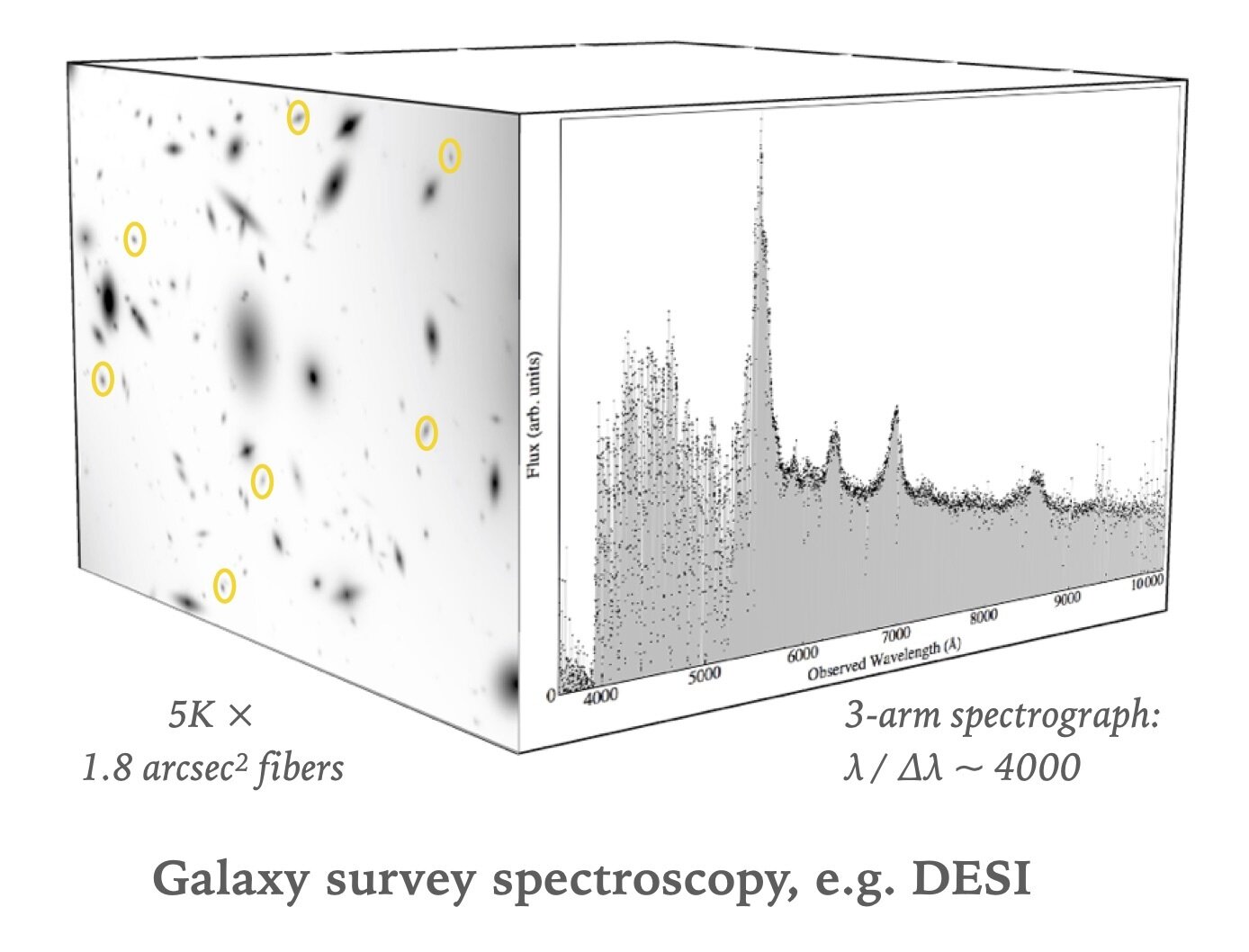
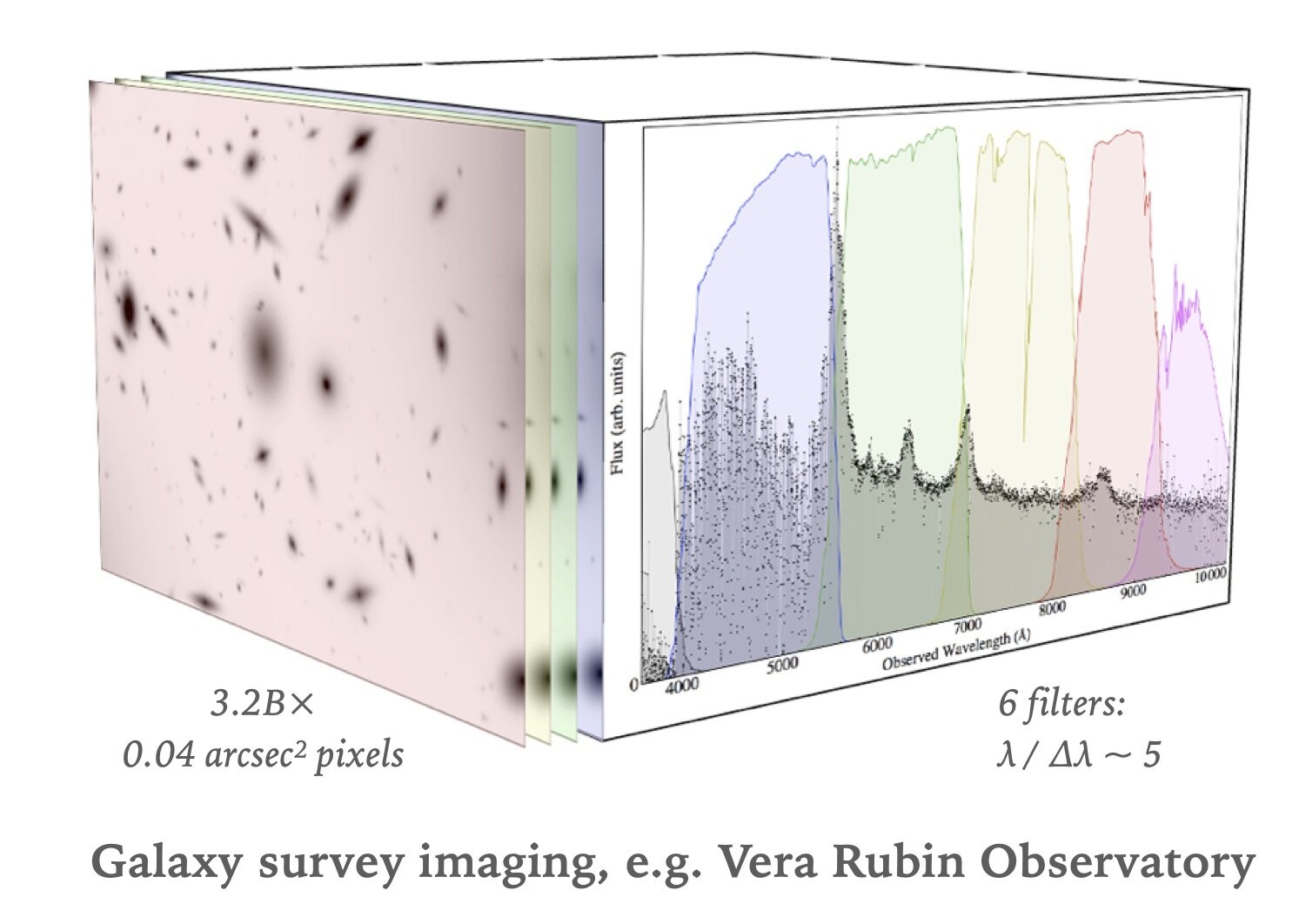
Photometric vs Spectroscopic surveys
Source: DESI communication figures
- Measure the spectra of objects (selected or not)
- Examples: SDSS, 6dFGS, DESI, 4MOST, Euclid NISP (spectro)
- Measure the object flux through a filter
- Examples: DES, ZTF, CFHT, LSST, Euclid VIS, Euclid NISP (photo)
Same detection method (CCD, IR)
Ecole Rodolphe Cledassou 2024 - galaxy clustering: observation
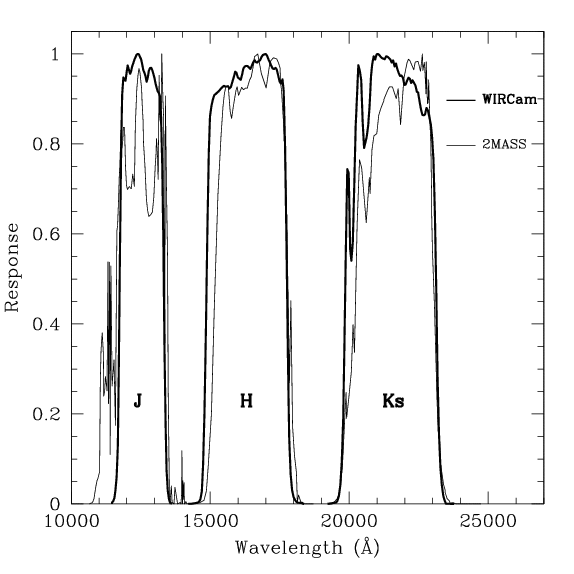
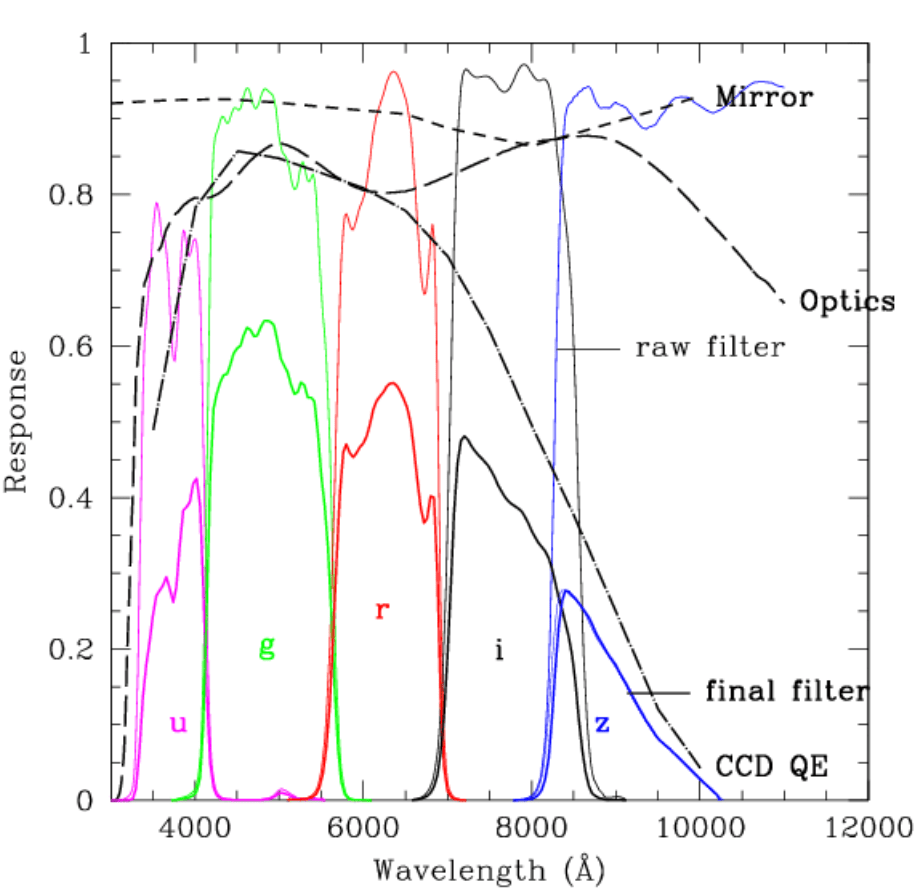
Photometric surveys: filters, filters and filters
- Filter: Precise transmission shape and width vs wavelength
- "Standard" filters: Johnson/Cousins (UBVRI), Bessel, Gunn, IR (JHK...)
- Full/Synthetic filter: Filter x throughput x quantum efficiency x standard atmosphere
- Images taken with different filters (fast changer for recent surveys)
Ecole Rodolphe Cledassou 2024 - galaxy clustering: observation
Photometric surveys: filters, filters and filters
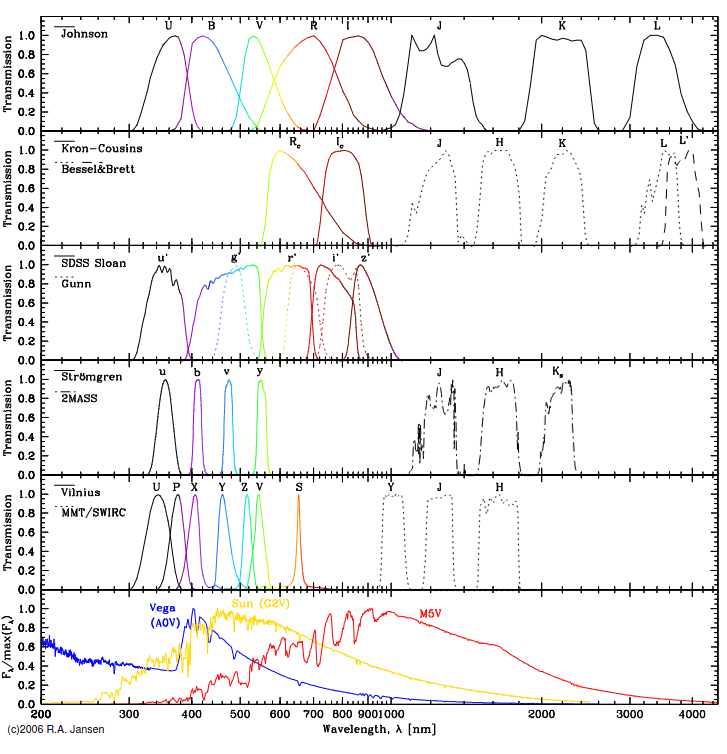
- A lot of different systems of filters are used...
-
Practical website for filter profiles:
- https://astroquery.readthedocs.io/en/latest/svo_fps/svo_fps.html
- https://speclite.readthedocs.io/en/latest/filters.html
Ecole Rodolphe Cledassou 2024 - galaxy clustering: observation
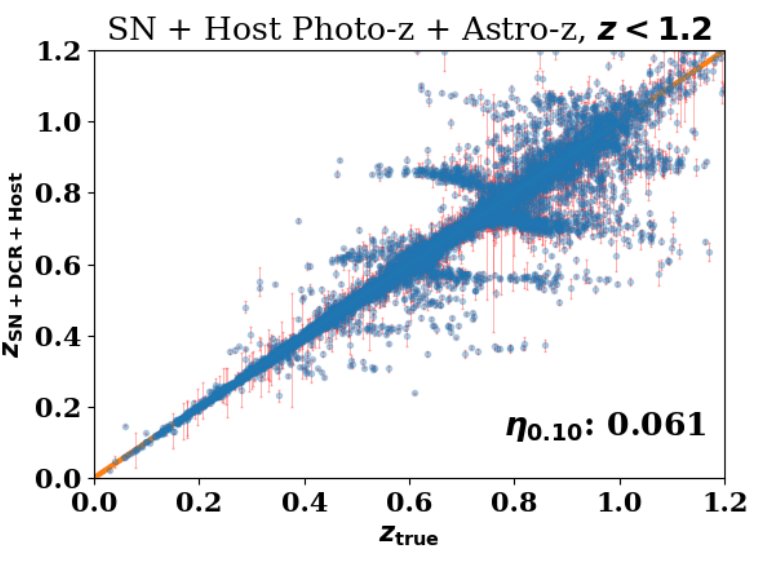
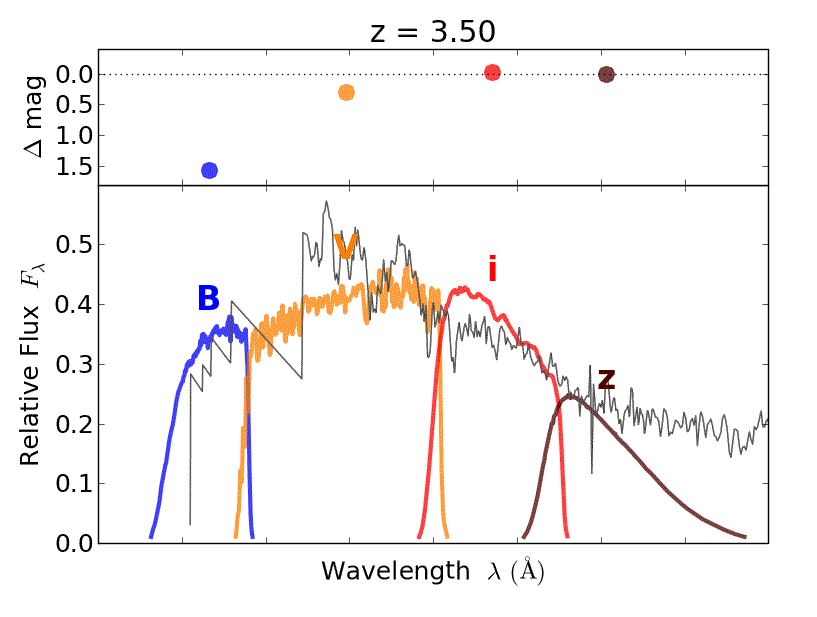
Photometric surveys: photometric redshift
- Only a partial part of the spectra is measured
-
Classification and redshift methods:
- Template fitting
- Machine learning
- Additional environment informations
- Outliers: redshift & object type confusion
- Recent precision:
- Need to be calibrated with spectroscopic redshift
Lee et al. 2024
Ecole Rodolphe Cledassou 2024 - galaxy clustering: observation
Photometric surveys: image calibration
- Photometry: providing a precise estimate of object magnitudes/brightness
- After the CCD, e⁻ are converted into digital counts, or Analog-Digital Units (ADUs) by ADC (Analog To Digital Convertor)
- Photon transfer curve: ADU variance of uniform exposures vs flux
- Gain: N input ADU / N output ADU
- Measuring stability of gain and saturation is essential !
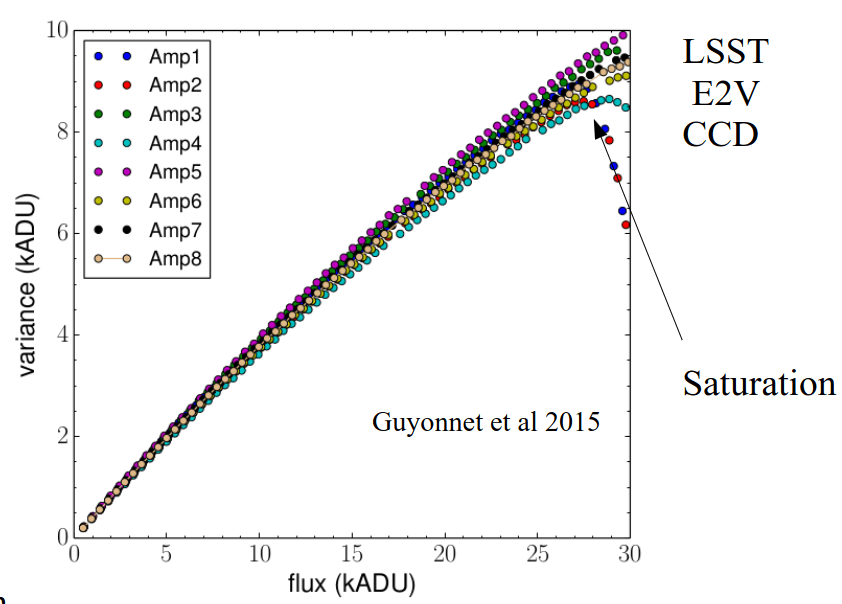
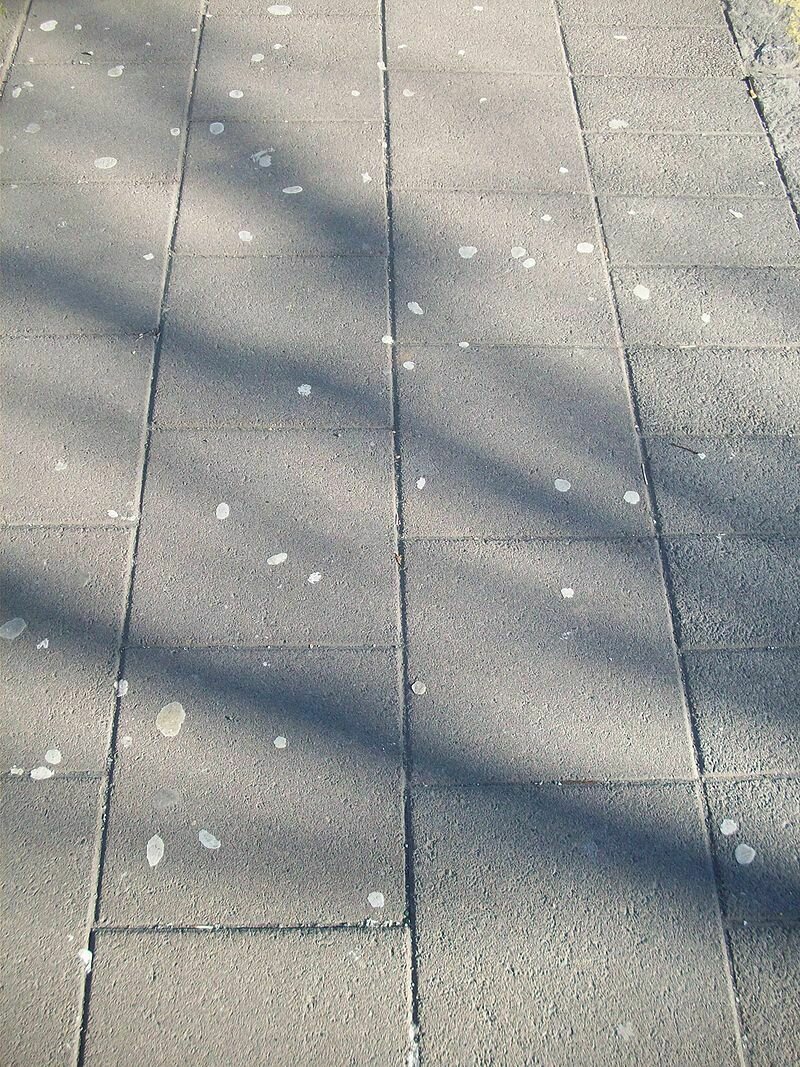
Photons on CCD follows Poisson law
(full well capacity)
Ecole Rodolphe Cledassou 2024 - galaxy clustering: observation
Spectroscopy
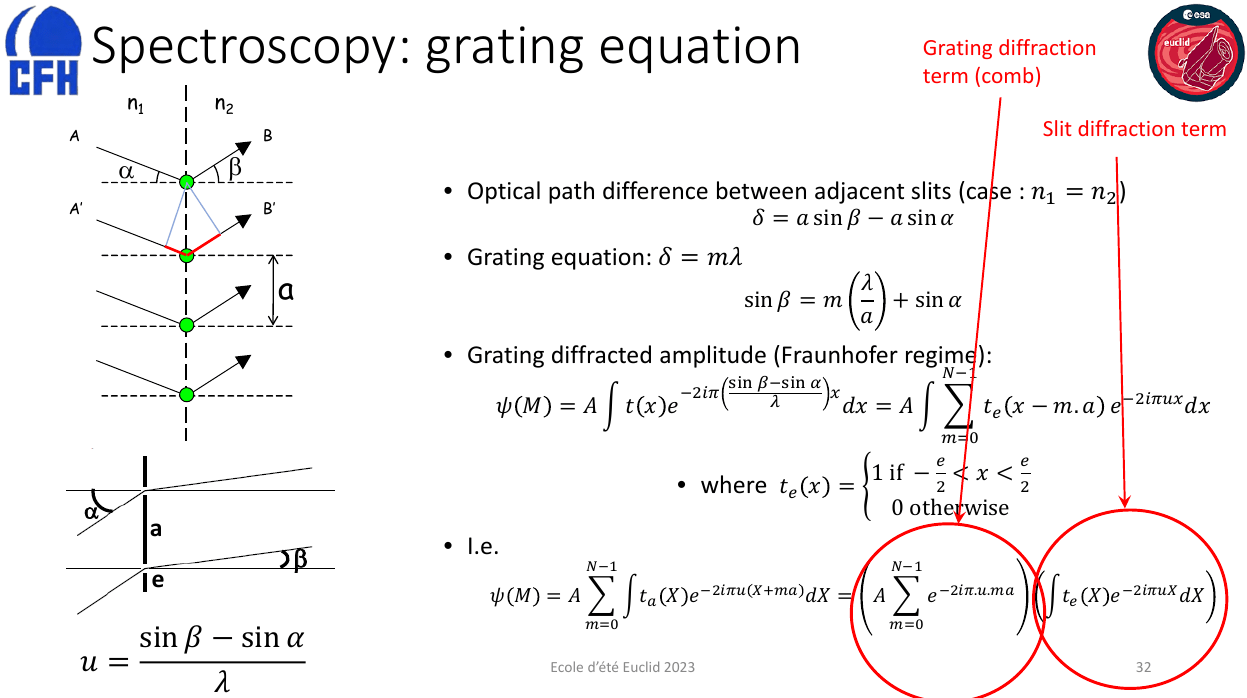
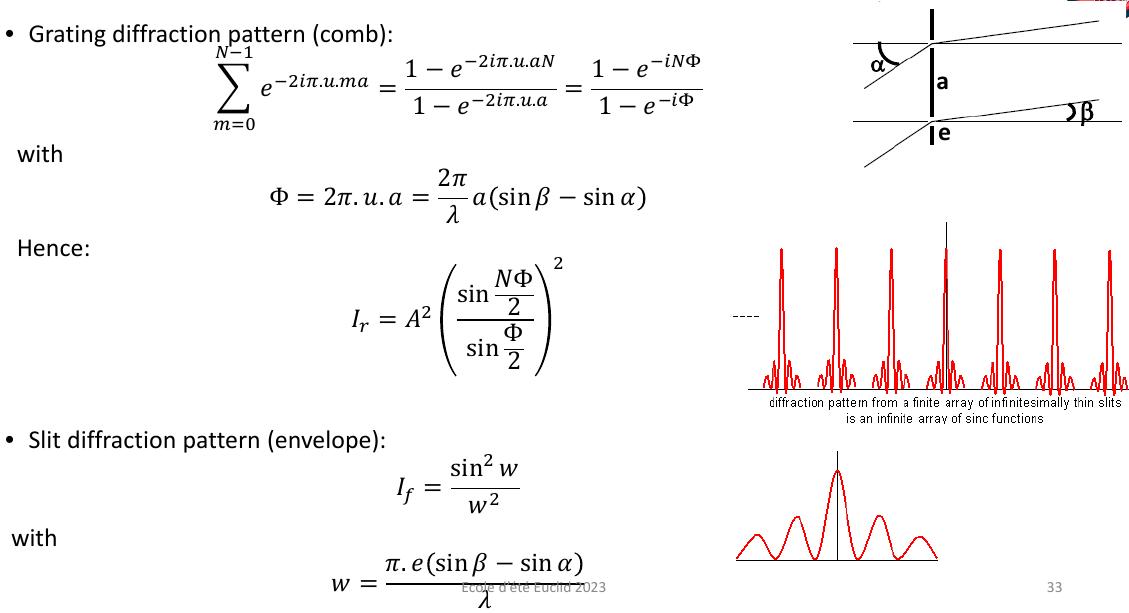
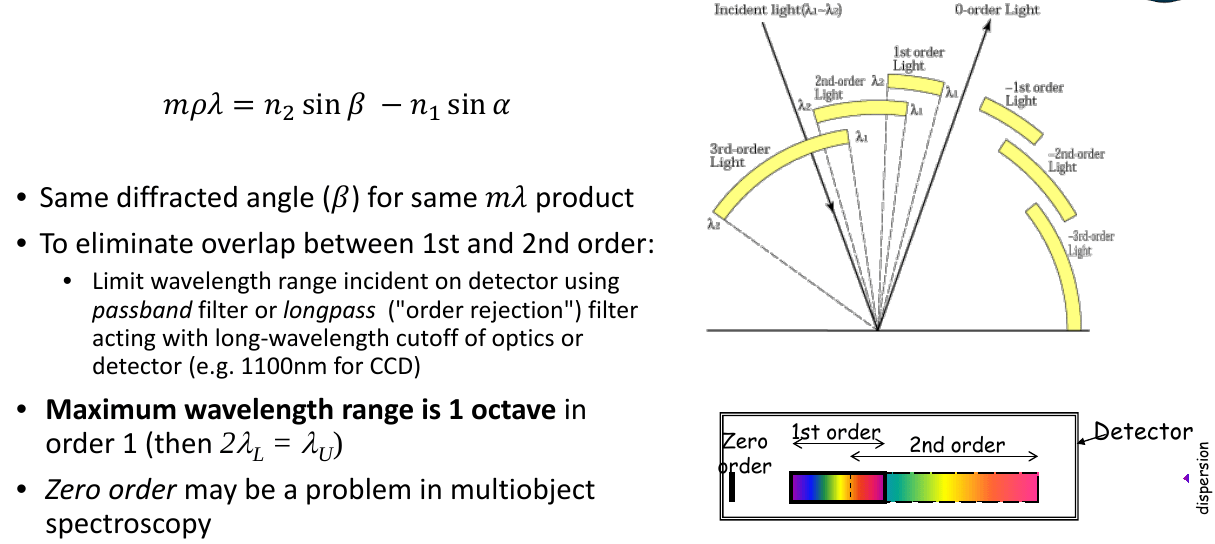
- Diffraction grating: periodic structure
- Interference condition: path difference between AB and A'B‘ is equal to an integer multiple of λ
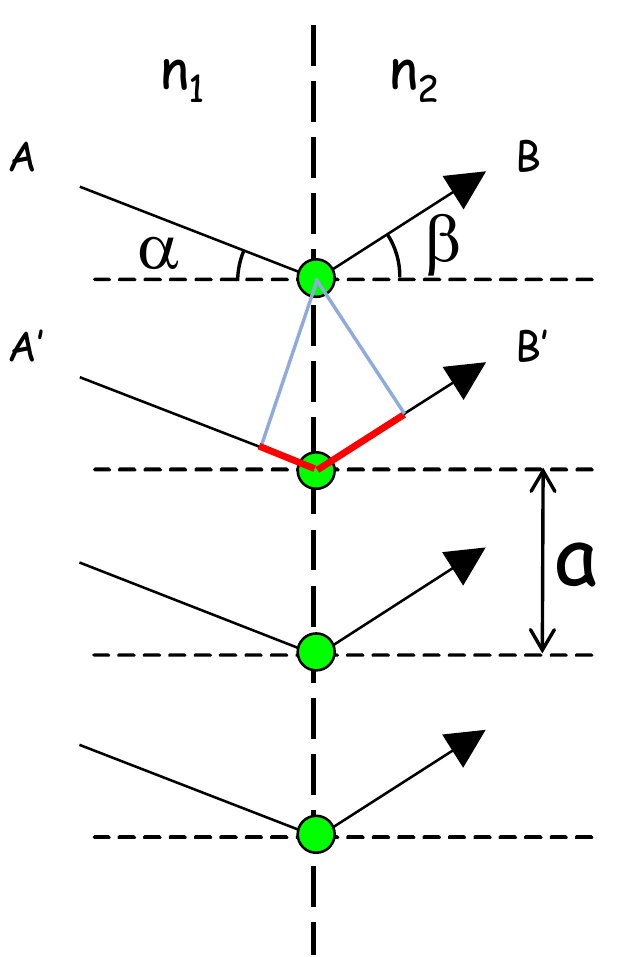
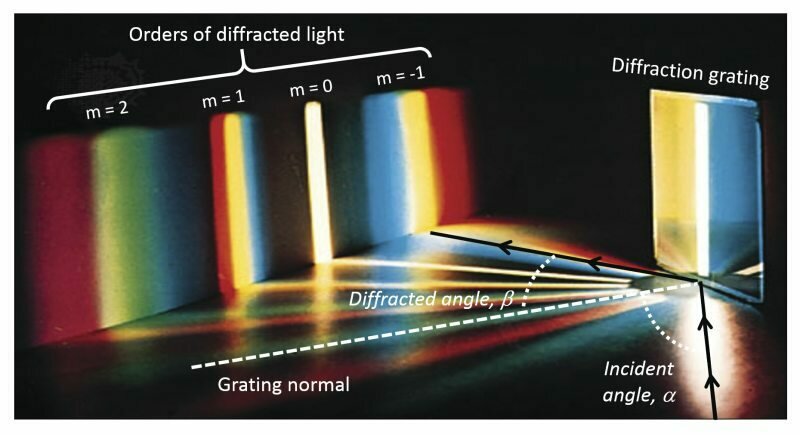
- Wavelength dependent dispersion
- Zeroth order corresponds to the specular reflection off the grating
= distance between adjacent grooves
Ecole Rodolphe Cledassou 2024 - galaxy clustering: observation
Spectroscopy
- Pattern of the gratting have an impact on the diffraction scheme
- Adjusting the slit profile can maximize efficiency in one order and minimize / cancel it in the other orders
- Littrow configuration:
- Achieve maximum grating efficiency in a given diffraction order m
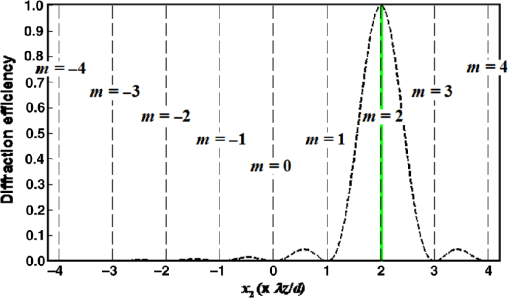
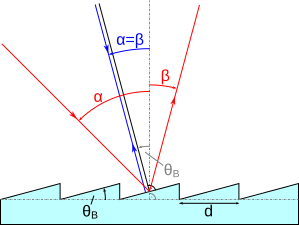
Blazed gratting
a
Ecole Rodolphe Cledassou 2024 - galaxy clustering: observation
Spectroscopy: dispersion
- Grism: Transmission grating attached to a prism
- Simple to engineer
- Quasi-Littrow configuration - no variable distortion
- Inefficient for number grooves > 600/mm due to groove shadowing and other effects
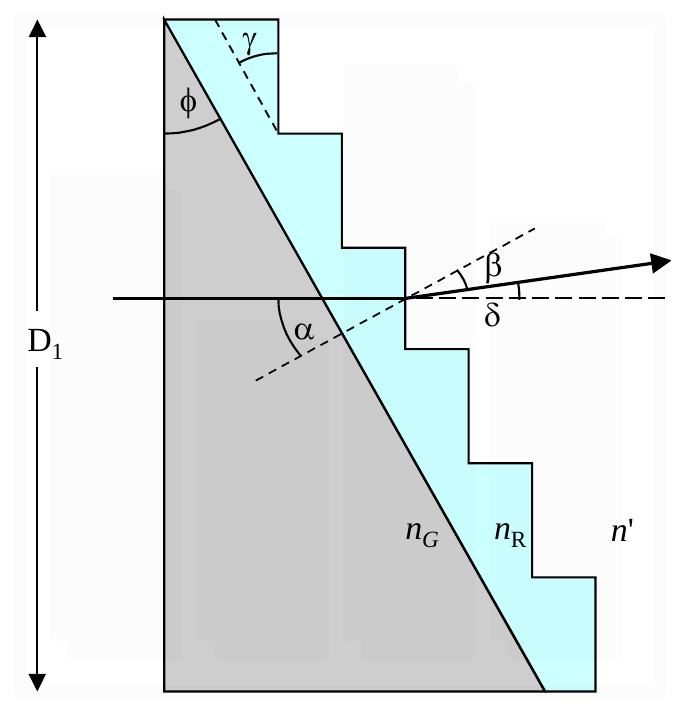
Ecole Rodolphe Cledassou 2024 - galaxy clustering: observation
Spectroscopy: dispersion
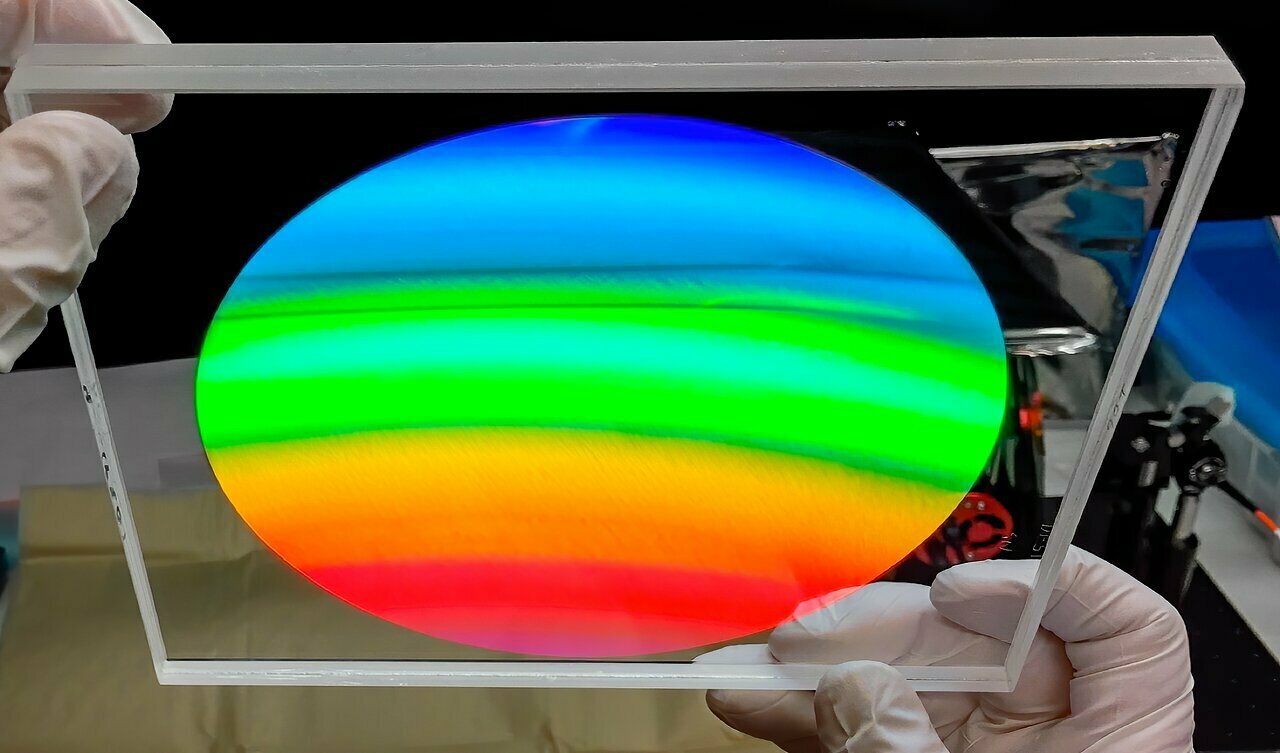
-
They work by a mechanism similar to Bragg diffraction (crystal diffraction)
- Periodic refractive index modulations in a volume of gelatin
- Interference pattern created by two coherent laser beams inside a photosensitive medium
- Transmission gratings with very low fringe spacings can be made
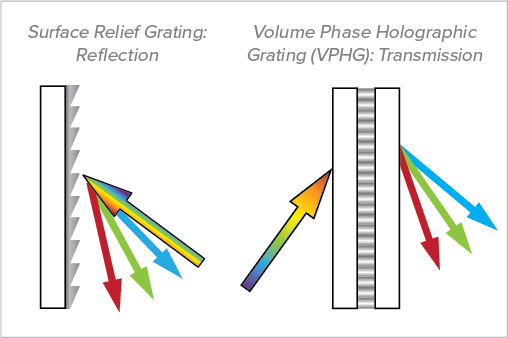
Glass
Glass
Ecole Rodolphe Cledassou 2024 - galaxy clustering: observation
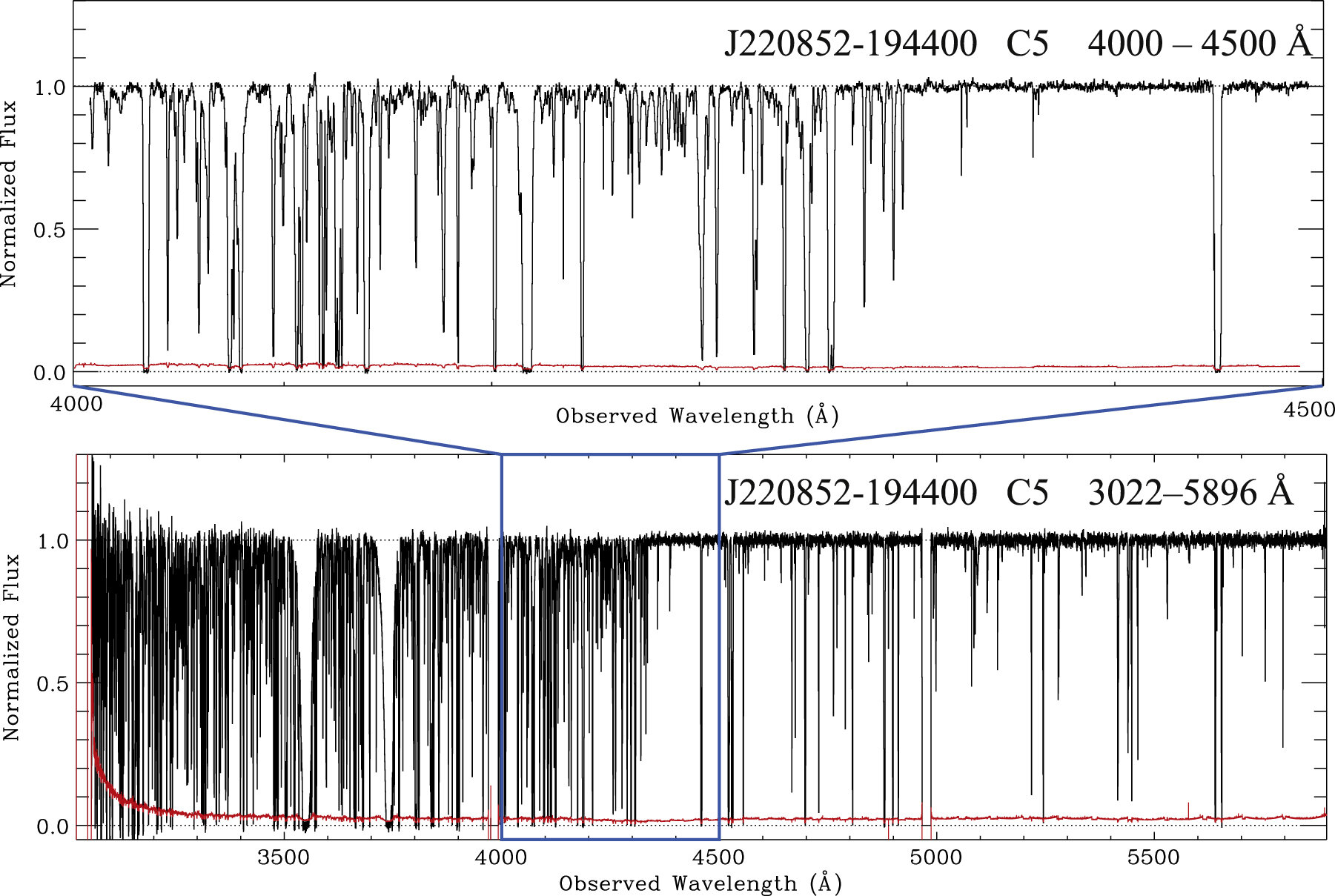
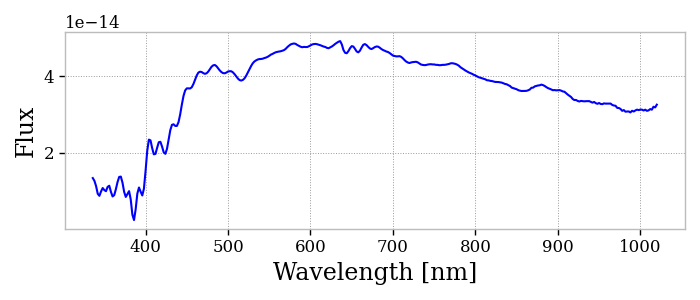
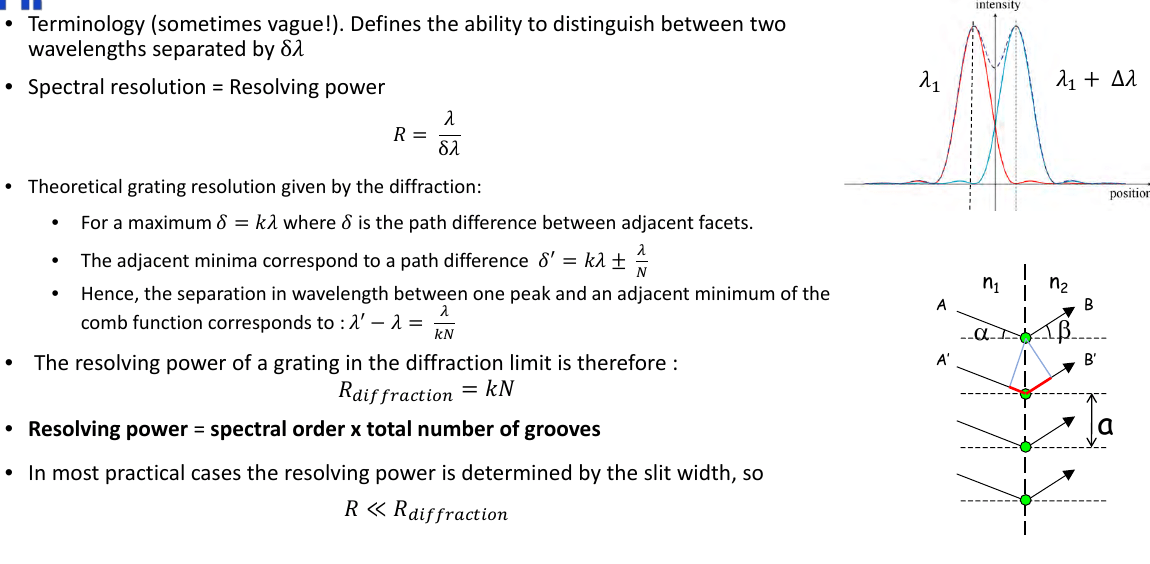
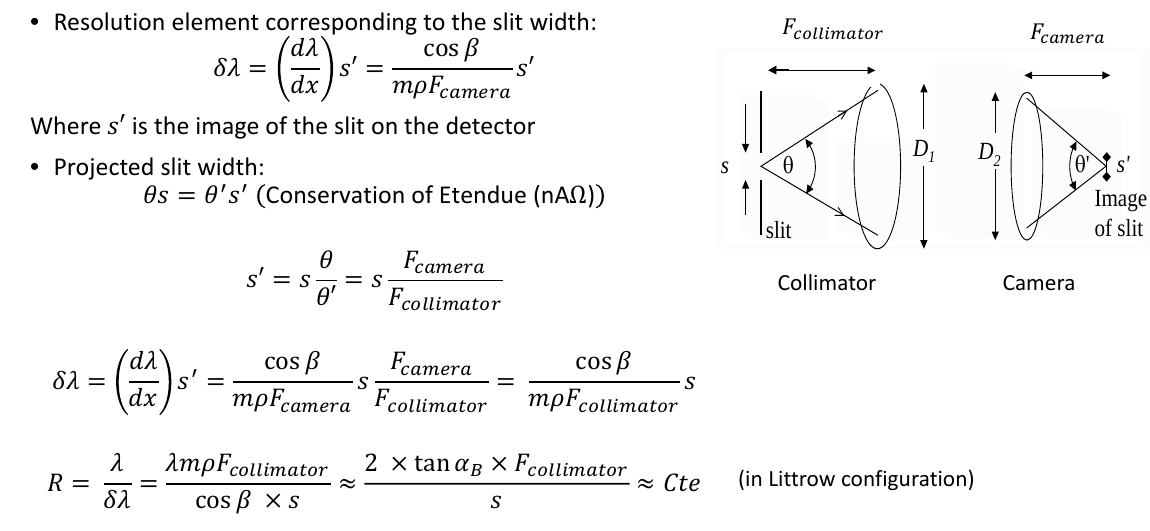
Spectroscopy: spectral resolution
- Ability to distinguish spectral features separated by Δλ
-
Resolving power:
- Low resolution
- High-resolution
-
Choice depends on the spectral features
- Broad features (e.g. because of velocity dispersion) or narrow (object properties)
- Higher resolution need larger exposure time for the same SNR
Ecole Rodolphe Cledassou 2024 - galaxy clustering: observation
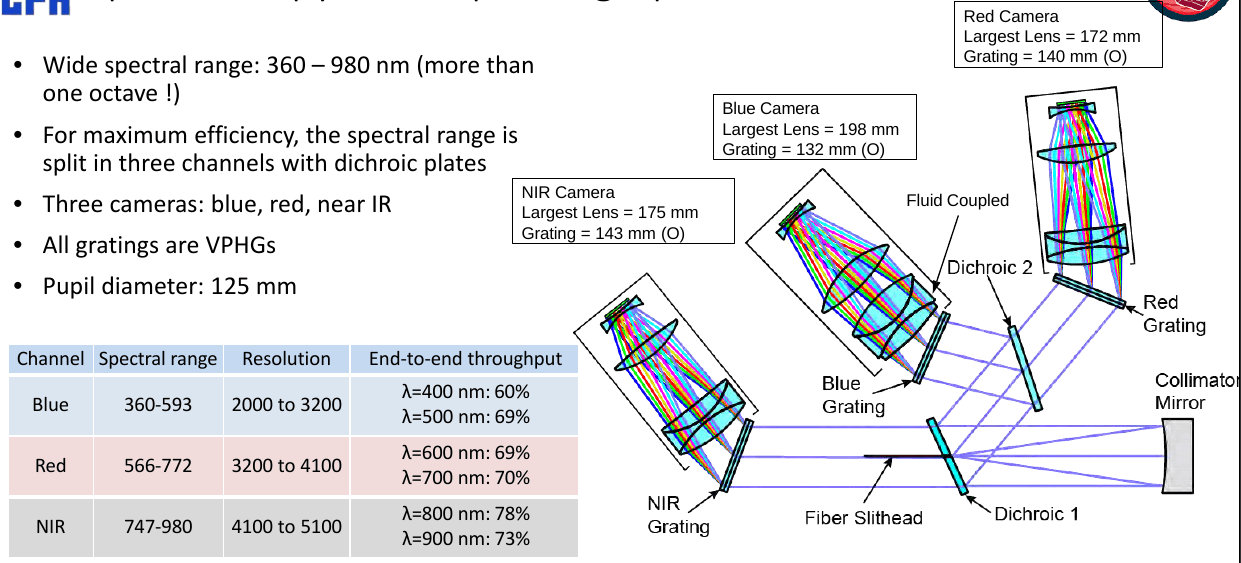
Spectroscopy: type of spectrograph

Slitless spectrograph (no mask, sky background)
Multi-slit spectrograph (focal plane mask)
Multi-fiber spectrograph (optical fibers)
Integral field spectrograph
Ecole Rodolphe Cledassou 2024 - galaxy clustering: observation
Spectroscopy: multi-object spectrographs
- Multi-split = insertion of slits (masks) and of a grating
- Typically, for small fields of view (up to 10 arcmin)
- Drilled in masks (hundreds of slits): Free positioning. Possibly multiple spectra in dispersion direction.
- Movable slitlets (tens of slits): Slits on top of each other. Positioning along the dispersion direction only.
- Multi-Shutter Assembly (Example: NIRSpec JWST) : Configurable shutters
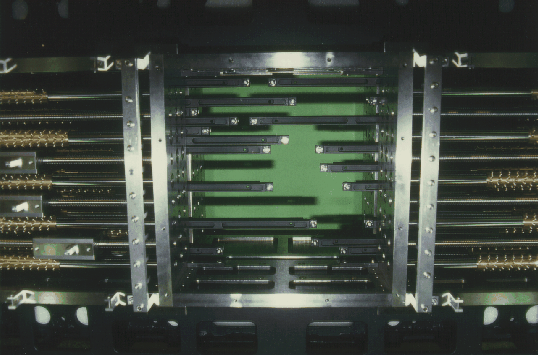
VLT-FORS
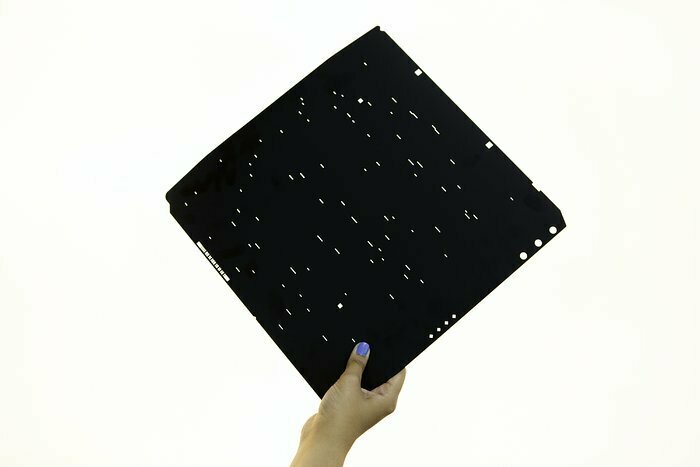
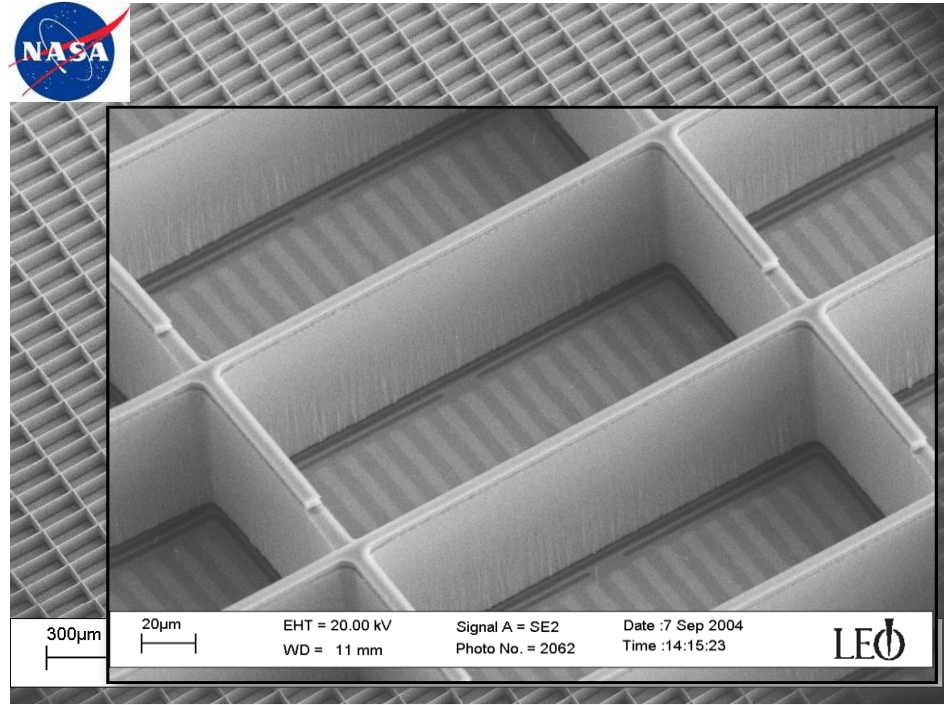
ESO
JWST MSA
Ecole Rodolphe Cledassou 2024 - galaxy clustering: observation
Spectroscopy: multi-object spectrographs
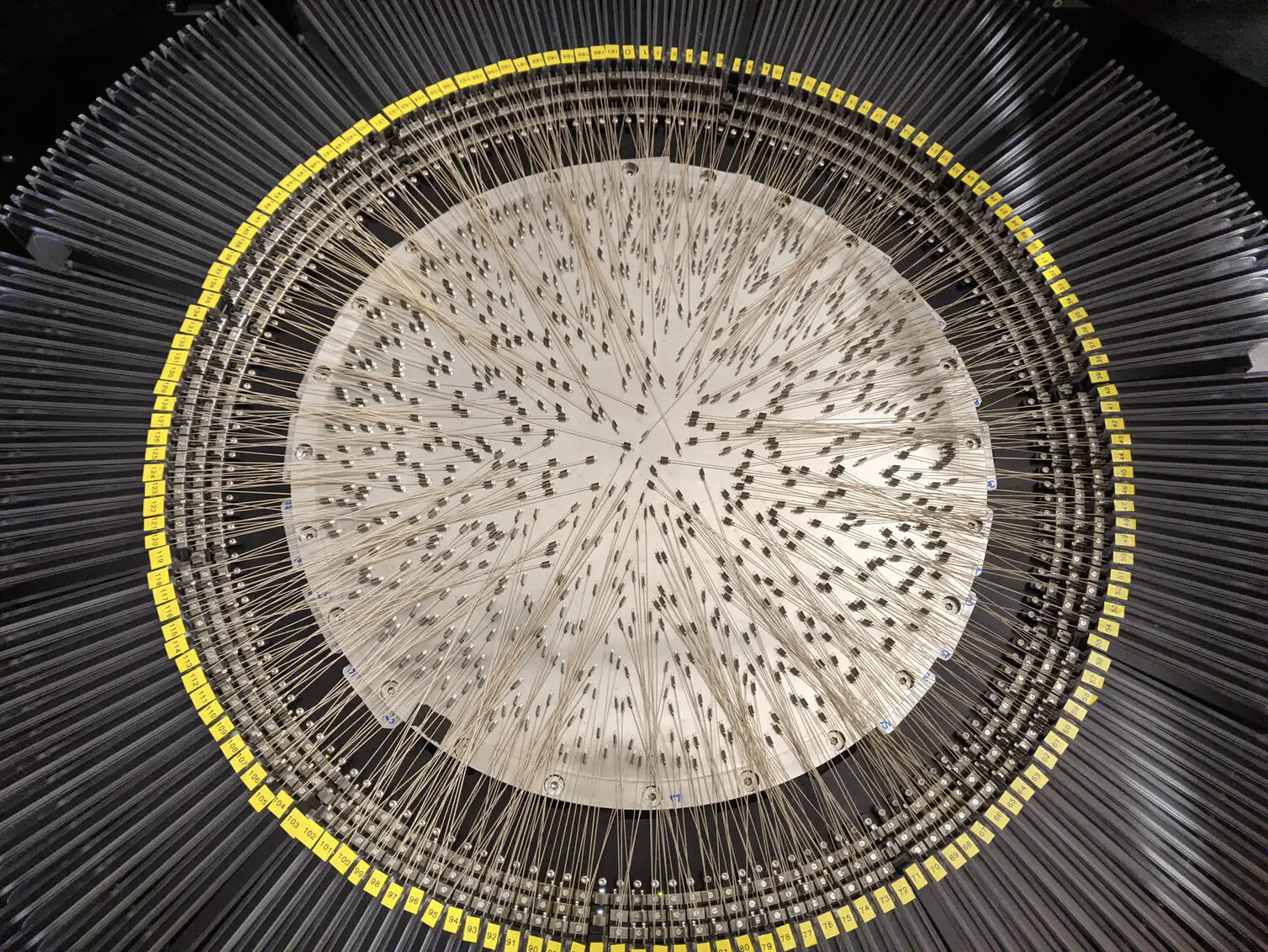
- Multi-fiber = decoupling of telescope and spectrographs
- Fields of view up to degree scales
- Up to thousands of fibres
-
Various positioner geometries:
- One motor (or a couple) positions fibres everywhere in the focal plane
- One motor per fibre, with limited patrol field per fibre
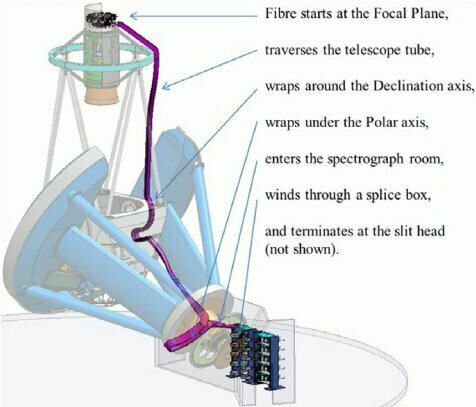
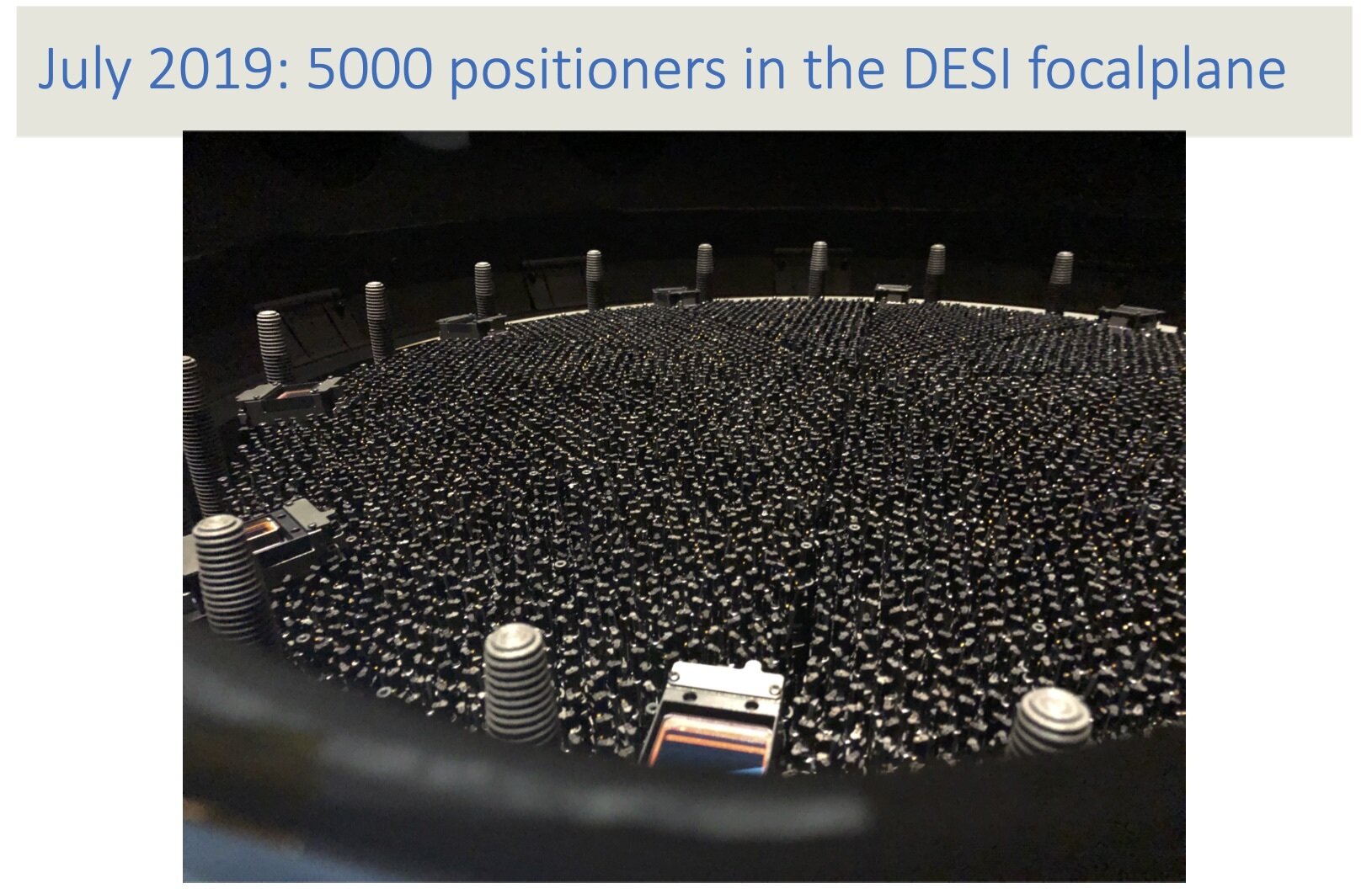
DESI
WEAVE
Ecole Rodolphe Cledassou 2024 - galaxy clustering: observation
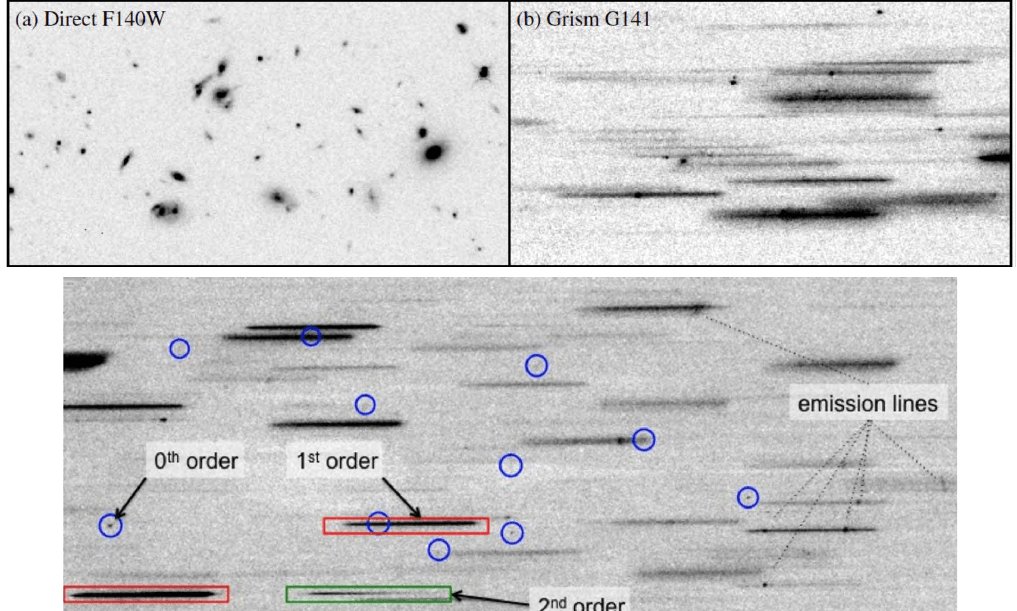
Spectroscopy: slitless spectroscopy
See "La spectrométrie IR" Y3 Y. Copin
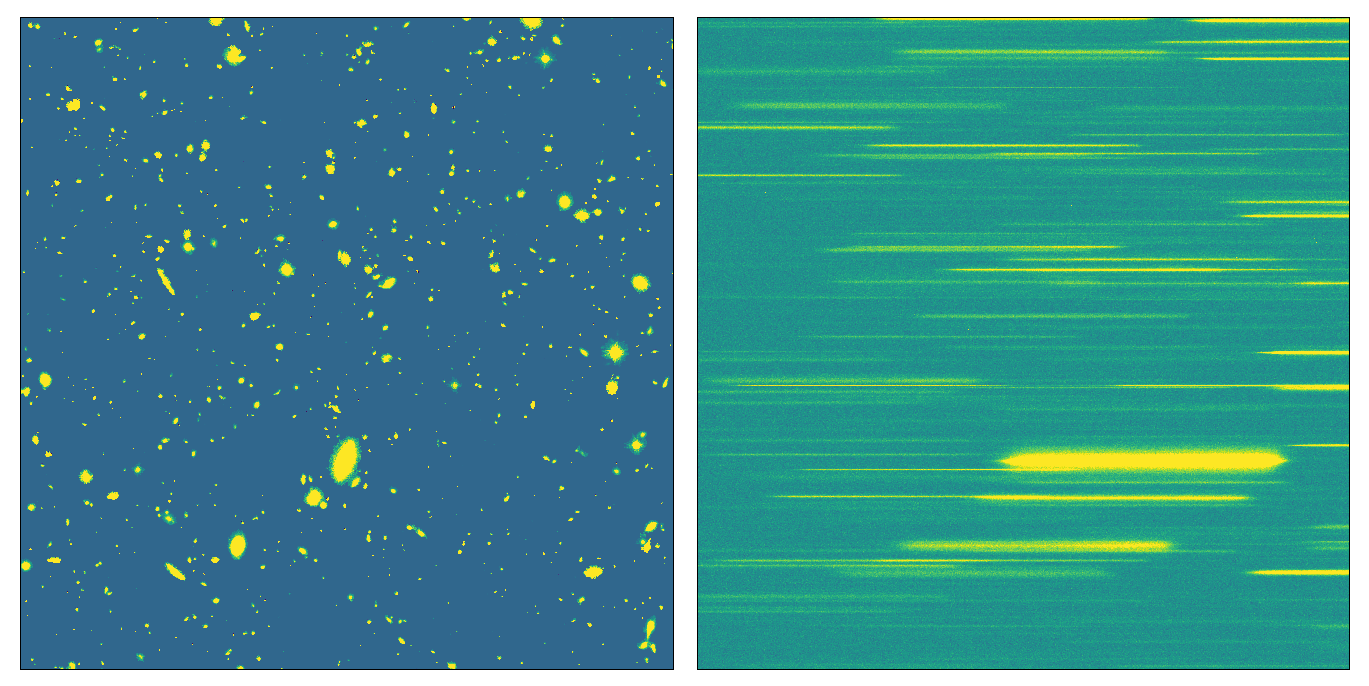
- Slitless spectroscopy with a prism or grism in the beam produces spectra for all objects in the field of view
- Pros: all objects get a spectrum
-
Cons:
- Cross contamination
- Mixing of spatial and spectral information
- High background, same as within an imaging filter of same bandpass as the grism
- Recent example: Hubble, JWST, Euclid, Roman space telescop
Ecole Rodolphe Cledassou 2024 - galaxy clustering: observation
Spectroscopy: target selection
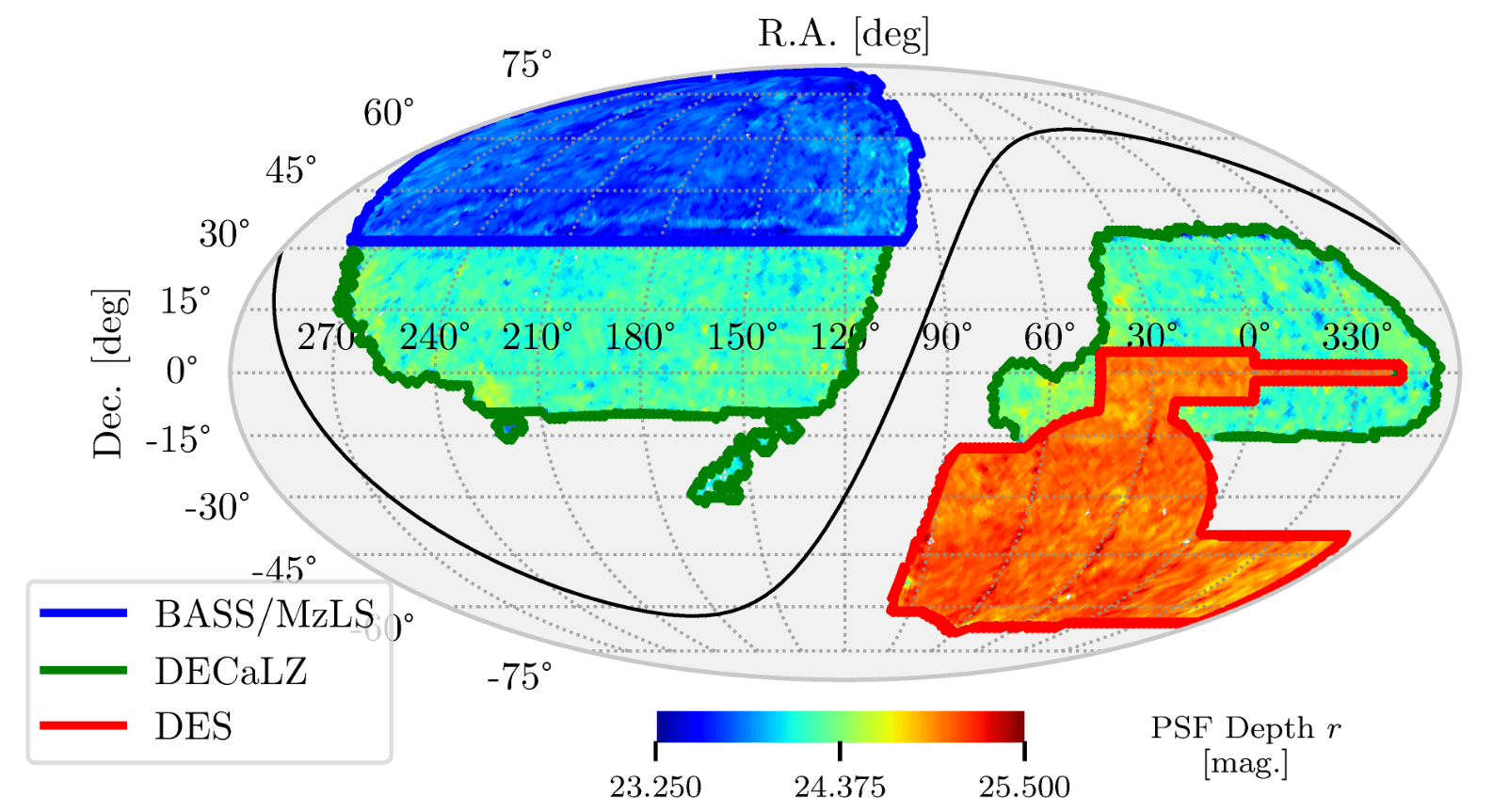
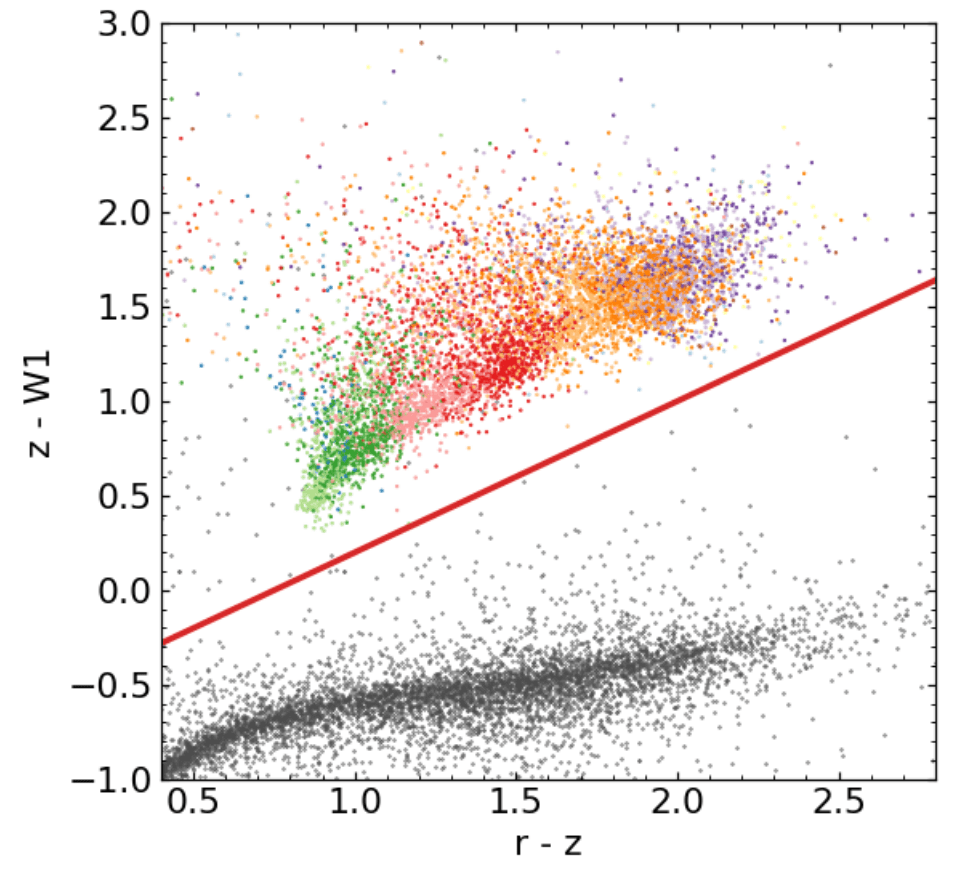
- For multi-object spectrographs: select measured objects to measure from photometric surveys
- Magnitude cuts: select brighter objects
-
Color (magnitude difference) cuts:
- Select a given population of object (LRG, ELG, QSO, LBG)
- Homogeneous sample for clustering measurements
- Reject stars and unwanted objects
Chaussidon et al. 2022
Galaxies
Stars
Zhou et al. 2022
Ecole Rodolphe Cledassou 2024 - galaxy clustering: observation
1. Properties of observed objects
2. Light path from source to detector
3. Galaxy survey properties
Outline
4. An overview of galaxy surveys
Ecole Rodolphe Cledassou 2024 - galaxy clustering: observation
Galaxy observations
- 964: Abd al-Rahman al-Soufi (persian astronomer) observes first galaxies (Andromeda, Large magellanic cloud)
-
1750/1755: Thomas Wright (english astronomer) & Emmanuel Kant postulate that nebulae are other galaxies like the Milky Way
- "Une nébuleuse n’est pas un unique et énorme soleil, mais un système de nombreux soleils, rassemblés en raison de leur distance dans un espace si étroit, que leur lumière, qui serait imperceptible pour chacun d’eux isolément, parvient, grâce à leur innombrable quantité, à produire une blancheur pâle et uniforme.” – Emmanuel Kant, Histoire générale de la nature et théorie du ciel, 1755
-
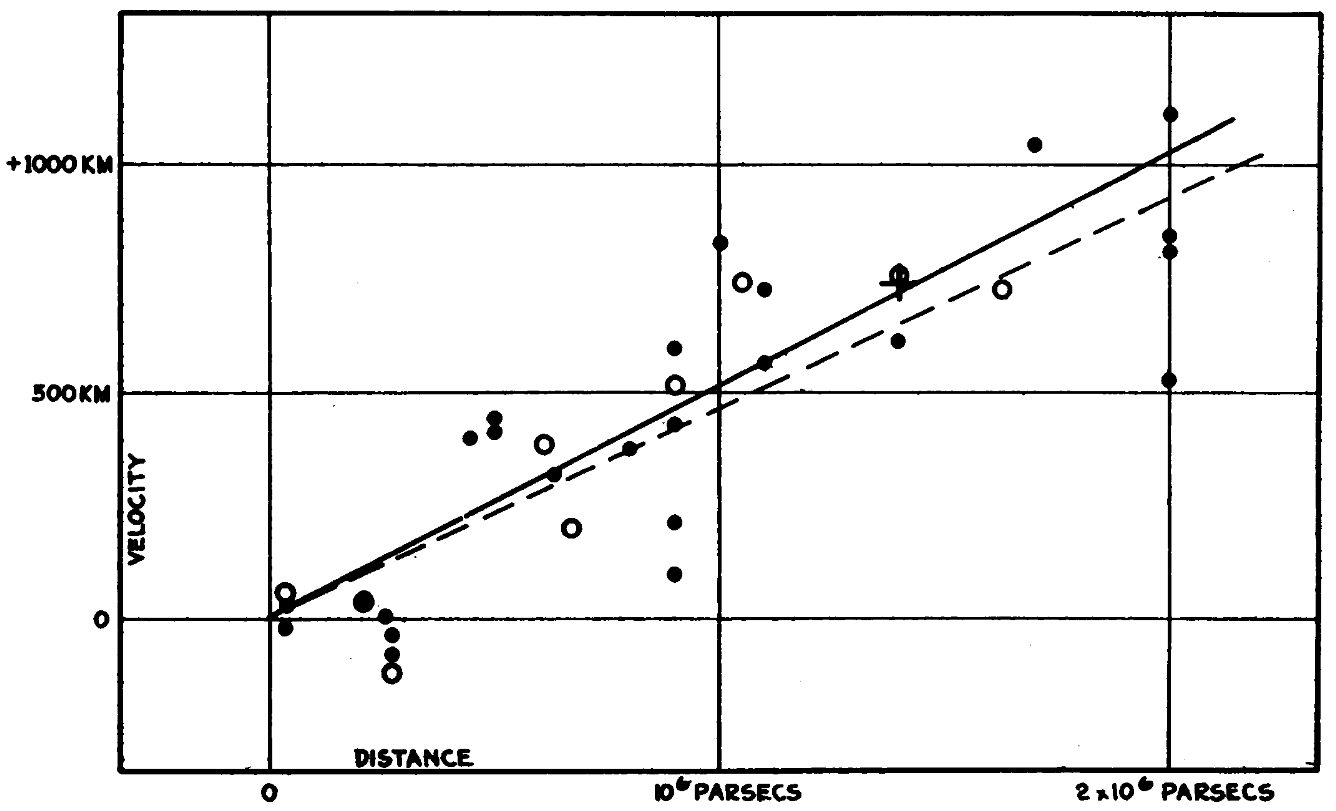
1910-20's:
- Leavitt & Hubble observations confirmed the existence of other galaxies
- Hubble & Lemaitre discovers expansion
Ecole Rodolphe Cledassou 2024 - galaxy clustering: observation
Photometric surveys - "Stage I"
- POSS I (1949 - 1958)
- UKST (1974 - 1999)
- POSS II (1985 - 2000)
- First digital surveys:
- Digitized Sky Survey (1994) scanning of POSS I/II and UKST
- 2MASS (1997 - 2001): 3-band NIR photometric survey (also considered "stage II")
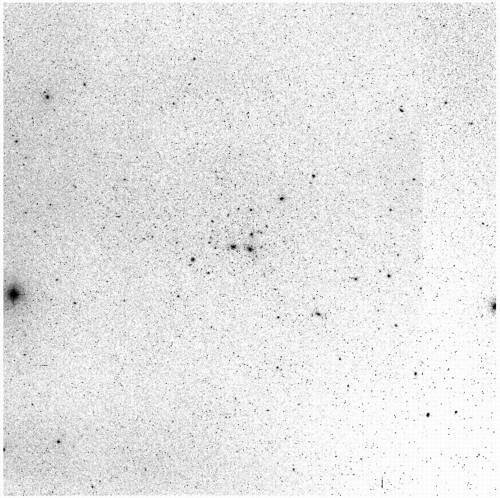
photographic plate of POSS I
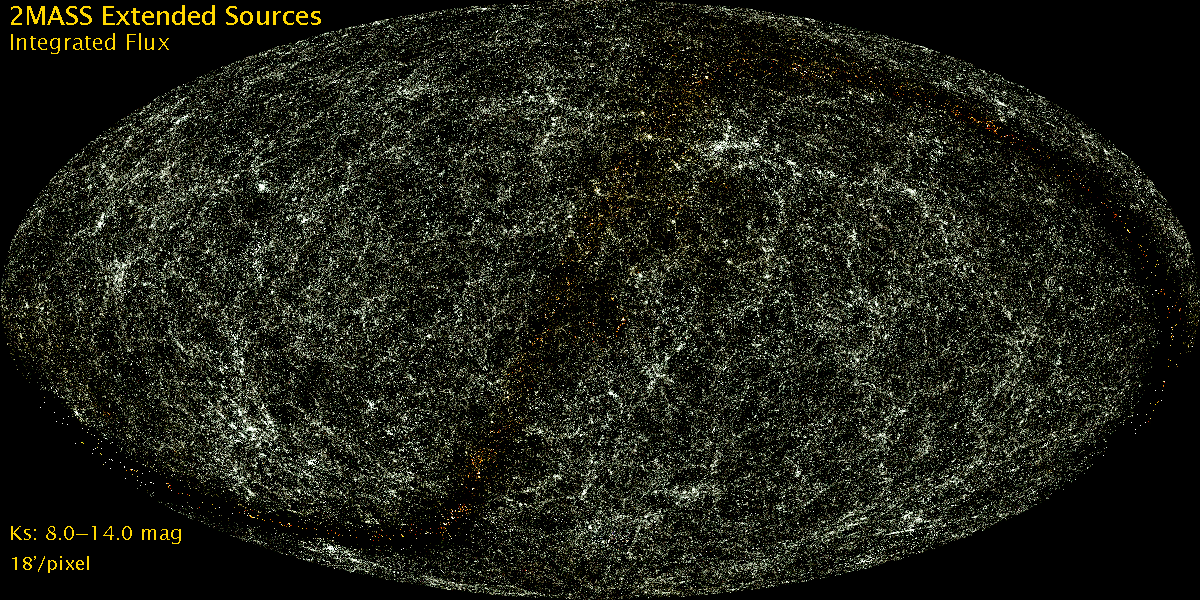
copy-paste from the mighty Arnaud
Ecole Rodolphe Cledassou 2024 - galaxy clustering: observation
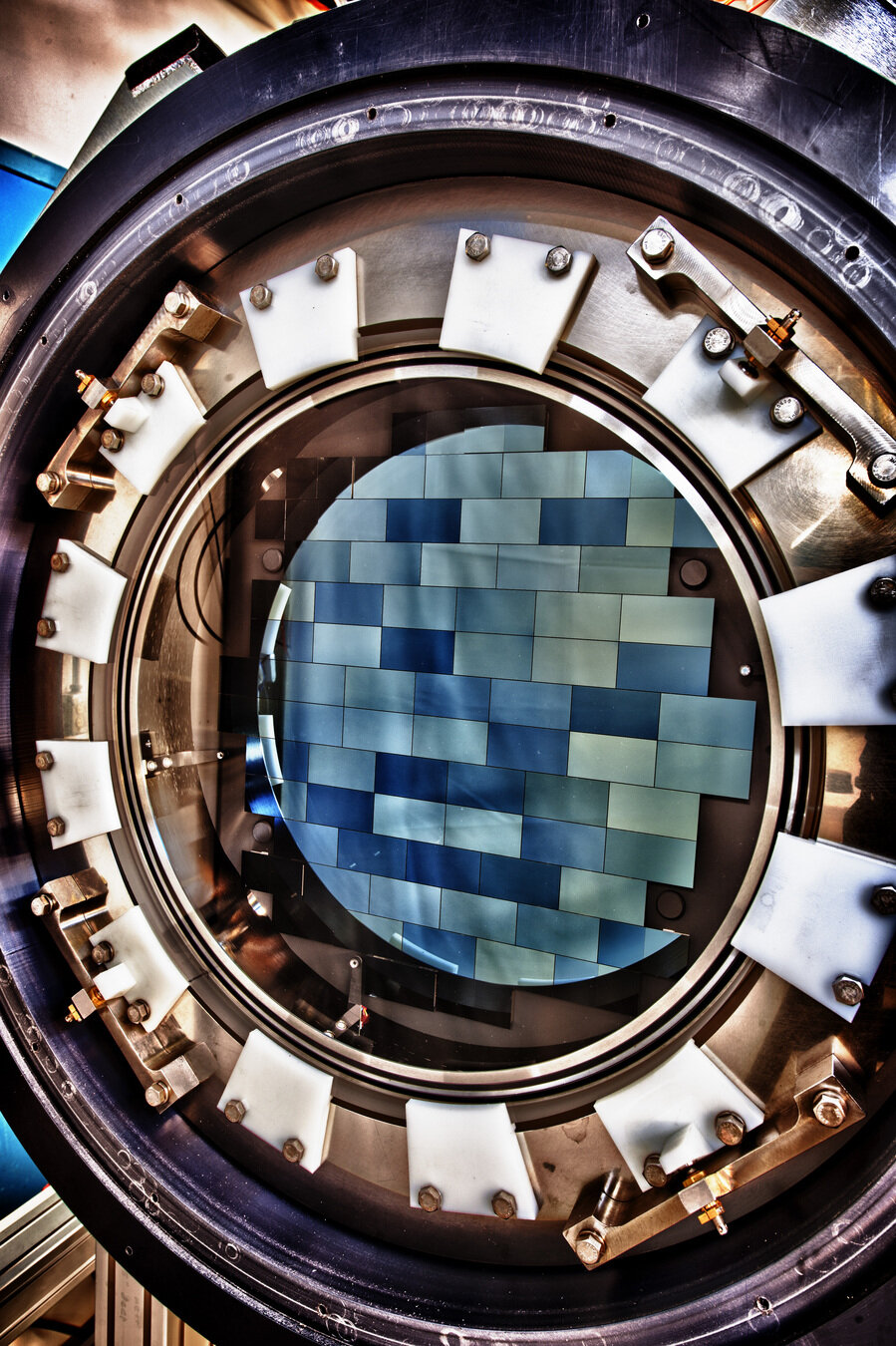
Photometric surveys - "Stage II/III"
-
Deep surveys:
- Hubble space telescop (1990-)
- VLT (1998-)
-
Wide surveys:
- DES (2013-2019)
- HSC (2014-)
- PanStarrs (2008-)
- CFHT (1979-)
- VISTA VHS (2009-2015)
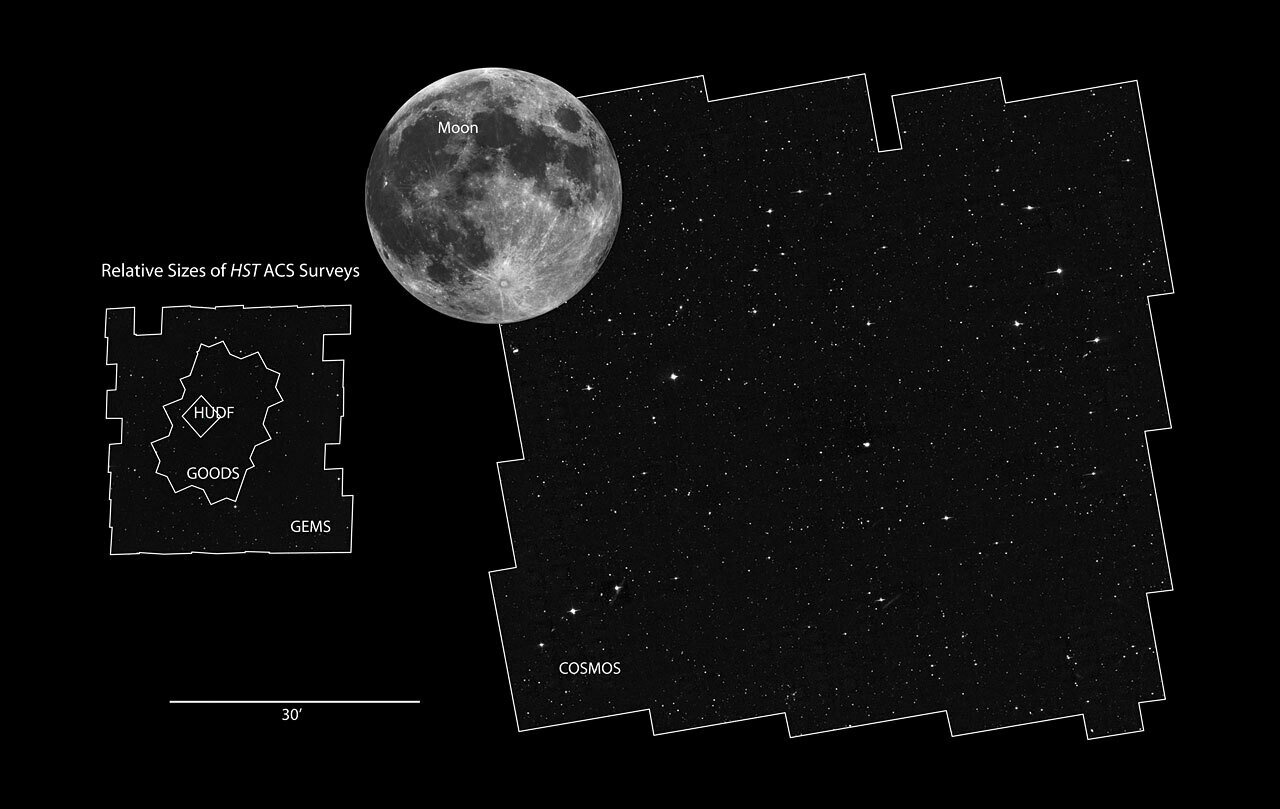
COSMOS
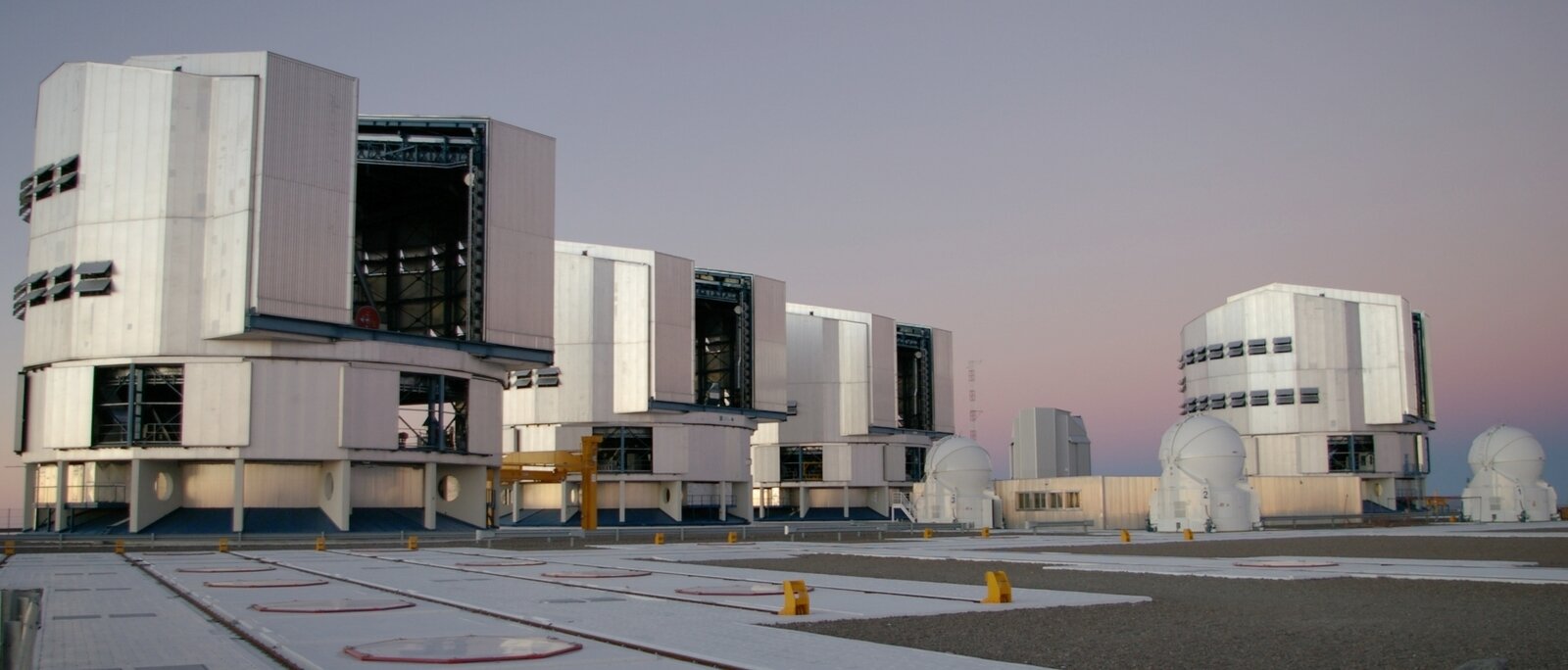
VLT
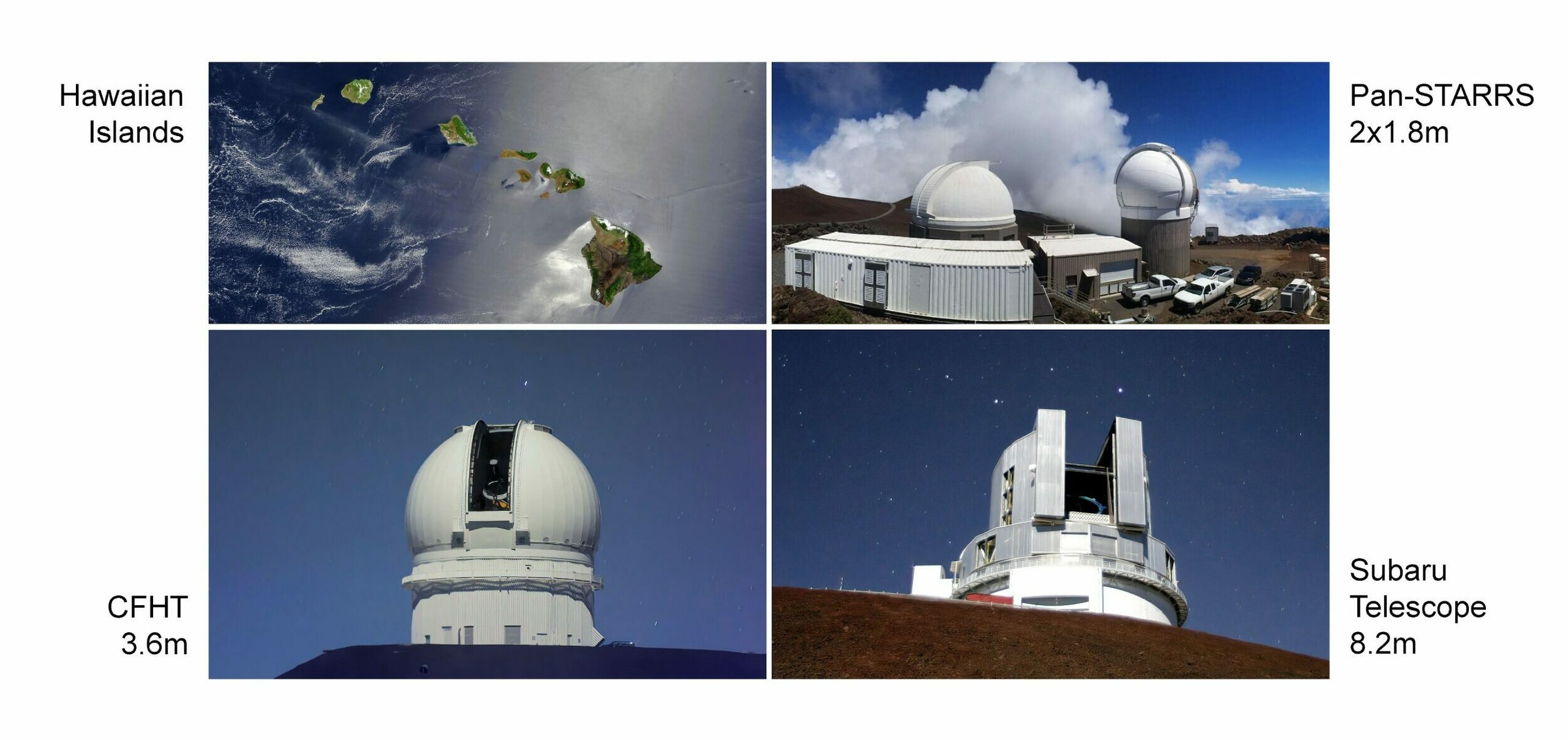
UNIONS
DES Imager
Ecole Rodolphe Cledassou 2024 - galaxy clustering: observation
Spectroscopic surveys - "Stage I"
- First spectrographic surveys:
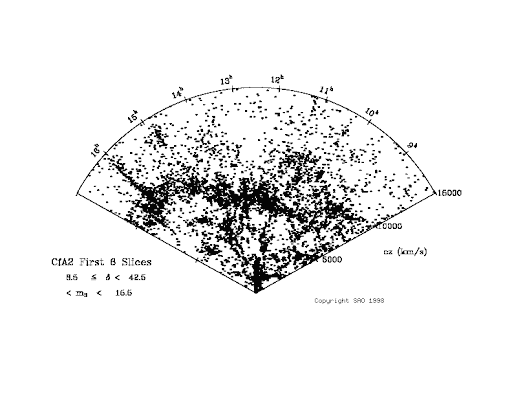
- CfA I (1977 - 1982), 1100 redshifts, structures formed by galaxies
- CfA II (1985 - 1995), 18 000 redshifts, Great Wall discovery
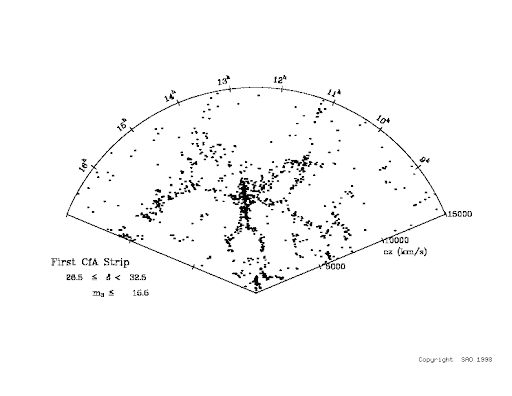
copy-paste from the mighty Arnaud
Ecole Rodolphe Cledassou 2024 - galaxy clustering: observation
Spectroscopic surveys - "Stage II"
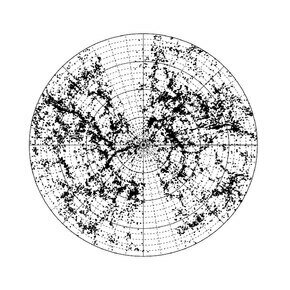
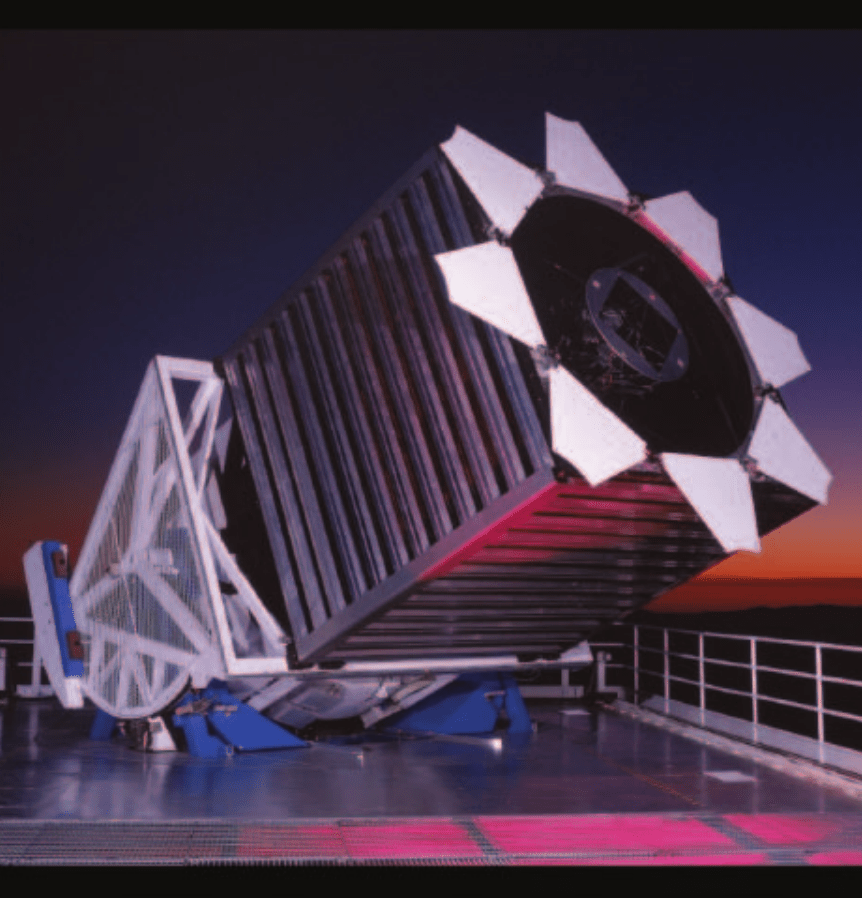
- SDSS-I SDSS-II (1998-2008)
- 2dFGS 6dFGS (1997-2009)
- WiggleZ (2006-2011)
- Goal: BAO detection
6dFGS map
SDSS
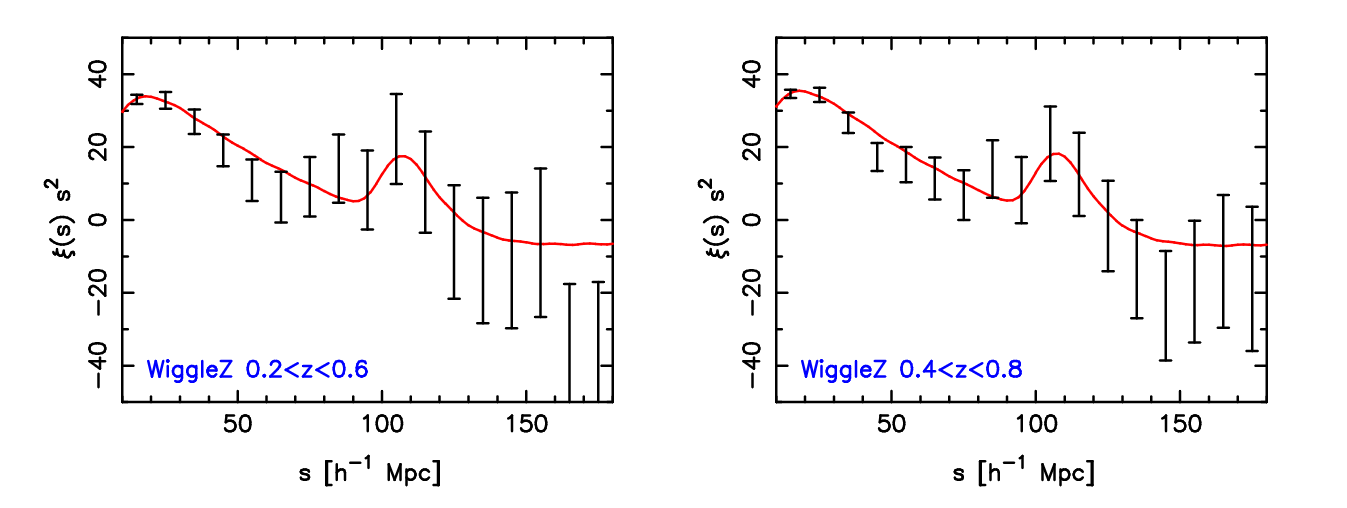
WiggleZ BAO
Blake et al. 2011
Ecole Rodolphe Cledassou 2024 - galaxy clustering: observation
Spectroscopic surveys - "Stage III"
- SDSS BOSS/eBOSS (2008-2020)
- HETDEX (2017-2024)
- PFS (2014 – 2020)
- Goal: improving BAO
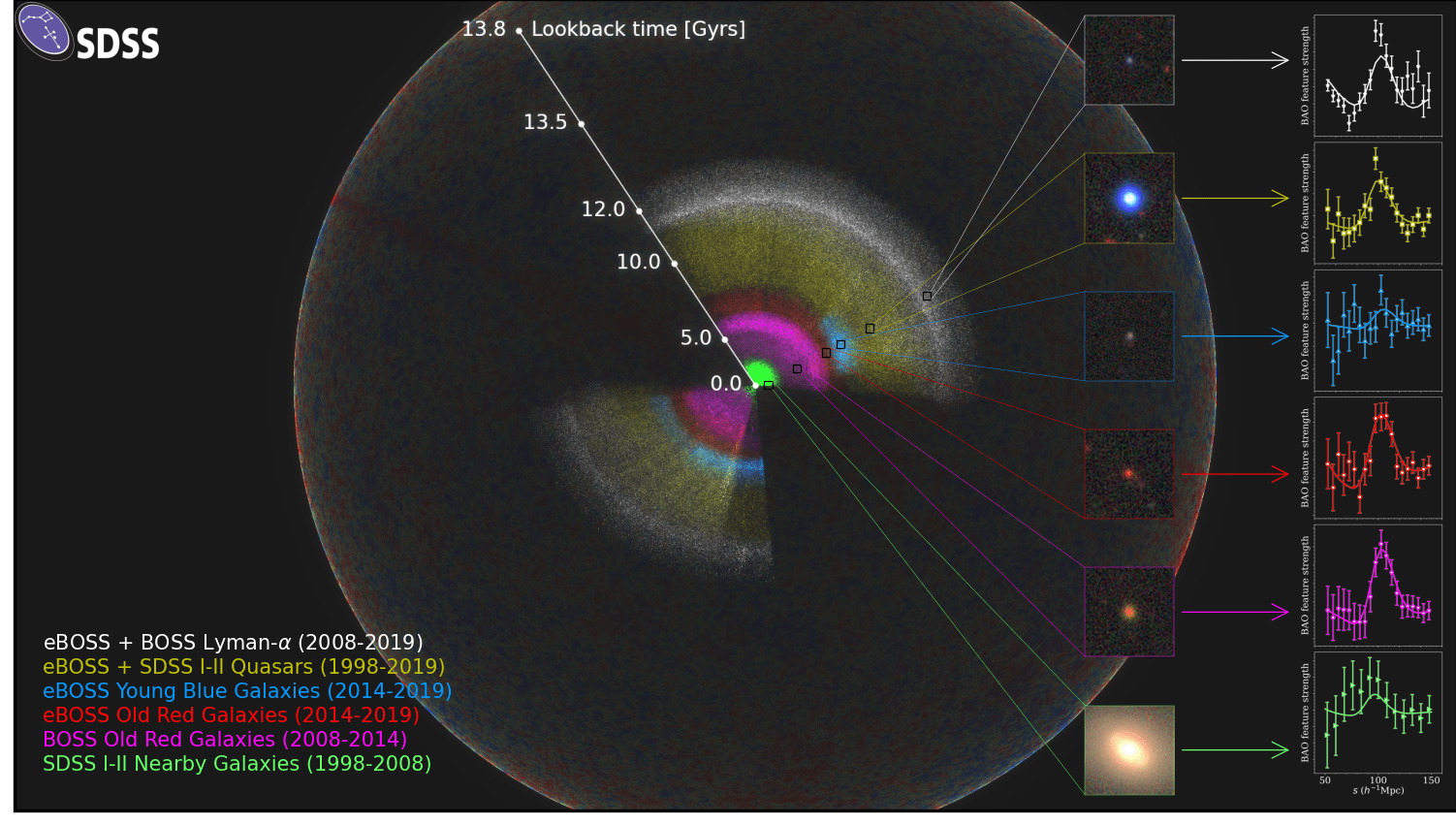
IFU
Ecole Rodolphe Cledassou 2024 - galaxy clustering: observation
Moore's law for spectroscopic galaxy survey
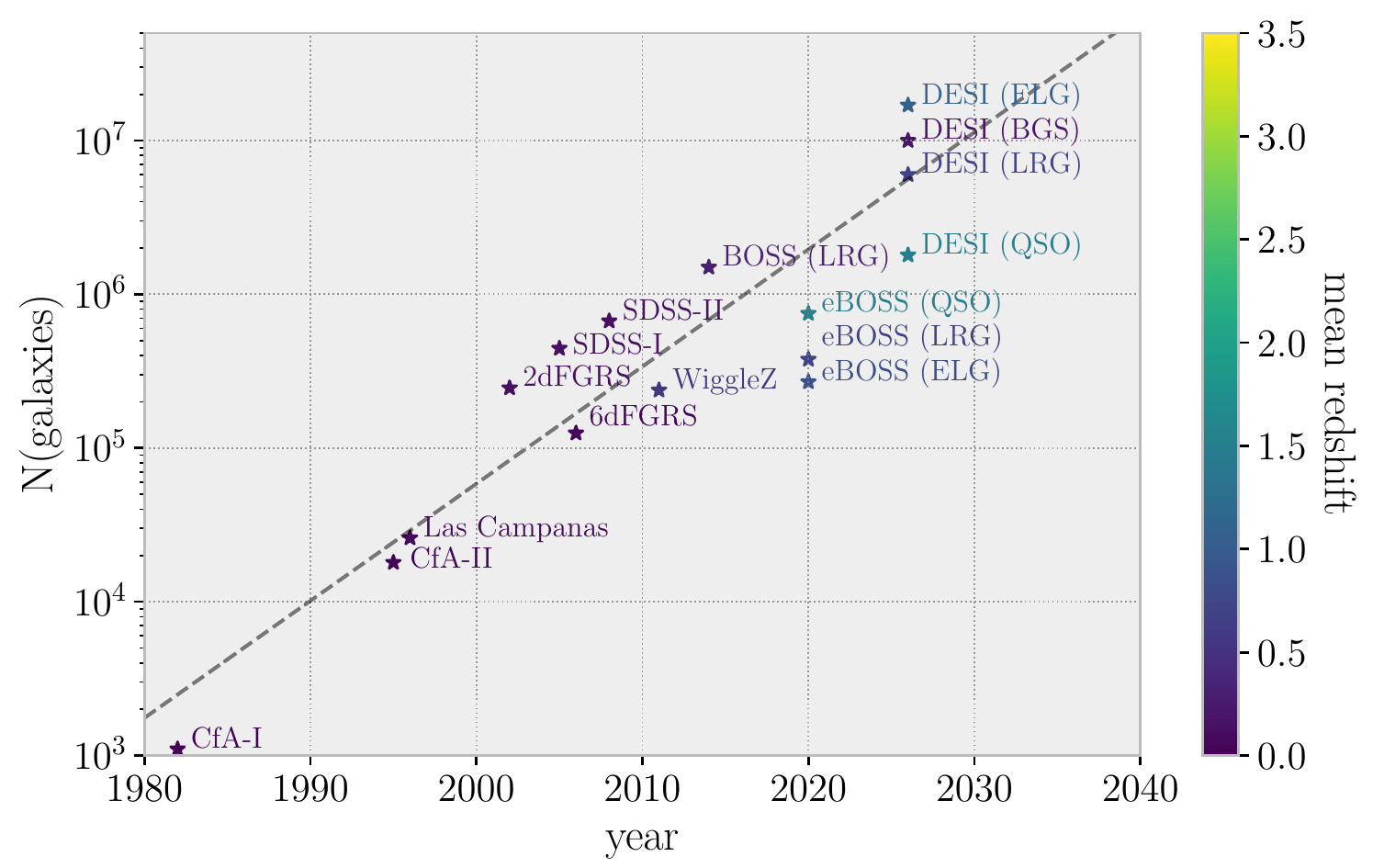
I
II
III
IV
copy-paste from the mighty Arnaud
Ecole Rodolphe Cledassou 2024 - galaxy clustering: observation
Present experiments: "Stage IV"
-
Ground photo:
- LSST (2025-)
-
Ground spectro:
- DESI (2021-)
- 4MOST (2024-)
-
Space (spectro/photo):
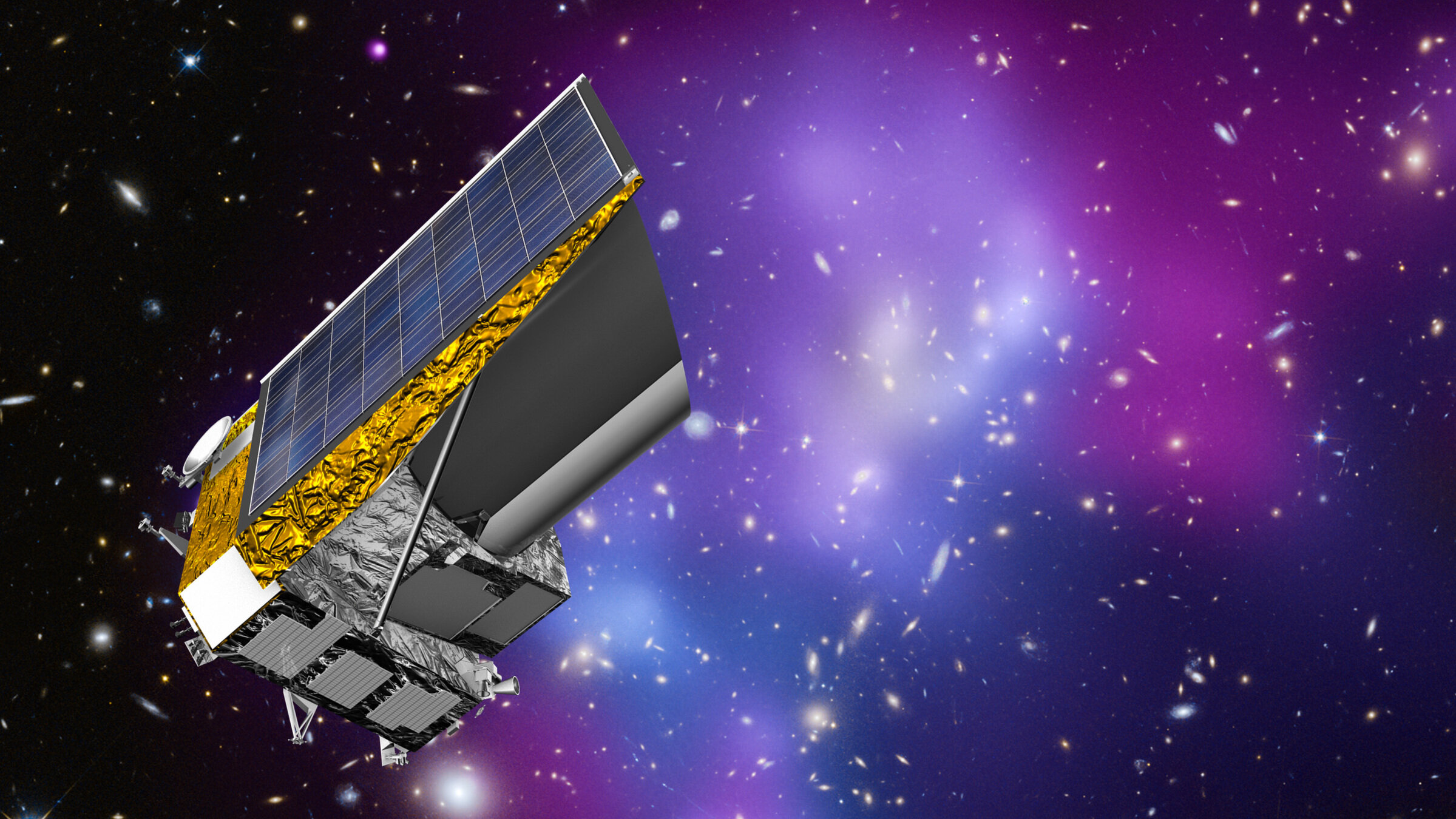
- Euclid (2023-)
- JWST (2023-)
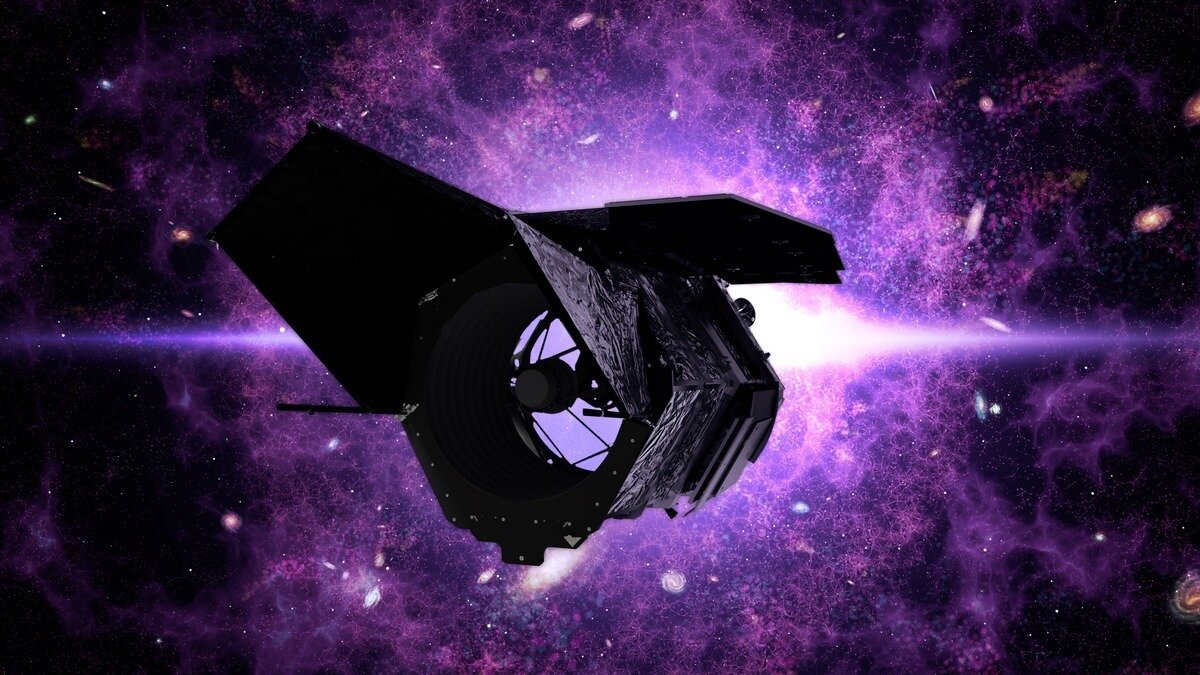
- Roman space telescop (2025-)

Ecole Rodolphe Cledassou 2024 - galaxy clustering: observation
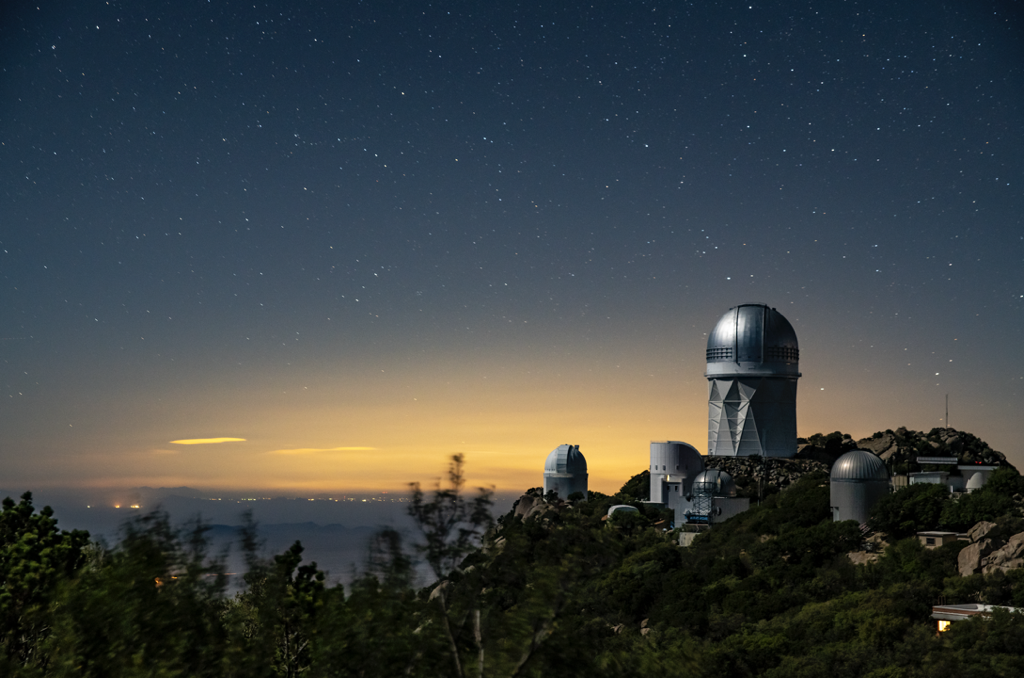
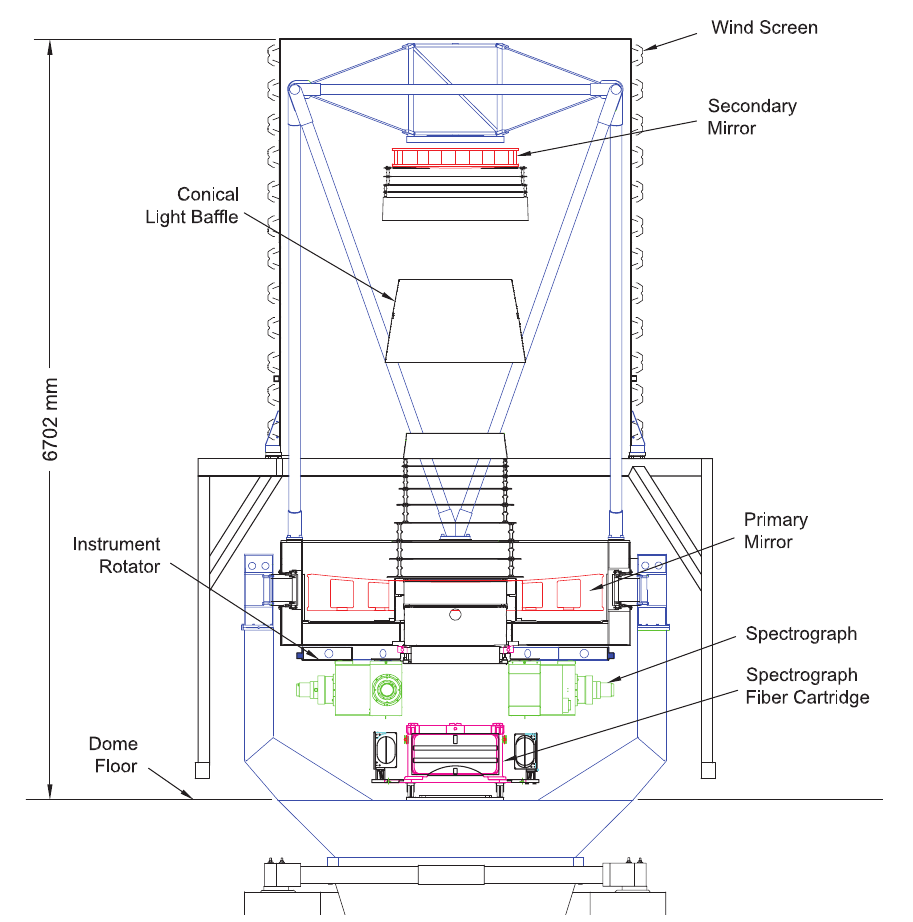
The Dark Energy Spectroscopic Instrument (DESI)
Ecole Rodolphe Cledassou 2024 - galaxy clustering: observation
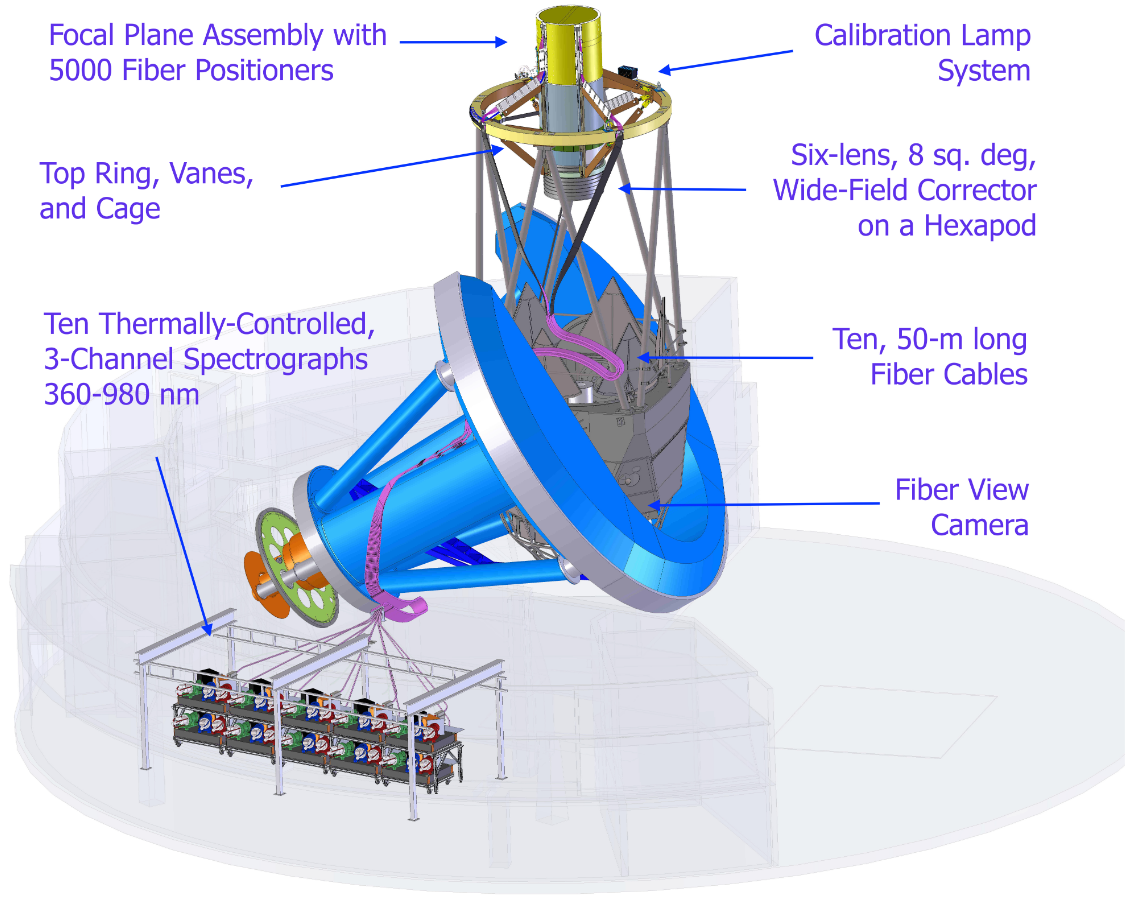
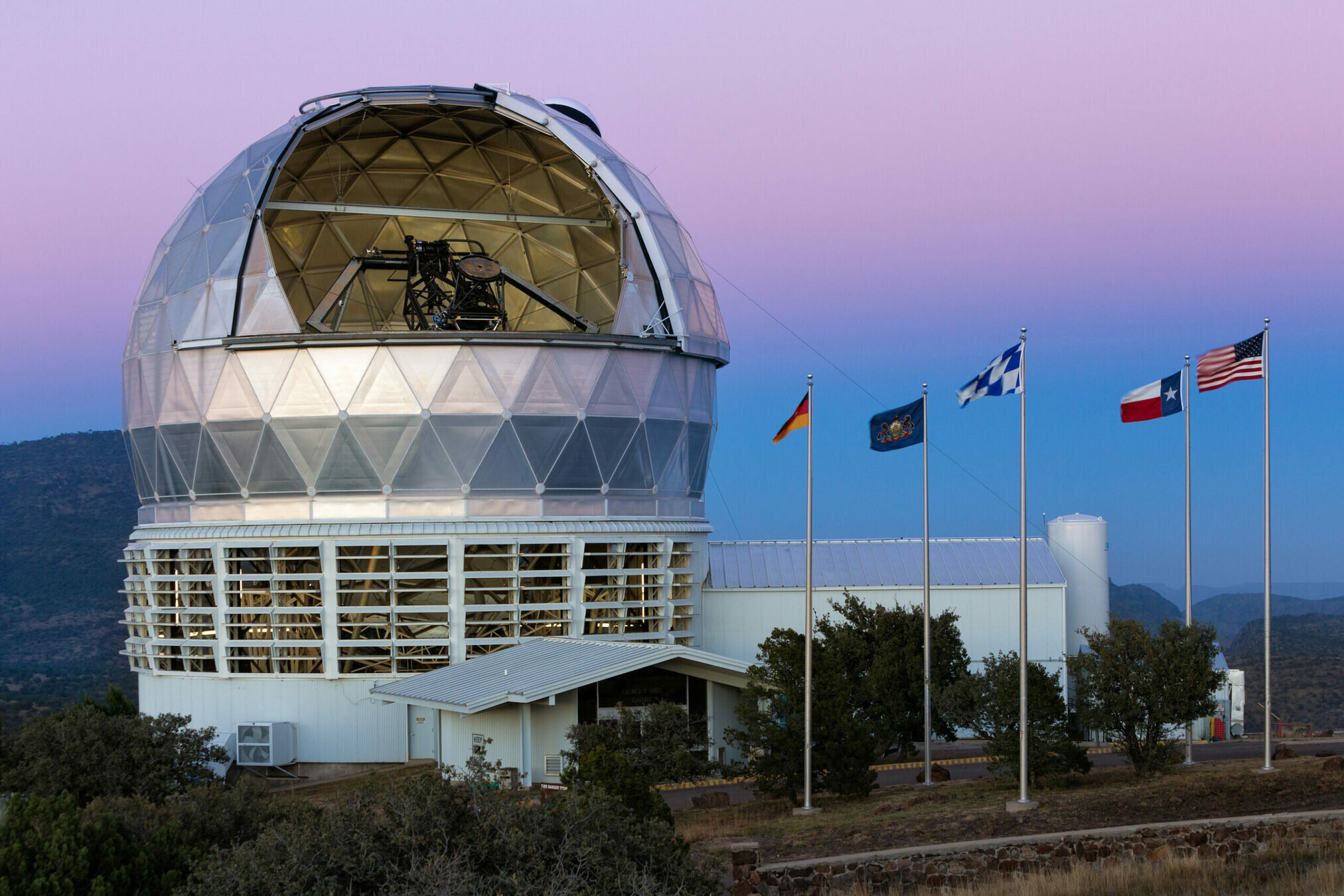
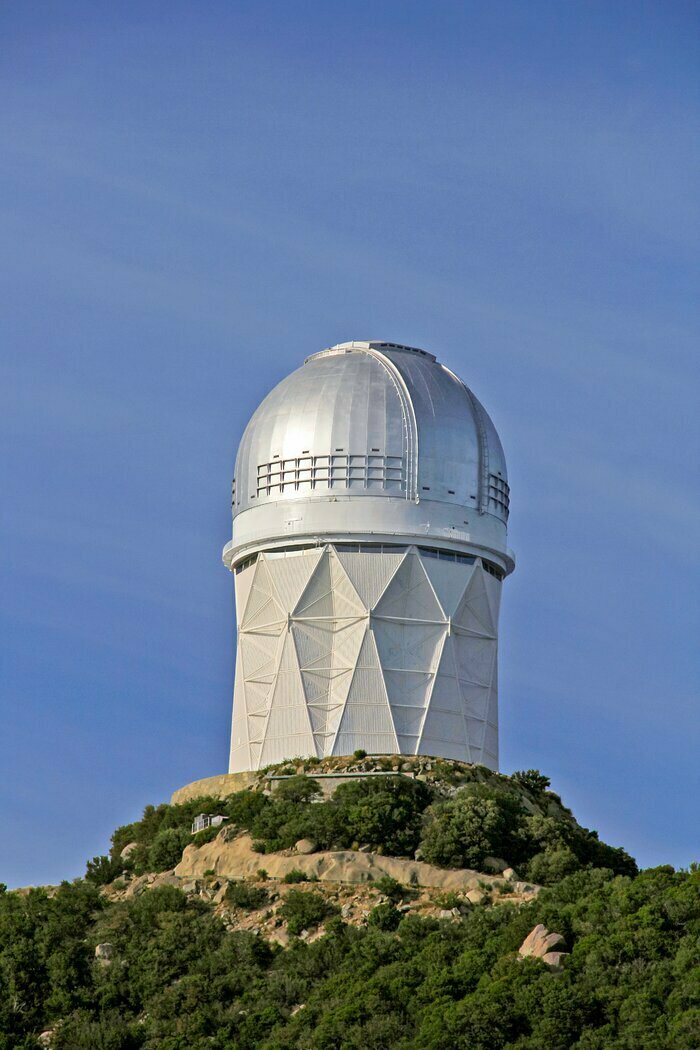
- 4 m telescope at Kitt Peak Observatory
- 2021 - 2026
- 3 years of data secured
DESI collaboration 2022
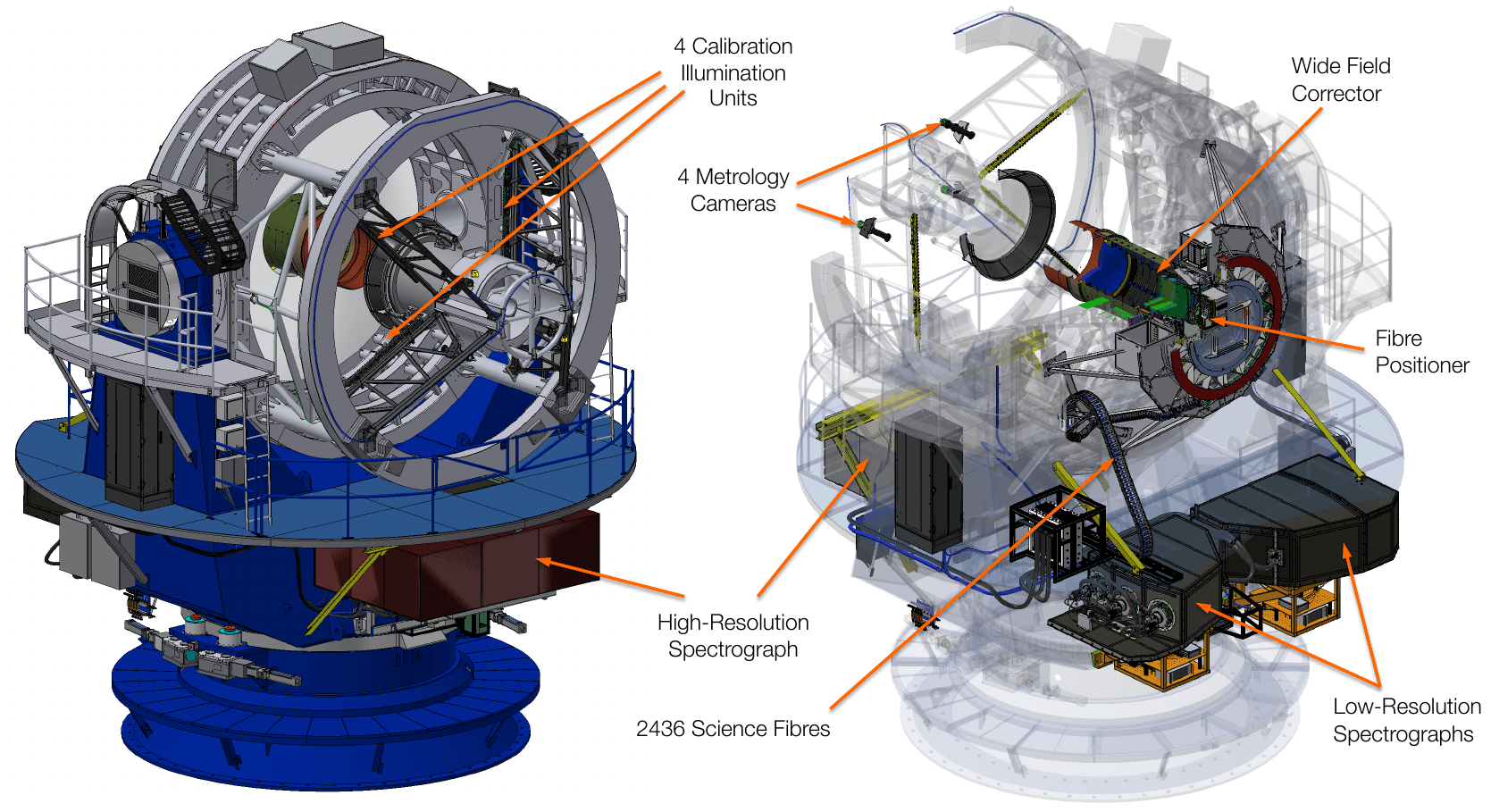
DESI instrument
Ecole Rodolphe Cledassou 2024 - galaxy clustering: observation
DESI survey forecast
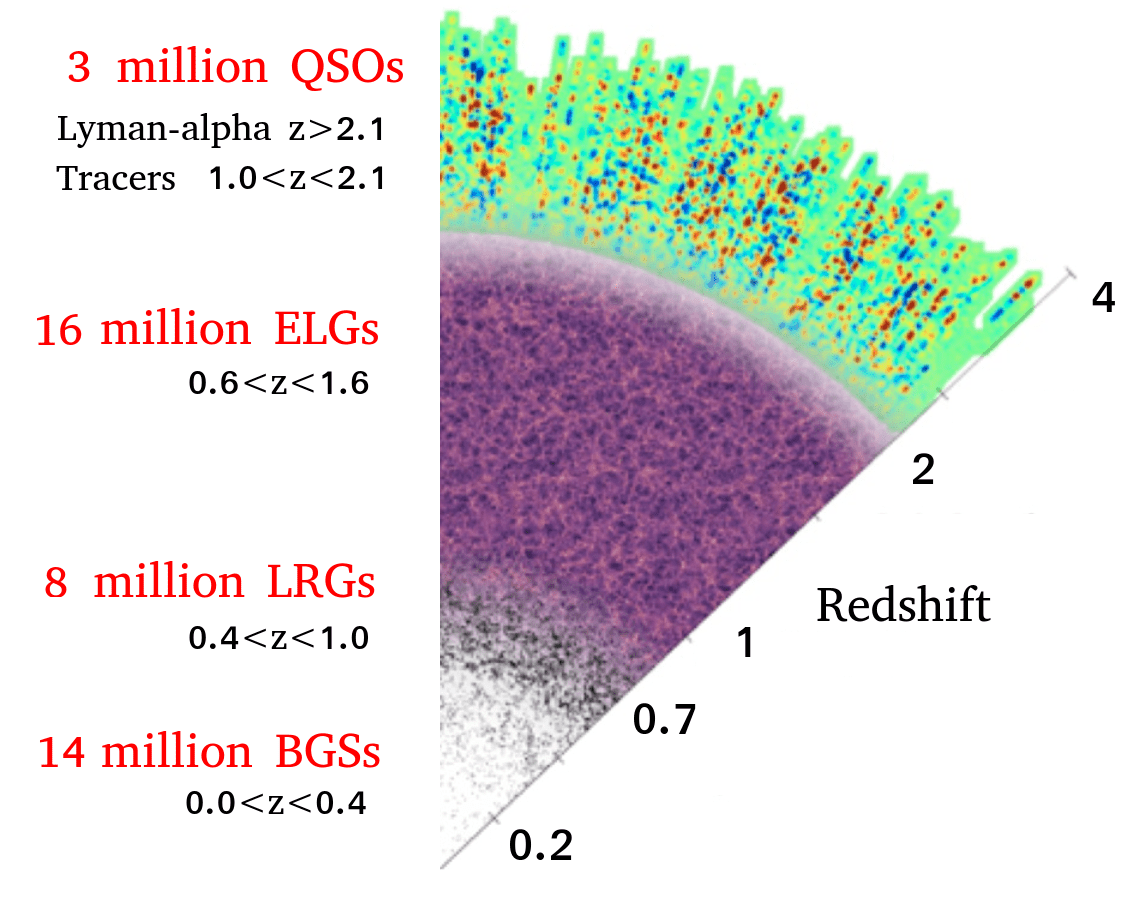
- BGS: Bright Galaxy Survey
- LRG: Luminous Red Galaxy
- ELG: Emission Line Galaxy
-
QSO: Quasar
- z > 2.1: with a Lyman-α forest
- z < 2.1: as tracers
40 million redshifts in 5 years
Ecole Rodolphe Cledassou 2024 - galaxy clustering: observation
DESI BAO
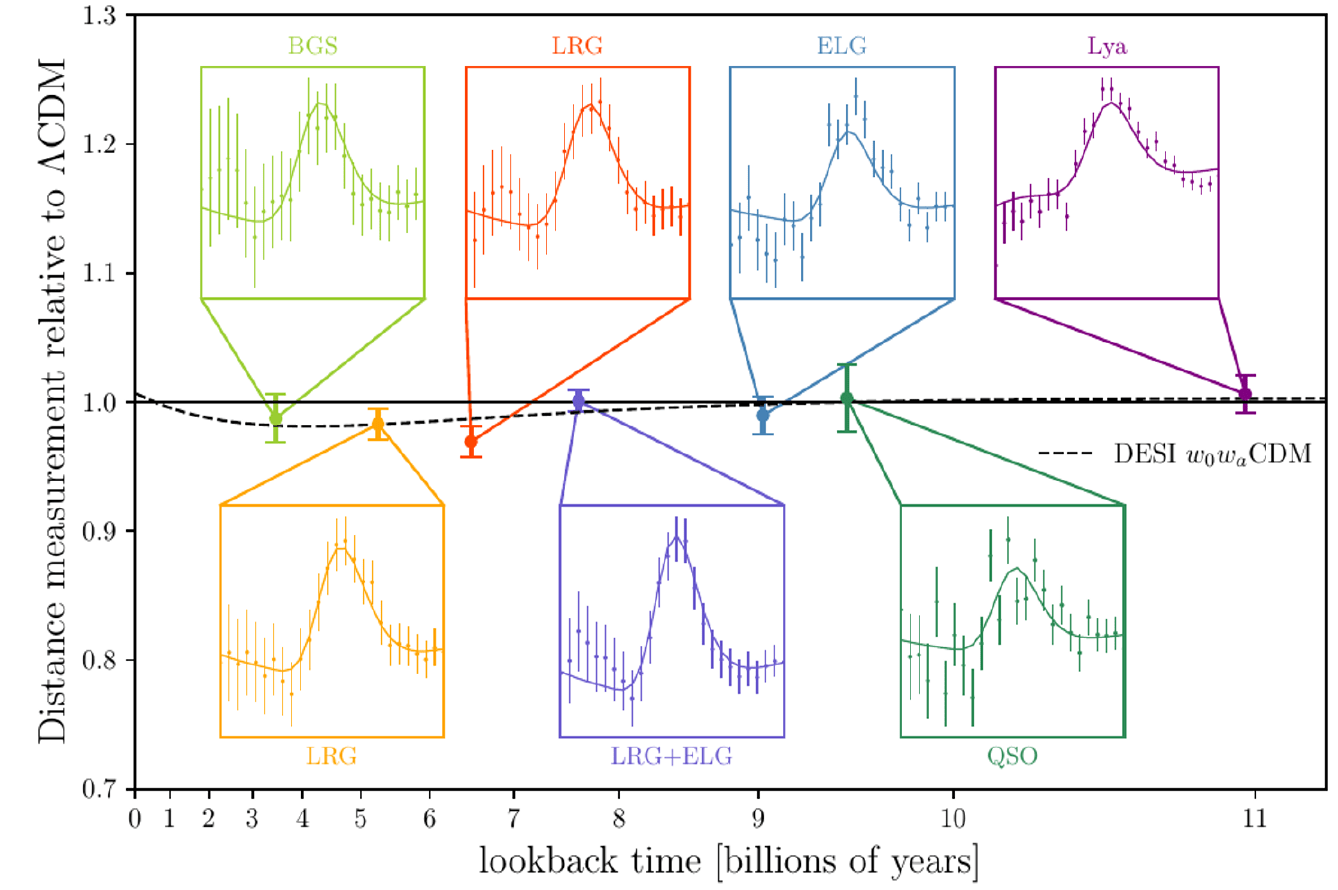
DESI collaboration 2024
See "Conférence DESI" A. de Mattia
Ecole Rodolphe Cledassou 2024 - galaxy clustering: observation
DESI focal plane
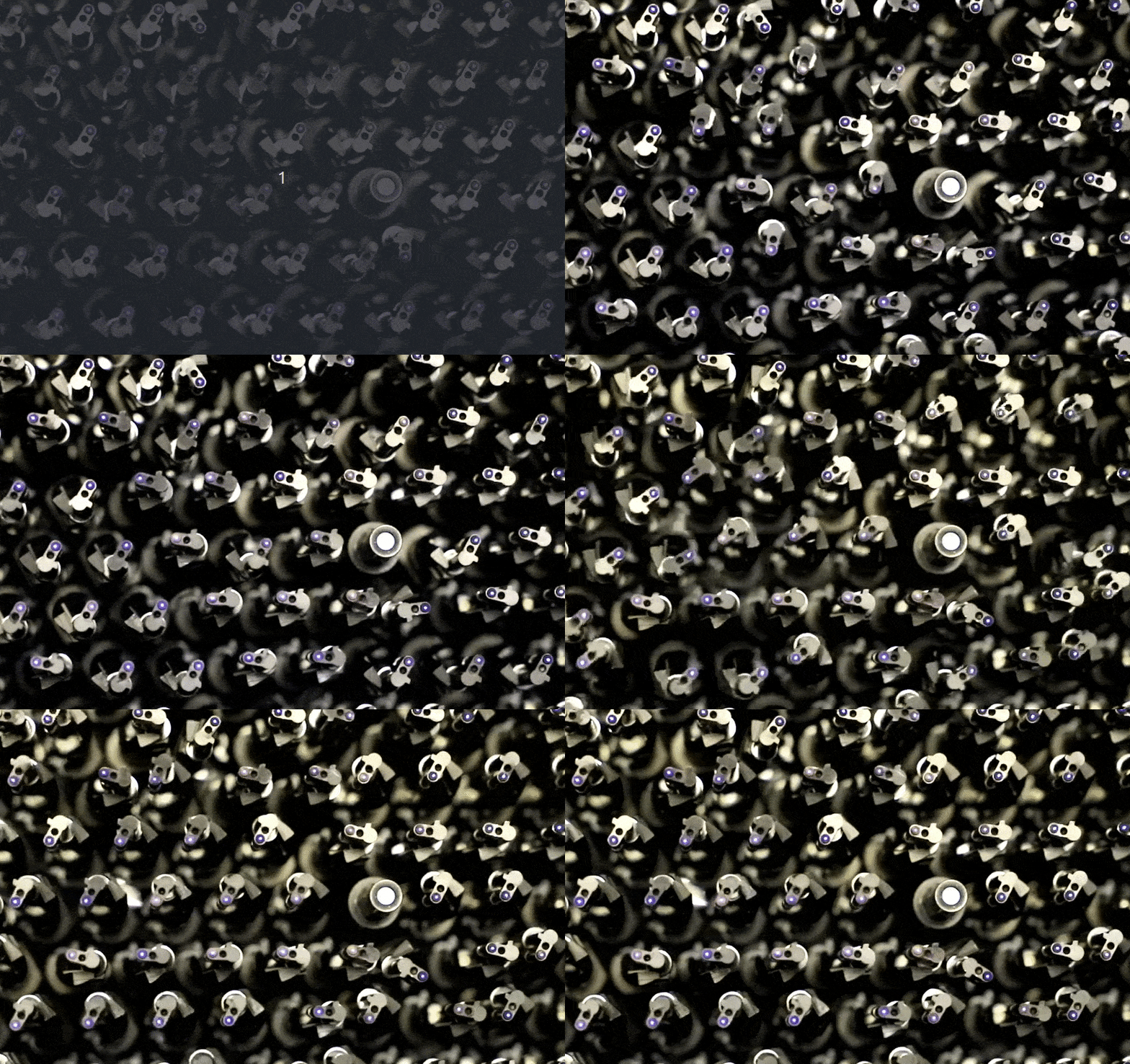
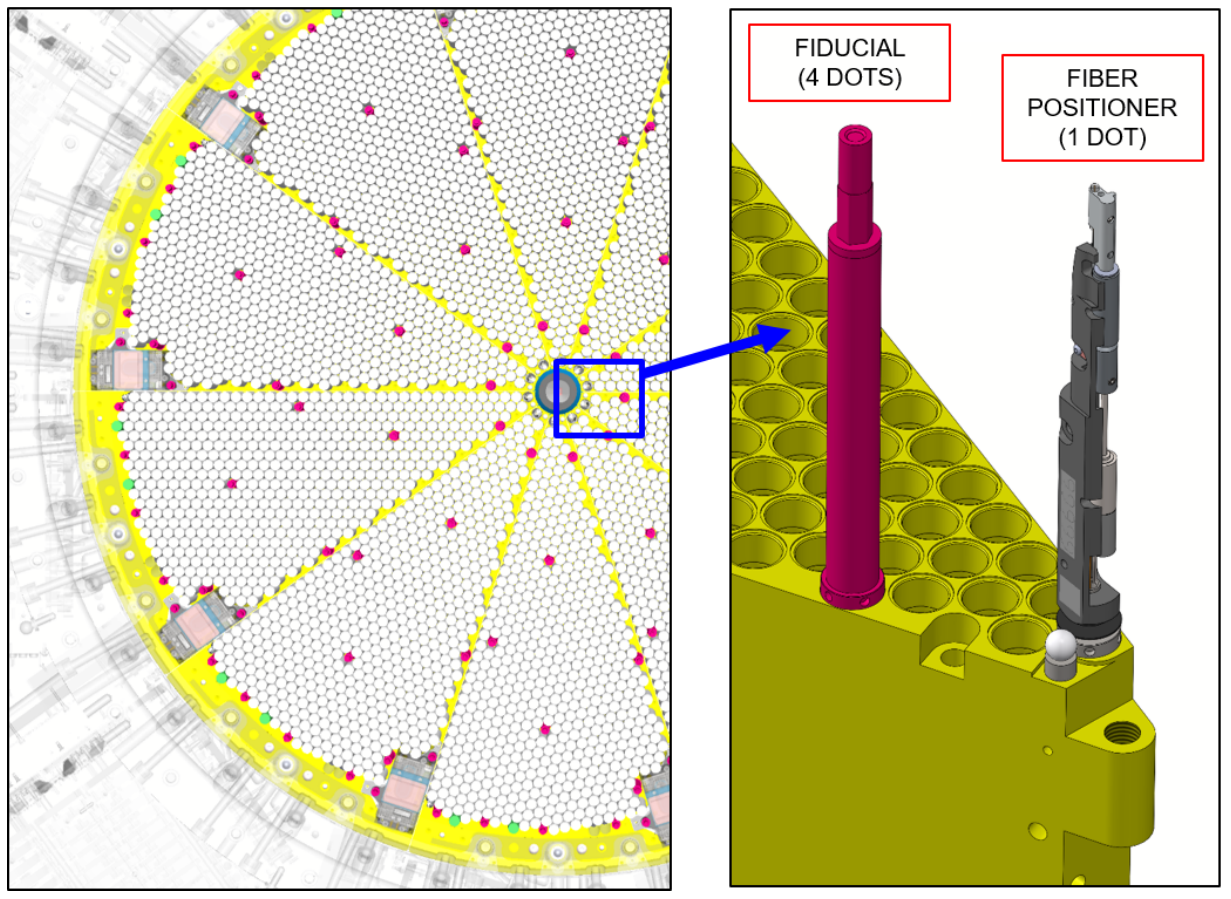
- 5 μm positioning in few sec. for 5000 targets
- All fibers connected to the spectrographs
Silber et al. 2022
Ecole Rodolphe Cledassou 2024 - galaxy clustering: observation
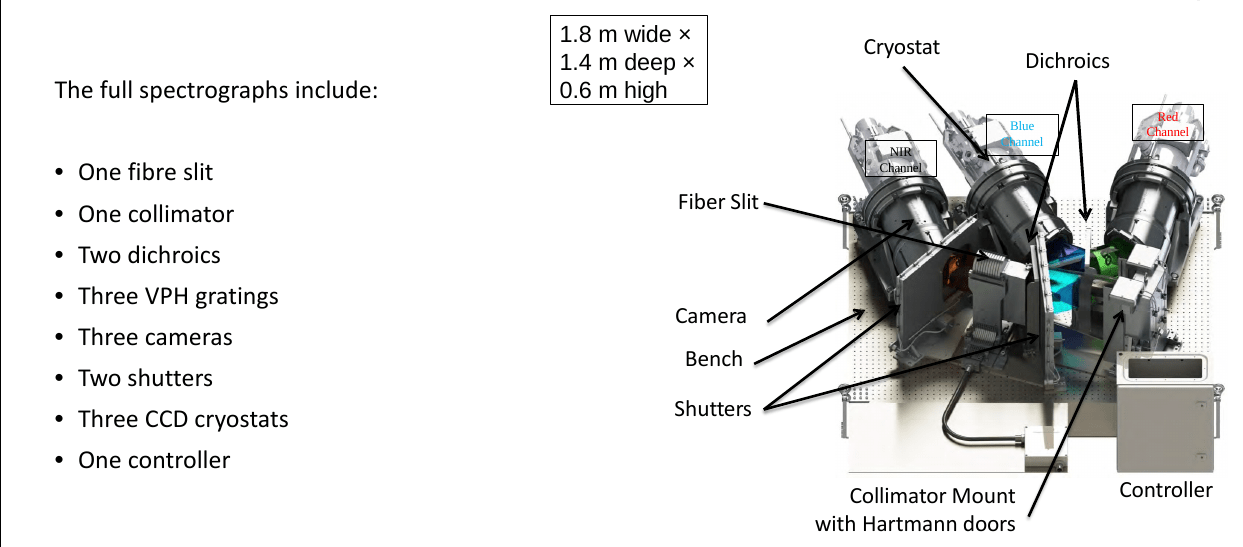
DESI spectrographs
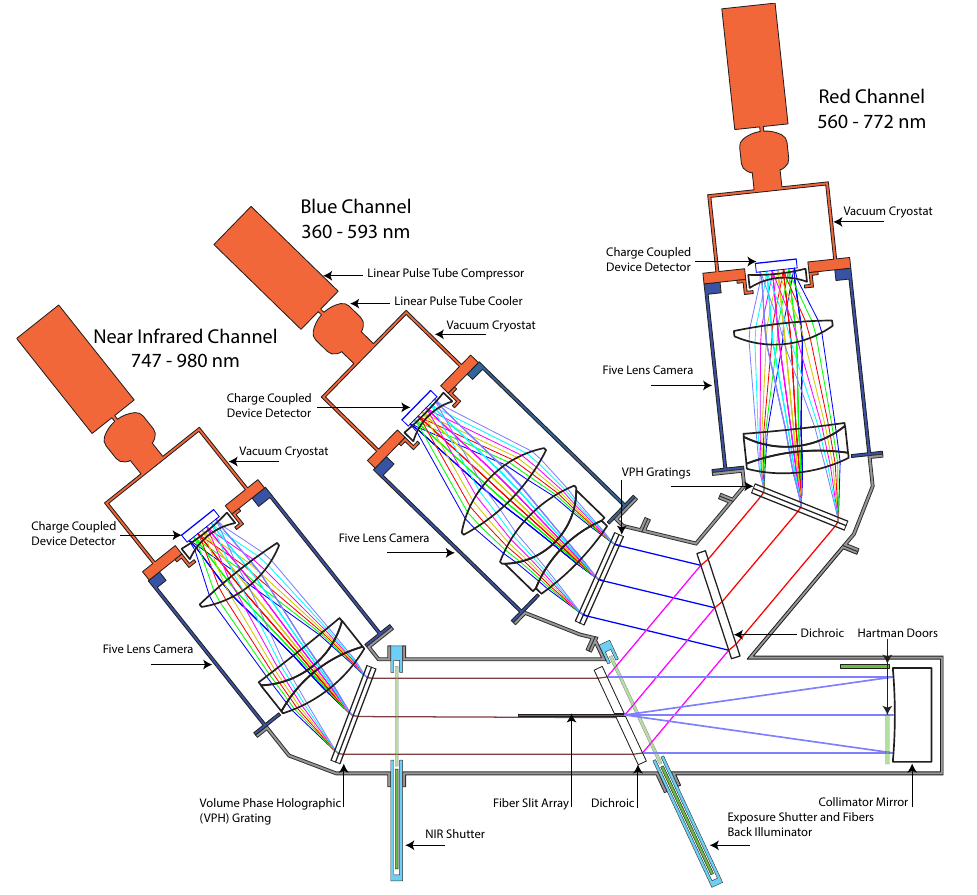
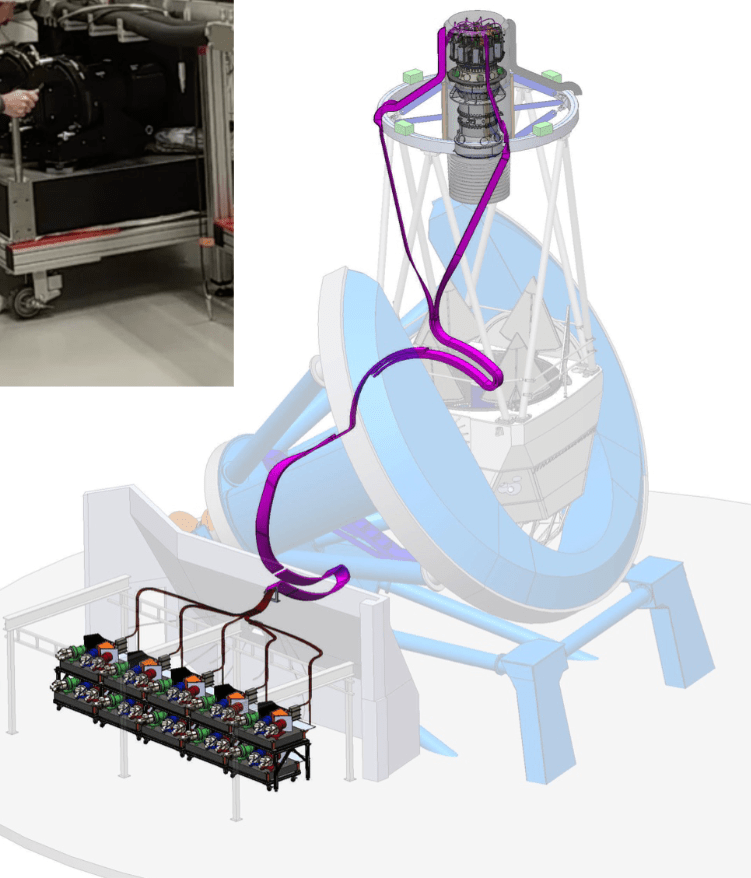
- 10 Spectrograph modules with cryostats containing 3 CCD
DESI collaboration 2022
Ecole Rodolphe Cledassou 2024 - galaxy clustering: observation
DESI science image
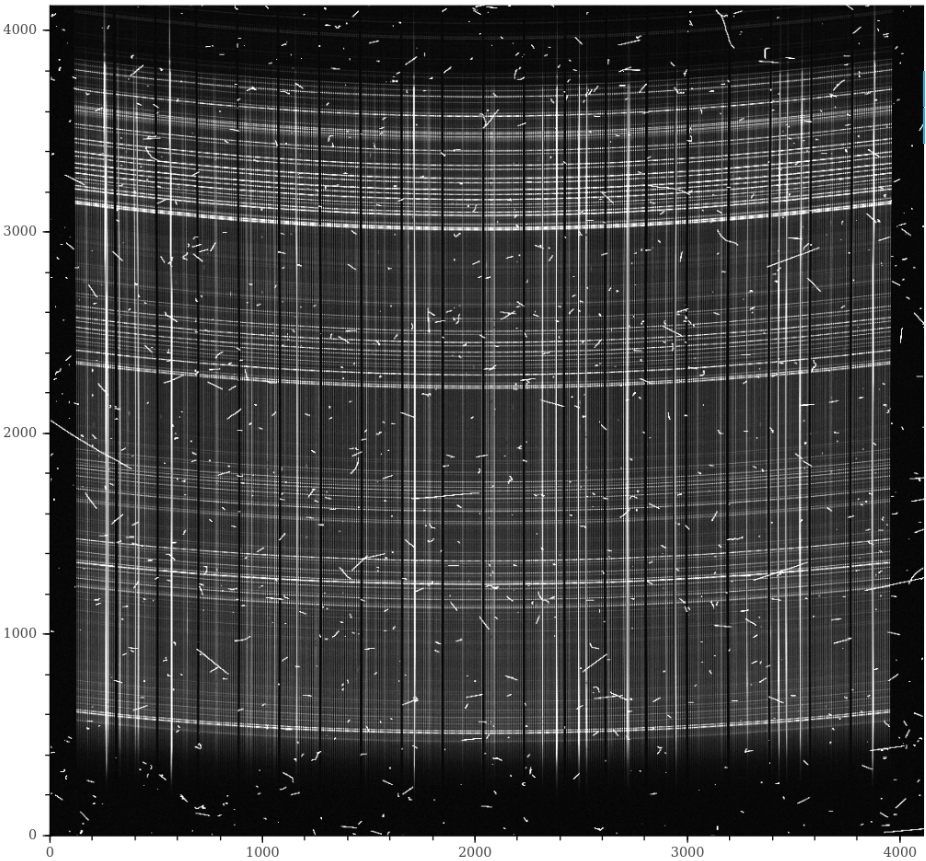
Raw image over one DESI CCD of one spectrograph
Identify some features
Ecole Rodolphe Cledassou 2024 - galaxy clustering: observation
DESI science image
Fibers side by side
Wavelength
Cosmics
Atmosphere emission lines
Extracted spectrum
?
Ecole Rodolphe Cledassou 2024 - galaxy clustering: observation
DESI calibration images
Zero/Bias
Dark
Flat
Arc
DESI calibration images
Minimal exposure time with dome closed
Science exposure time with dome closed
Telescope pointed to a uniformly illuminated screen in the dome
Screen in the dome illuminated with calibration emission lamps
Ecole Rodolphe Cledassou 2024 - galaxy clustering: observation
DESI spectral extraction
- Raw image calibrated with bias/flat/dark/arc
- Cosmics and bad pixels detected and flagged by software
- Spectra extracted with the "spectroperfectionism" algorithm:
Camera signal
Flux
Noise
- Spectral noise evaluated with calibration images
- Spectrum level normalized using sky fibers (fixed, or broken positioners) and standard stars
A = matrix measured with arc images, containing full 2D PSF modeling
Ecole Rodolphe Cledassou 2024 - galaxy clustering: observation
DESI spectral extraction
Object type and
redshift obtained by:
- Visual inspection
- Template fitting
- Machine learning
for galaxies
for Lyman-alpha forest
Correlation function and power spectrum measurements
Ecole Rodolphe Cledassou 2024 - galaxy clustering: observation
Legacy Survey of Space and Time (LSST)



Ecole Rodolphe Cledassou 2024 - galaxy clustering: observation
LSST acronyms
Vera Rubin Observatory (VRO)
Legacy Survey of Space and Time (LSST)
Dark Energy Science Collaboration (DESC)
+ 7 (Transients, SL, AGN...)
Observatory/Telescop
Survey organism
Science collaborations
Ecole Rodolphe Cledassou 2024 - galaxy clustering: observation
Rubin observatory
30 m diameter dome

Telescope mount assembly
AuxTel: 1.2m atmospheric telescop
Cerro Pachon
Service and maintenance facility
Control room
Ecole Rodolphe Cledassou 2024 - galaxy clustering: observation
Rubin observatory: mirrors
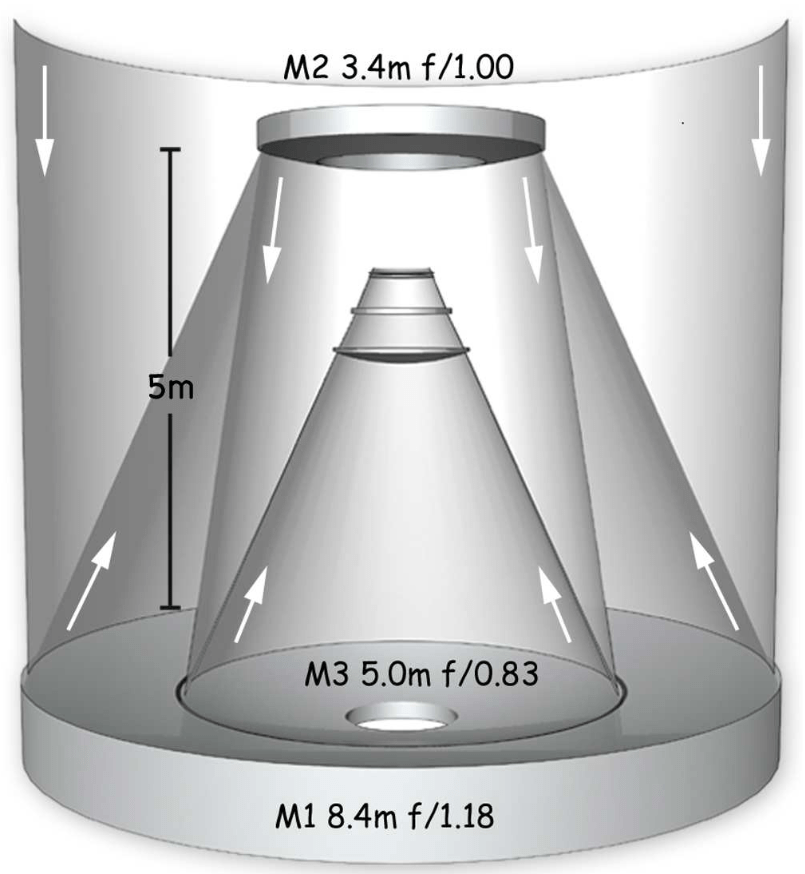
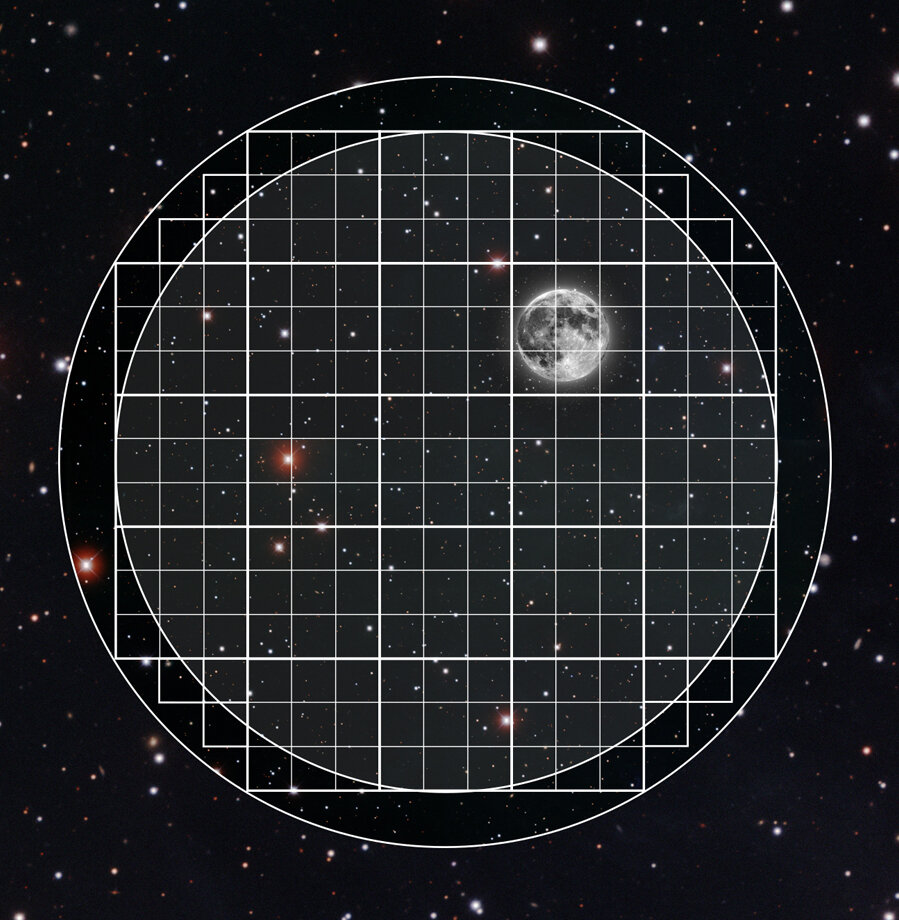
- Modified three-mirror Paul-Baker design: M3 and M1 polished from a single substrate
- 8.4 m primary mirror
- 9.6 square degrees field of view
Ecole Rodolphe Cledassou 2024 - galaxy clustering: observation
Rubin observatory: mechanical structure
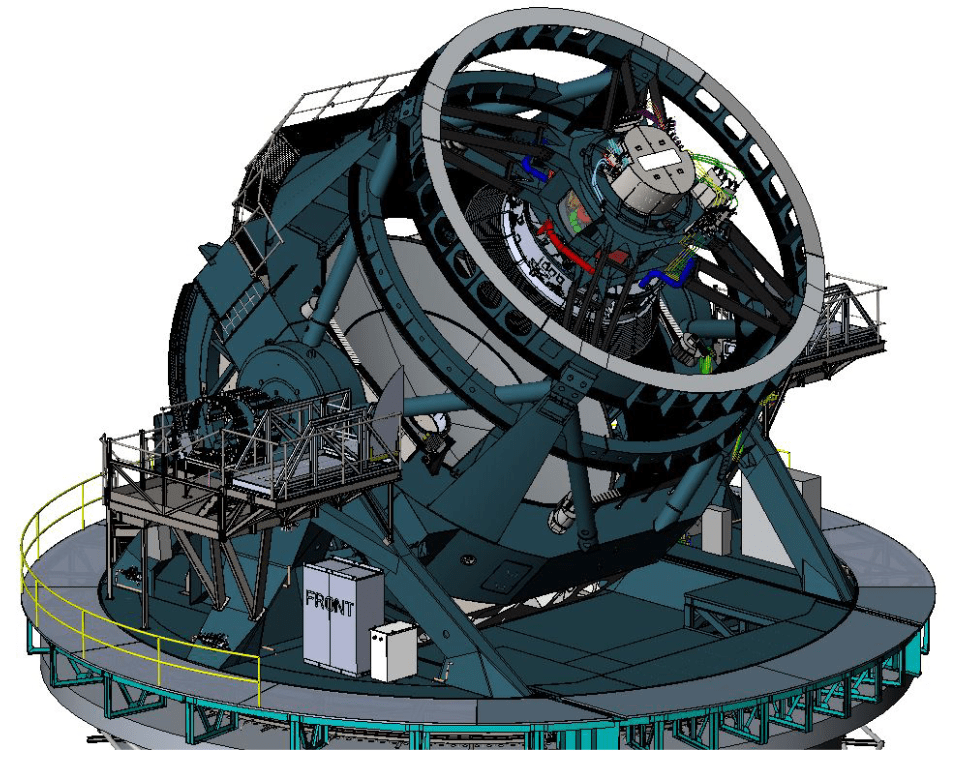
- Telescop Mount Assembly (~15 m)
- Can move 3.5° in 4 seconds
- Mirrors mounted on hexapods and correctors: counteract the changing distortions produced by changes in the gravitational orientation
Ecole Rodolphe Cledassou 2024 - galaxy clustering: observation
Rubin observatory: camera
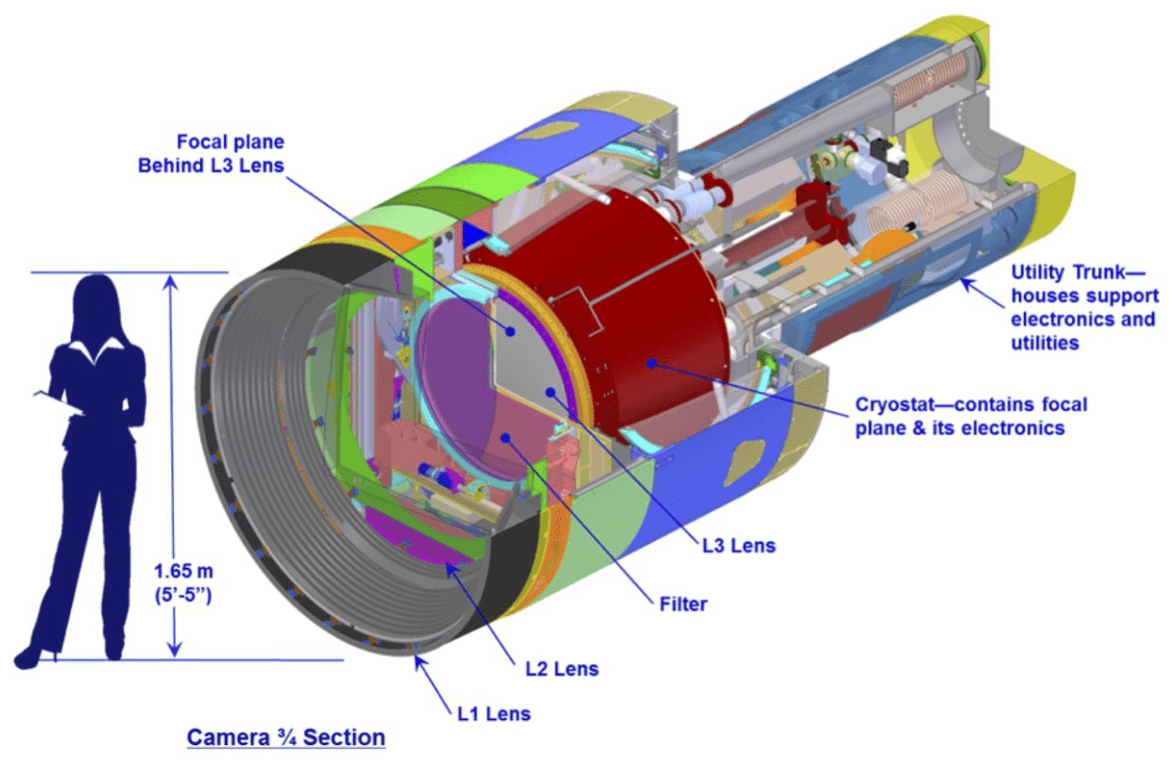
- Largest numerical camera in the world (3.2 Gpixels)
- 2s readout time
- Integrated cryostat modules (~120°C)
- 3060 kg
Ecole Rodolphe Cledassou 2024 - galaxy clustering: observation
Rubin observatory: camera
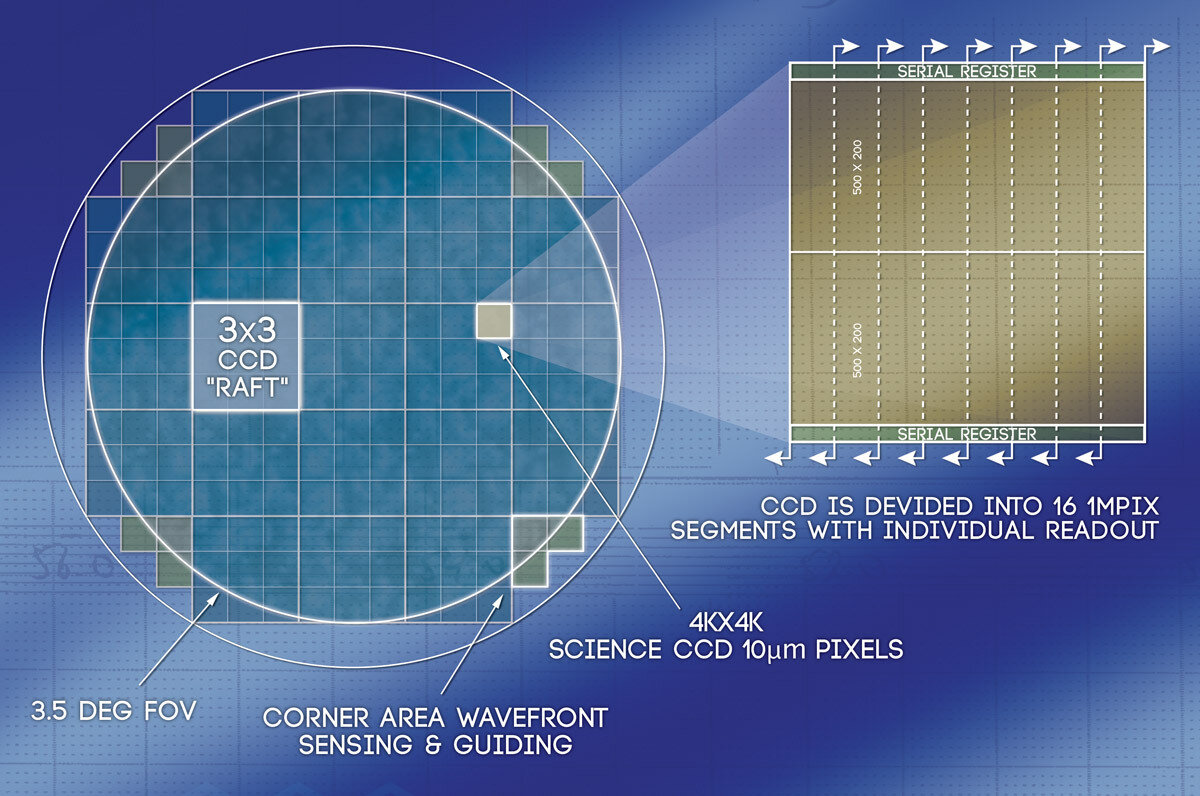
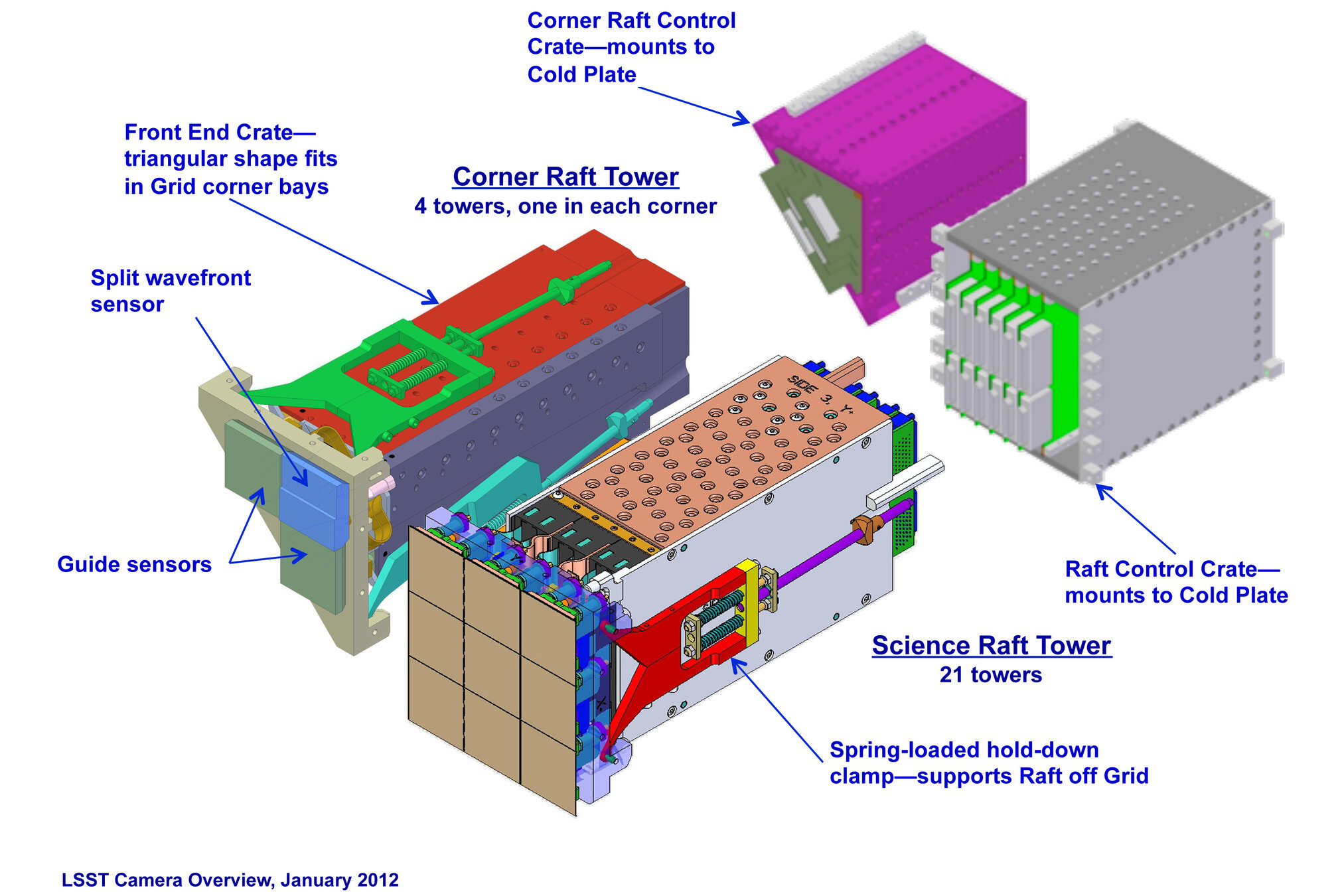
- 189 4k x 4k science CCD
- Corner sensor for guiding and wave-front analysis
- CCD packed by raft (3x3) with dedicated electronic treatment system
Ecole Rodolphe Cledassou 2024 - galaxy clustering: observation
Rubin observatory
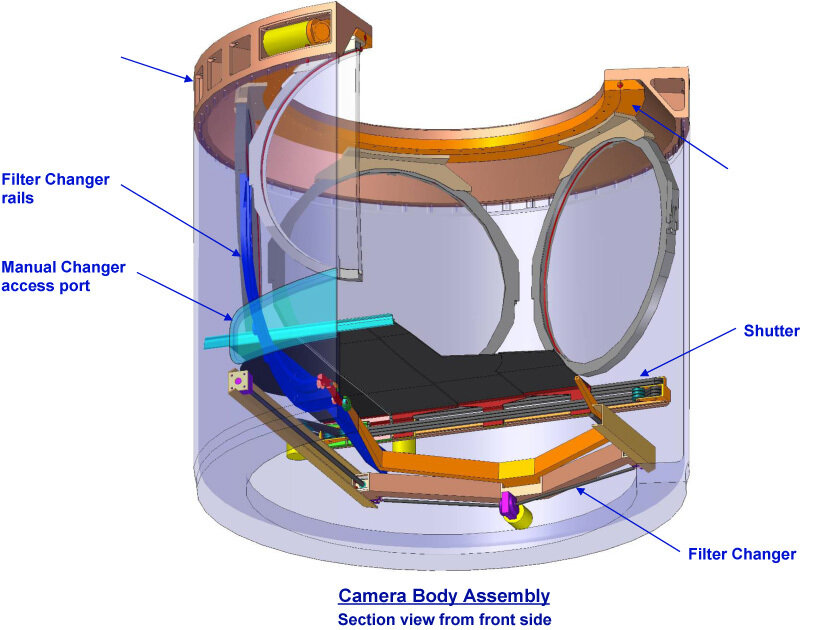
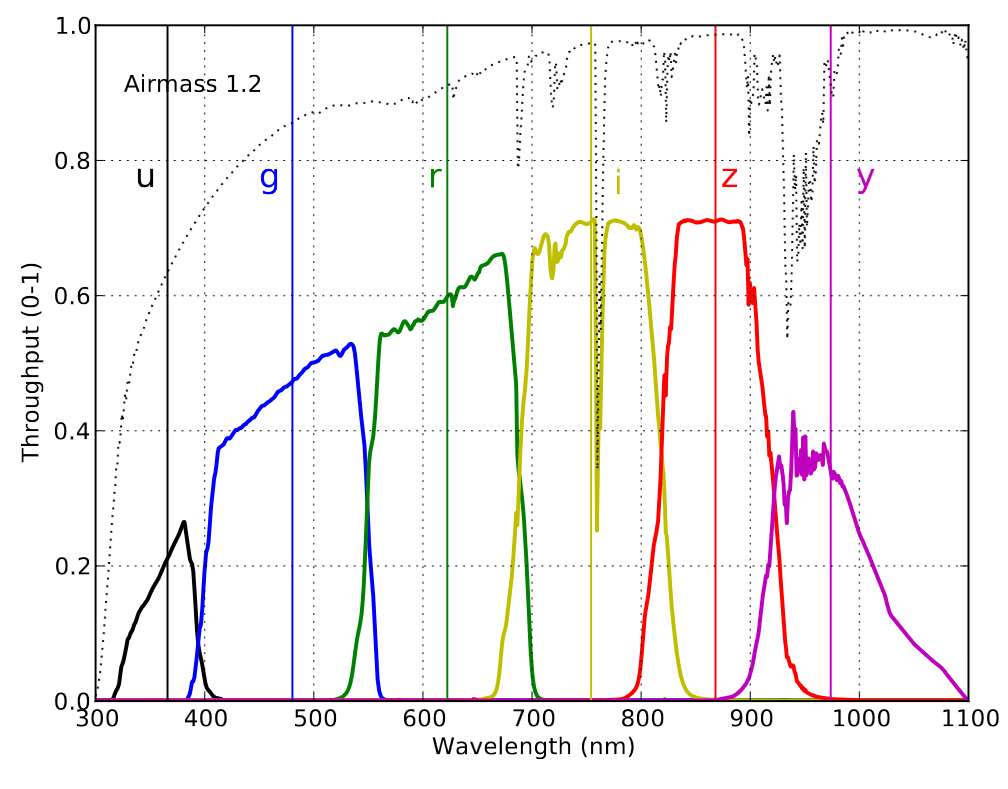
- Integrated filter wheel and filter changer (french contribution)
- 6-band ugrizy survey
Ecole Rodolphe Cledassou 2024 - galaxy clustering: observation
LSST survey
- 10-year photometric survey of half of the sky (~ 20 000 deg²)
- In commissioning, expected start in september 2025
- Complete coverage every 4 nights during 10 years (static and transient survey)
- 15 TB data per night, 100 PB in total, 10 million alerts per night in average
-
Deliverables:
- 20 billion galaxies with photometric redshifts up to z=3
- 17 billion resolved stars
- ~ 1 million type Ia supernovae (with ~ 300,000 cosmological SNe Ia)
Ecole Rodolphe Cledassou 2024 - galaxy clustering: observation
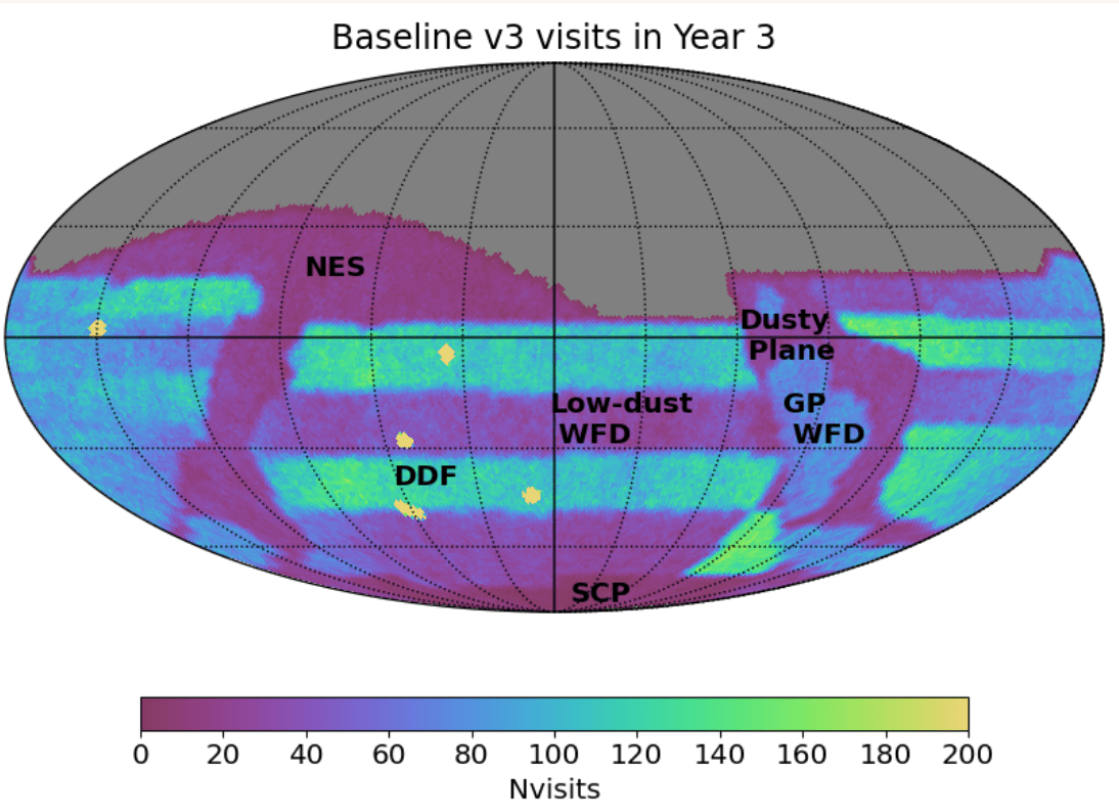
LSST survey: observation strategy
- Strategy elaborated for 10 years to satisfy 8 science collaboration and a lot of science cases
- Full survey simulation night by night
- Creation of precise metrics
- Example: full SNIa simulation and impact of rolling cadence
- 5 Deep Drilling fields for photo-z & WL calibration, high redshift SNIa ...
XMM-LSS
COSMOS
EUCLID
CDFS
ELAIS-S1
Ecole Rodolphe Cledassou 2024 - galaxy clustering: observation
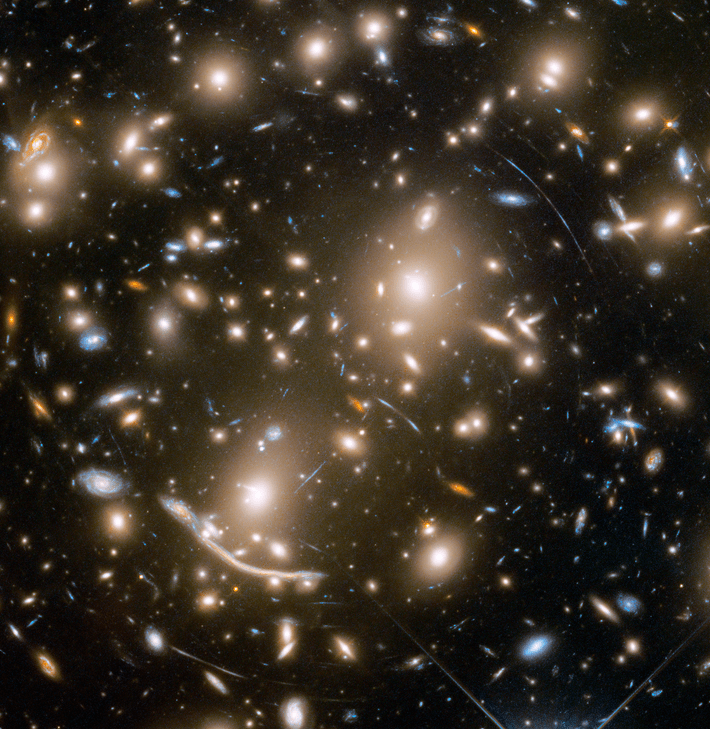
LSST survey: science
Dark matter & Dark energy
- Strong & Weak lensing
- BAO (angular and photo-z)
- Clusters, Supernovae cosmology
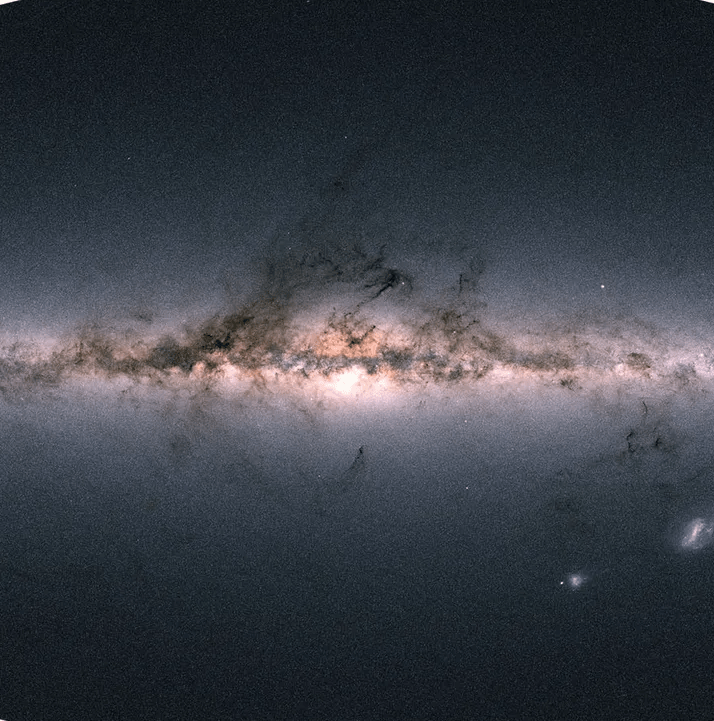
Mapping the Milky Way
- Structure and evolution
- Stellar properties
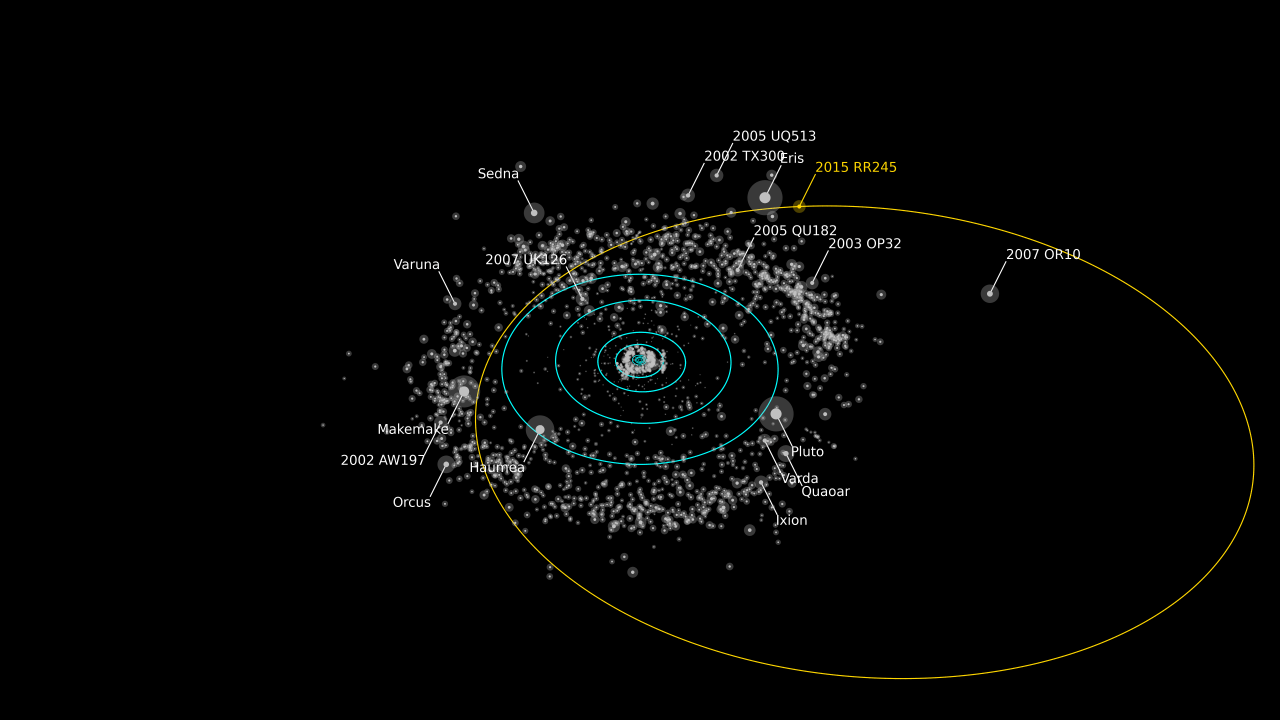
Solar System science
- Comets & asteroids
- Small body census
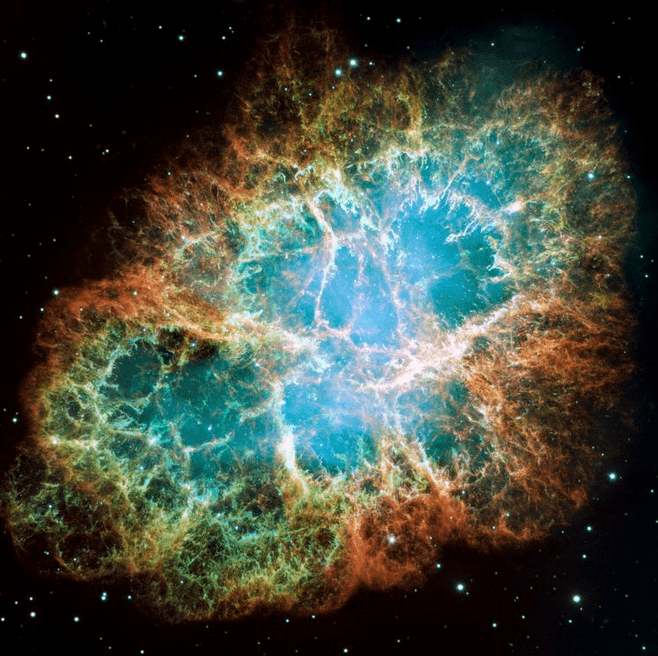
Transient sky
- Supernovae, variable stars
- Rare events (kilonovae, TDE)
- New classes of transients
Ecole Rodolphe Cledassou 2024 - galaxy clustering: observation
Euclid telescope
Ecole Rodolphe Cledassou 2024 - galaxy clustering: observation
Euclid telescope
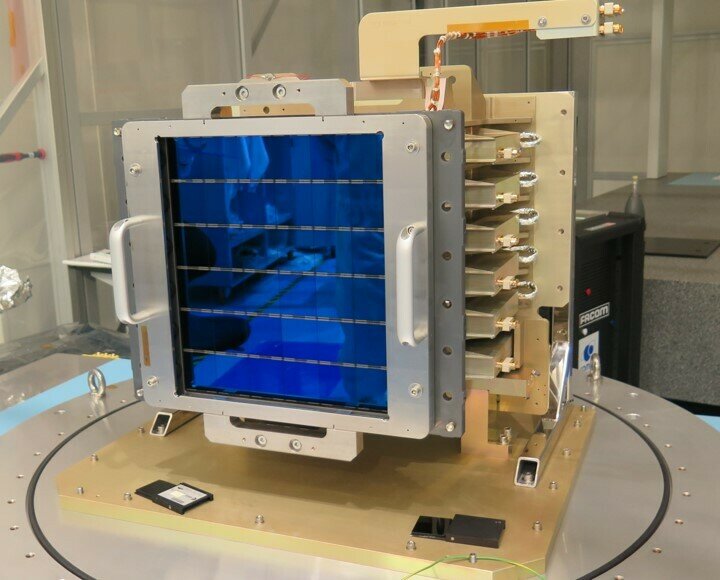
VIS
NISP
See "La mission Euclid, objectifs et organisation" F. Bernardeau
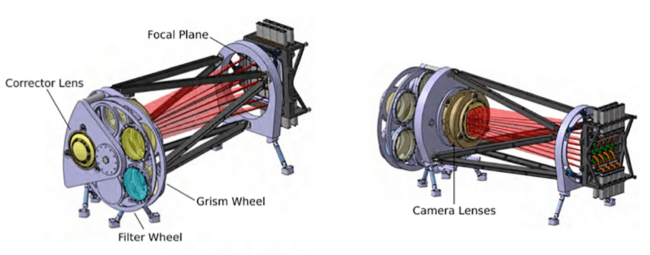
- Two modes: photometric and slitless spectro (grisms)
- 16 2k × 2k NIR HgCdTe detectors
- Visual imager (photometric)
- 36 4k x 4k CCD with one single very broad band filter
Ecole Rodolphe Cledassou 2024 - galaxy clustering: observation
Euclid: First light

VIS
NISP (Spectro)
NISP (Photo)
+ Early release observation
Ecole Rodolphe Cledassou 2024 - galaxy clustering: observation
Euclid: NISP slitless spectroscopy
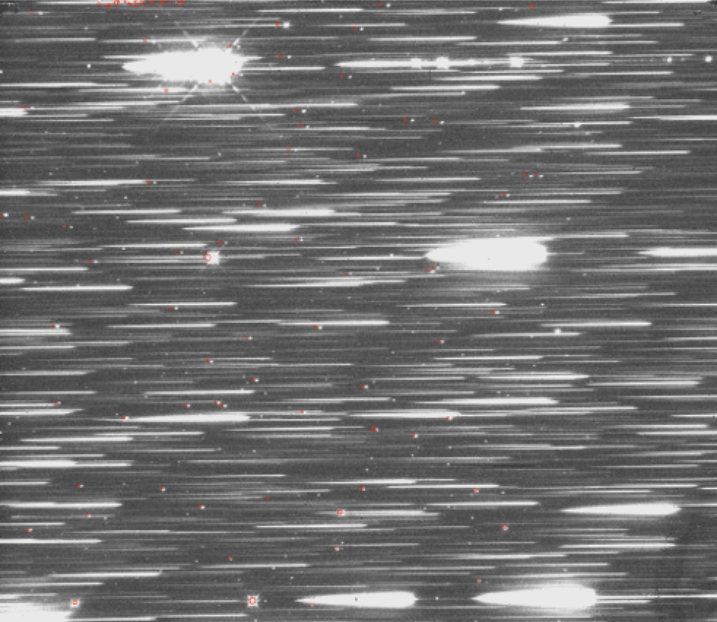

HST WFC3 images
- Euclid-like image: HST WFC3
- Slitless spectroscopy over one axis:
- Source confusions
- Spectroscopic order superpositions
- Decontaminate
spectral overlap: Grism wheel with different orientations
Ecole Rodolphe Cledassou 2024 - galaxy clustering: observation
Euclid: NISP slitless spectroscopy
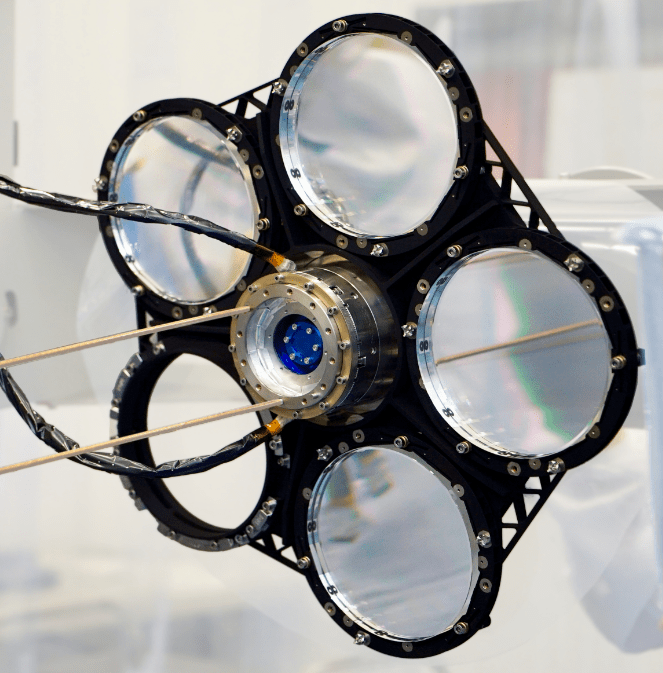
- 3 "red" grisms with different rotations, 1 "blue" grism
- 1 red grism did not met requirement: correction of source confusion by tilting the two other grisms
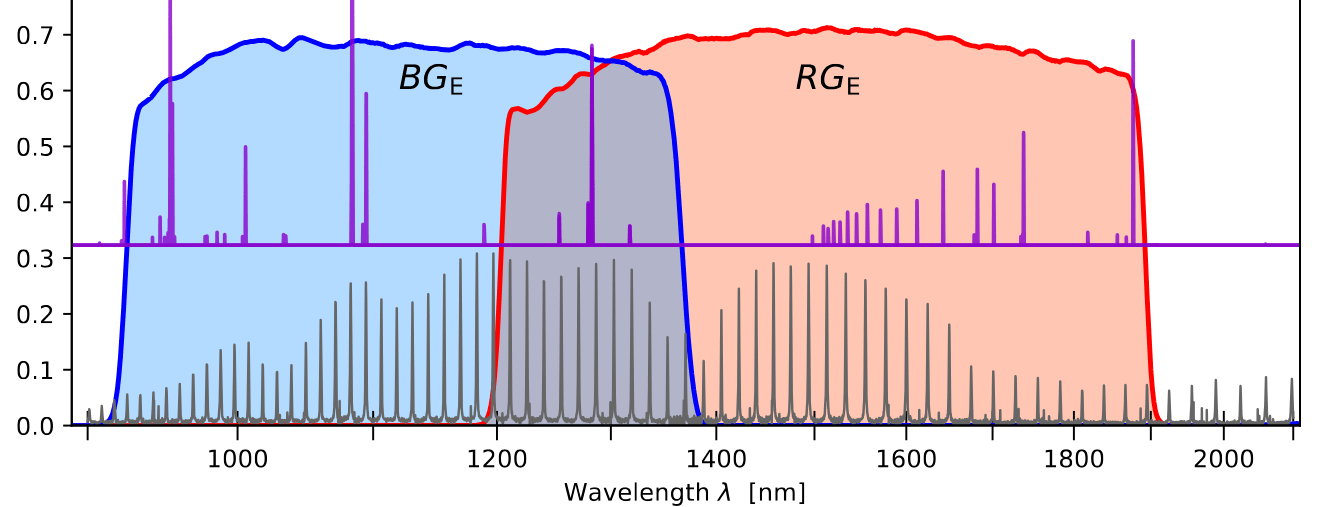
Throughput
RGS000
RGS180
RGS270
+4°
-4°
Ecole Rodolphe Cledassou 2024 - galaxy clustering: observation
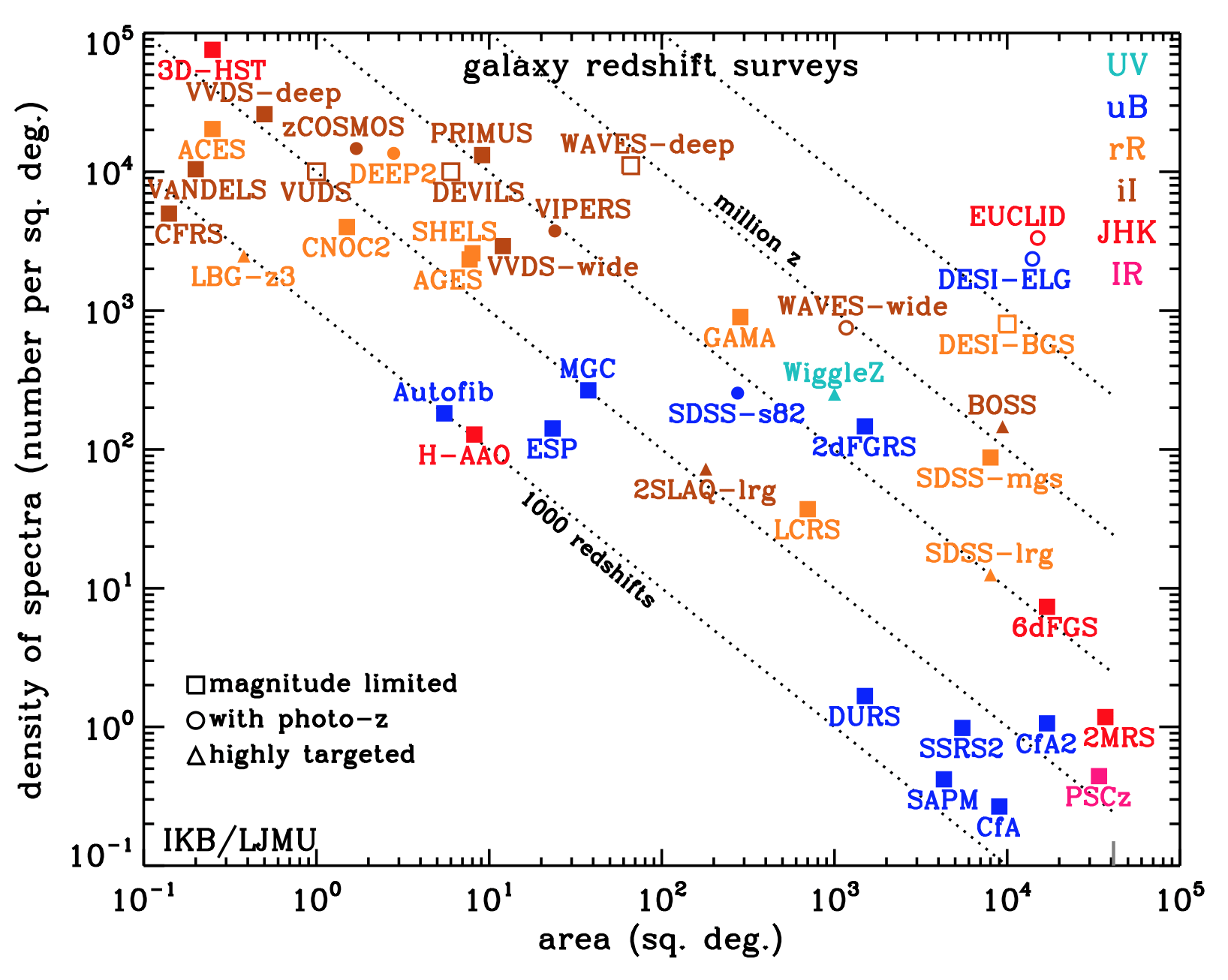
Galaxy survey summary
Ecole Rodolphe Cledassou 2024 - galaxy clustering: observation
ACCEL² simulation
- Two main class of surveys: photometric and spectroscopic
- Stage IV DE experiments just started: exciting time ahead !
Annexes
Annexes
Annexes
Annexes
Annexes
Annexes
Annexes
Annexes
Annexes
Annexes
Annexes